
Beet leaf miner
Pegomya
Description
How to identify
The beet leaf miner (Latin Pegomya betae) is a dipteran insect belonging to the Anthomyiidae family. Adult flies are approximately 6–7 mm long with a grayish, ash-colored body and characteristic dark bristles.
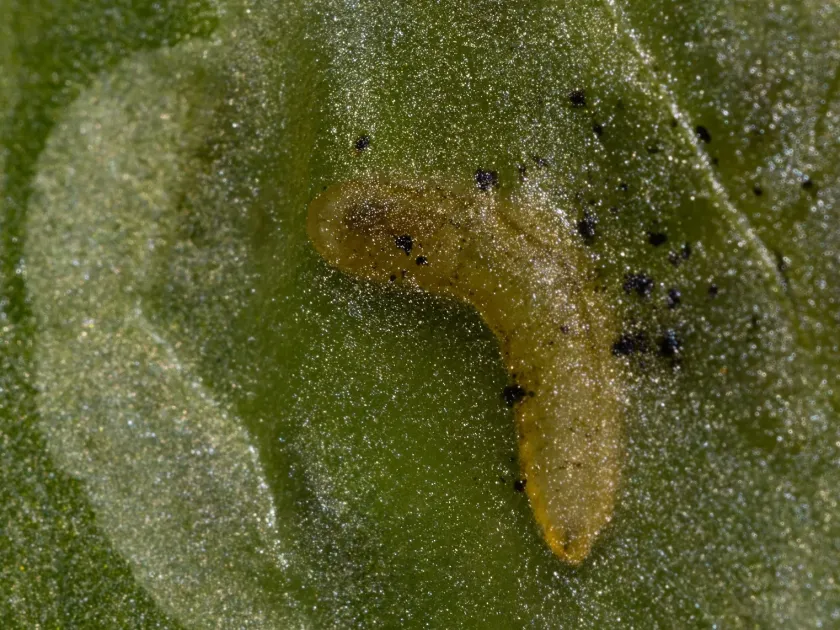
The larva of the beet leaf miner is legless and cylindrical, reaching up to 8 mm in length. Its color ranges from white to pale yellow, making it well-adapted to life inside the plant tissue where it remains hidden from predators.
The life cycle consists of four stages: egg, larva, pupa, and adult. The insect typically undergoes several generations per year, depending on the climatic conditions of the region.
Pupation occurs in the soil, where the insect overwinters. In spring, as temperatures rise, adult flies emerge to mate and lay eggs on the undersides of host plant leaves.
Female flies lay eggs in clusters, and a single female can produce several hundred eggs during her short lifespan, leading to rapid population outbreaks if left uncontrolled.
What it damages
This pest primarily attacks beets, including sugar beet, red beet, and mangelwurzel. Other hosts include spinach and various weed species within the Amaranthaceae family.
Larval feeding involves burrowing into the leaf tissue and consuming the parenchyma, which results in the characteristic mine patterns. The epidermal layers of the leaf remain intact for a time, creating a blistered appearance.
The most severe damage occurs on young seedlings. Extensive mining destroys the photosynthetic capacity of the leaves, resulting in stunted growth and potential plant mortality.
Damaged plants exhibit reduced vigor and are more susceptible to secondary fungal and bacterial infections. In sugar beet crops, this leads to lower root weight and reduced sugar content.
Infestations often lead to premature leaf drop, forcing the plant to use its energy reserves to produce new foliage instead of developing the root crop, directly reducing the total harvest.
Signs of infestation
The first sign of an infestation is the presence of small, white, oval-shaped eggs arranged in groups on the underside of leaves. These are visible during close inspection of the foliage.
As larvae begin to feed, the surface of the leaf displays light-colored, blistered patches known as mines. These start as thin, winding channels that eventually expand into larger, irregular, whitish blotches.
Leaves affected by the larvae may appear wrinkled, distorted, or discolored. In severe cases, the leaf tissue dries out, turns brown, and becomes brittle, eventually crumbling away.
Visual verification can be done by carefully opening a mined area on a leaf to expose the larvae or their black frass (excrement), which confirms active feeding.
- White egg clusters on the undersides of leaves.
- Blistered, translucent, or brown leaf mines.
- Withered and distorted leaf growth.
- Reduced plant height and stunted development.
Control measures
Integrated pest management (IPM) is essential for controlling this pest. Cultural practices like deep autumn plowing help destroy overwintering pupae hidden in the soil.
Weed management is critical, particularly the removal of alternative hosts such as common lambsquarters (Chenopodium album), which often harbor the first generation of the pest.
Chemical control should be timed based on economic injury levels. Systemic insecticides are preferred as they penetrate the leaf tissue to reach the larvae hidden inside the mines.
Monitoring using yellow sticky traps or regular field scouting is recommended to track adult fly activity and determine the optimal timing for protective interventions.
Biological control agents, including various species of parasitic wasps (hymenopterans), can significantly reduce population levels and are an important part of sustainable management programs.
Taxonomy
- Latin name
- Pegomya
- Order
- Diptera (flies)
- Family
- Anthomyiidae
- EPPO code
- PEGOSP
Discussion
No discussions yet — be the first.