
Seedcorn maggot
Hylemya
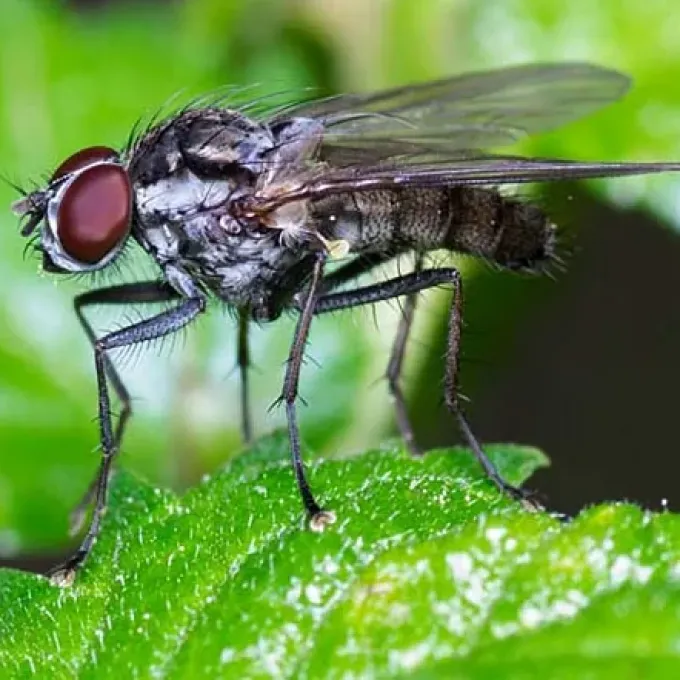
Description
How to identify
The seedcorn maggot (Delia platura) belongs to the Anthomyiidae family within the order Diptera. The adult fly is small, approximately 3 to 5 mm long, with a greyish appearance and characteristic dark stripes on its thorax.
The life cycle begins when adult flies lay eggs in moist soil enriched with organic matter. The larvae are legless, white, and reach about 6–7 mm in length, representing the most destructive stage of this pest.
These insects prefer cool and wet conditions, which explains why they are most active during early spring plantings. Depending on temperature, the complete life cycle from egg to adult takes approximately three weeks.
The pupal stage is the primary overwintering form, usually situated deep in the soil profile. They emerge as adults when soil temperatures reach favorable levels for early season activity.
There can be multiple generations throughout the growing season, though the first generation typically causes the most significant damage to newly planted seeds.
What it damages
The seedcorn maggot is a generalist pest, attacking a wide range of crops including soybeans, corn, beans, peas, cucurbits, and various cruciferous vegetables.
Damage occurs primarily during the germination process. Larvae are attracted to the volatile gases emitted by germinating seeds and move through the soil to feed on them.
The larvae destroy the embryo inside the seed, preventing the plant from emerging entirely. This often leads to significant gaps in the field stand.
When the damage happens after germination, the larvae tunnel into the hypocotyls or stems of young seedlings, leading to wilting, stunting, or total death of the plant.
Secondary infections, such as seedling blight, often follow the maggot feeding, as the injured plant tissues become vulnerable to fungi and soil-borne bacteria.
Signs of infestation
The most evident sign is patchy or poor emergence in newly planted fields, which is often mistakenly attributed to poor seed quality or unfavorable weather.
Examining the soil around poorly emerging or wilted seedlings often reveals the white maggots or the damaged, hollowed-out seeds beneath the soil surface.
Seedlings that do manage to emerge may look weak and yellow, with distorted leaves or stems that appear tunneled near the base.
Fields with recent applications of manure or heavy crop residue are typically at higher risk for maggot infestations and show more severe damage signs.
The presence of adults (small grey flies) hovering over freshly prepared soil is an early indicator of potential infestation in the coming days.
Control measures
Cultural control is the first line of defense; specifically, delaying planting until the soil warms up allows for faster germination, which reduces the time the seed is vulnerable.
Avoiding the incorporation of heavy, fresh organic matter or manure immediately before planting can significantly decrease the attractant signals for adult flies.
Seed treatments with systemic insecticides are highly effective in protecting seeds during the critical germination window and are standard practice in many regions.
Tillage practices that incorporate crop residues early in the fall can help disrupt the life cycle and reduce the local population of overwintering pupae.
- Monitor soil temperature before planting.
- Use high-quality seeds with high vigor.
- Avoid planting during cool, wet weather patterns.
- Implement proper crop rotation schedules.
Taxonomy
- Latin name
- Hylemya
- Order
- Diptera (flies)
- Family
- Anthomyiidae
- EPPO code
- HYLESP
Discussion
No discussions yet — be the first.