
Bean seed fly
Delia florilega
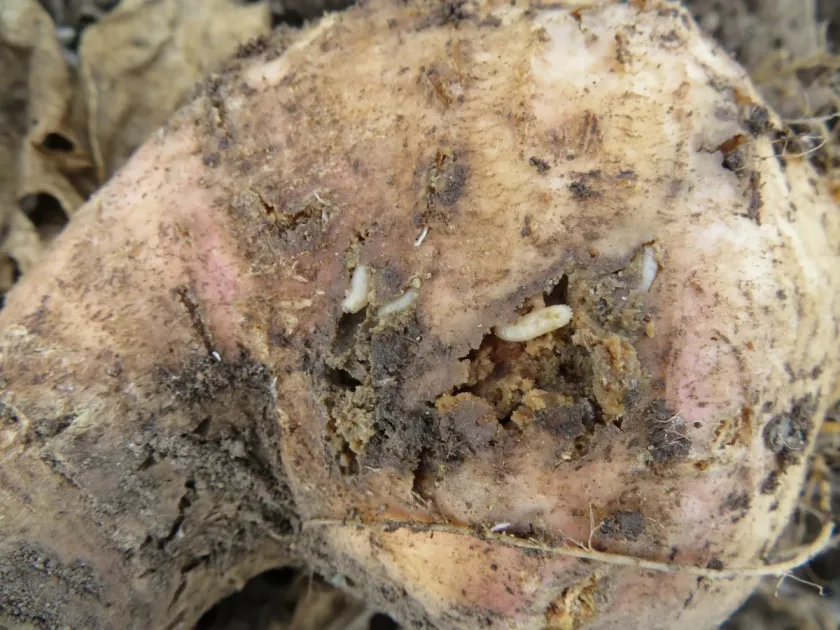
Description
How to identify
The bean seed fly, known scientifically as Delia florilega, belongs to the Anthomyiidae family. Adults are small, greyish flies measuring approximately 4–5 mm in length with characteristic markings on the thorax.
The life cycle consists of four stages: egg, larva, pupa, and adult. Females lay their eggs in the soil, specifically targeting areas with high moisture and organic matter content.
Larvae are legless, creamy-white maggots that grow up to 7 mm long. They thrive in organic-rich soils and are the primary stage responsible for crop destruction.
Pupation occurs within the soil at a depth of several centimeters. The puparia are dark brown and oval, allowing the insect to survive unfavorable conditions.
Adults are active flyers and are often attracted to the smell of decaying organic materials or germinating seeds in freshly cultivated fields.
What it damages
This fly is a notorious polyphagous pest that attacks a variety of legumes, cucurbits, and cereal crops, including beans, peas, corn, and squash.
The larvae are particularly destructive because they attack the seeds just as they begin to swell or germinate, consuming the embryo entirely.
This damage prevents the plant from emerging at all, resulting in patchy stands and significantly reduced crop density, often requiring farmers to reseed.
Even if the plant survives, the larvae may tunnel into the hypocotyl or primary roots, causing the plant to become stunted, yellowed, and eventually collapse.
The damage is most severe in cool, wet springs when germination is slow, leaving the seeds exposed to larval feeding for a longer period of time.
Signs of infestation
One of the most obvious signs is the poor emergence of crops. If you see gaps in the rows, it is often a sign that the seeds were destroyed underground.
Carefully digging up non-germinated seeds will often reveal feeding damage, such as hollowed-out cotyledons and the presence of small maggots inside.
Wilting plants that appear suddenly in the field, combined with yellowing or necrotic lower stems, are strong indicators of larval tunneling below the soil surface.
Large numbers of adult flies hovering over freshly prepared soil during spring are a visual indicator that egg-laying is occurring in the area.
If you split the damaged stem of an emerged plant, you may find larval galleries or the larvae themselves near the root zone of the plant.
Control measures
Effective control starts with good agricultural practices, such as avoiding the use of fresh manure, which releases odors that attract egg-laying females.
Ensuring rapid germination is key. Planting into well-drained, warm soil allows the crop to outgrow the vulnerable stage quickly, minimizing the exposure period.
Deep plowing in the autumn helps to disrupt the life cycle by burying pupae deep in the soil, which reduces the emergence rate of adults in the spring.
Seed treatment with systemic insecticides is the most effective chemical method to protect emerging crops during the first two to three weeks of growth.
- Proper crop rotation to break the pest cycle.
- Avoid overly damp, cold soil at planting.
- Use of high-quality, vigorous seed lots.
- Monitoring soil moisture and organic decomposition levels.
Taxonomy
- Latin name
- Delia florilega
- Order
- Diptera (flies)
- Family
- Anthomyiidae
- EPPO code
- HYLEFG
Discussion
No discussions yet — be the first.