
Wheat bulb fly
Delia coarctata
Description
How to identify
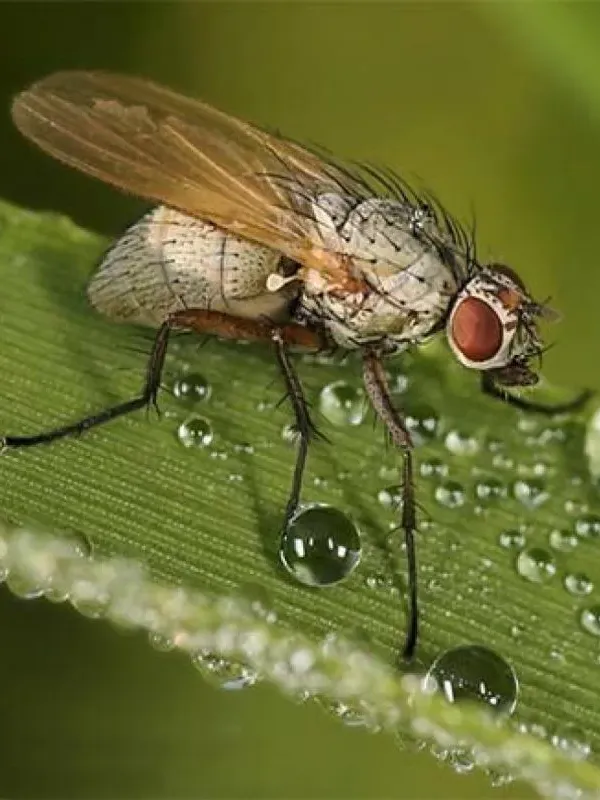
The Wheat bulb fly (Delia coarctata) belongs to the Anthomyiidae family, order Diptera. The adult fly is approximately 7–9 mm long, with a grey body and distinctive dark stripes on the thorax.
The eggs are white, elongated, and have a unique reticulated surface. The larvae, reaching up to 10 mm in length, are legless, whitish-yellow, and taper towards the front end.
This species completes one generation per year, making its phenology highly dependent on specific environmental conditions and the developmental stages of winter cereals.
The adult flies are active during the summer, after which they lay eggs in the soil, which then overwinter before hatching in the early spring.
Correct identification of the larvae and early signs of infestation is essential for farmers to prevent significant yield losses in winter wheat and rye crops.
What it damages
The Wheat bulb fly primarily infests winter wheat, rye, and barley. It is considered a significant threat to cereal crops sown after fallow or late-harvested root crops.
The larvae bore into the center of the cereal shoot, feeding on the growing point. This activity causes the central leaf to yellow, wilt, and eventually die, leading to the loss of the primary shoot.
In cases of severe infestation, a single larva can migrate between multiple plants, destroying several tillers and resulting in significant stand thinning.
The economic damage is particularly high when crop development is slow, as young plants remain vulnerable to larval feeding for a longer period of time.
Reduced plant density leads to poor crop canopy coverage, increased weed pressure, and, ultimately, a substantial reduction in grain harvest yield.
When it appears
Overwintering occurs in the egg stage within the topsoil. Eggs are typically laid in bare soil during the summer months, often in fields following cereal harvest or fallow.
Larval hatching takes place in early spring, synchronized with the warming of the soil, typically when temperatures rise above 5–7 degrees Celsius.
The feeding phase of the larvae lasts approximately 4 to 6 weeks, depending on temperature and moisture conditions, after which the larvae move deeper into the soil to pupate.
Adult flies emerge in June and July, starting the cycle over again through mating and oviposition in suitable soil conditions.
Monitoring the egg density in the soil before planting can help farmers determine the potential risk level for the upcoming growing season.
Signs of infestation
The most characteristic sign of infestation is the yellowing and wilting of the central leaf of the shoot, which is often referred to as "dead heart" symptom.
Careful inspection reveals a small entry hole at the base of the stem. Pulling the central leaf usually results in it coming away easily from the leaf sheath.
Upon splitting the affected stem, one can observe the larva feeding inside or find evidence of destroyed internal tissues and larval excrement.
Patches of stunted or missing plants in a field are a clear indicator of a widespread infestation, which is more noticeable in thin or poorly established crops.
Secondary infections often develop in damaged stems, causing the base of the plant to turn brownish and soft, which further weakens the cereal plant.
Control measures
Cultural control is the most effective approach, including the avoidance of planting susceptible crops after bare fallow or crops that favor egg-laying.
Strategic timing of sowing can help; early-sown crops are often better established and more resilient to larval damage by the time hatching begins.
In regions with high risk, seed treatments with systemic insecticides are recommended to provide early-season protection to the germinating seedlings.
Post-emergence foliar insecticide applications may be necessary if larval counts exceed the established economic threshold levels during the spring growth stage.
- Deep plowing in autumn to bury eggs and larvae, reducing survival rates.
- Balanced nitrogen fertilization to encourage rapid tillering and plant recovery.
- Monitoring adult fly populations using traps to predict future infestation risks.
Taxonomy
- Latin name
- Delia coarctata
- Order
- Diptera (flies)
- Family
- Anthomyiidae
- EPPO code
- HYLECO
Discussion
No discussions yet — be the first.