
Flower fly
Anthomyia
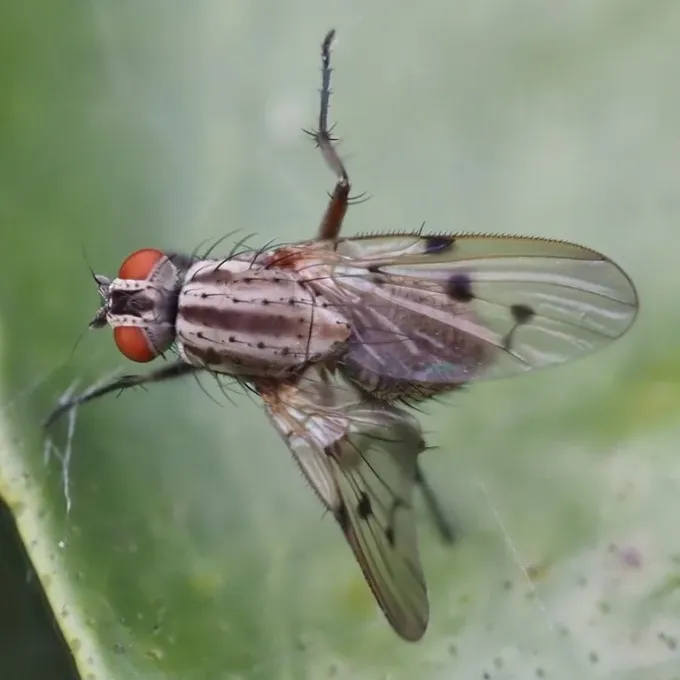
Description
How to identify
Flower flies, belonging to the family Anthomyiidae, are a group of insects known as significant agricultural pests. The adult insects, resembling common houseflies but with more slender bodies, are frequently seen visiting flowers to feed on nectar.
Taxonomically, they fall under the order Diptera. The larvae, commonly known as root maggots, are legless, white to creamy-yellow, and reach up to 10 mm in length. They possess hook-like mouthparts used to macerate plant tissues.
These pests are characterized by their cryptic nature, as the damaging stage usually lives within the plant roots or stem bases. Adults are typically gray or brownish, often with bristles on their abdomen which helps in their morphological identification.
Correct identification is crucial as the Anthomyiidae family includes several species that are host-specific, such as the onion fly or the cabbage fly. Distinguishing between them often requires expert knowledge or specific trapping data.
The life cycle involves the adult stage laying eggs in the soil or on the plant near the stem base. Once hatched, the larvae immediately seek out the host tissue to begin their destructive feeding.
What it damages
The larvae are primary pests of various vegetable crops including onions, garlic, cabbage, radishes, carrots, and beets. They cause severe damage by feeding on the root systems and the underground portions of the plant stems.
In bulbous plants, maggots burrow deep into the bulb, causing it to rot rapidly. This turns the internal tissue into a mushy, foul-smelling mass that is entirely unsuitable for harvest.
Young seedlings are particularly vulnerable; a single larva can kill a developing plant by destroying the primary root. This leads to large gaps in the rows, significantly reducing the overall yield.
The damage is not just mechanical. The feeding activity creates entry points for secondary bacterial and fungal pathogens, which often accelerate the decay of the plant tissue, compounding the loss.
Economic impact is significant, as infestations often lead to total crop failure in heavily attacked patches. Furthermore, the aesthetic and commercial quality of harvested roots is severely compromised.
When it appears
The flight period of adult flies typically begins in spring, coinciding with the flowering of specific plants like dandelions or lilacs. This marks the onset of the risk period for early-season vegetable crops.
Depending on the climatic conditions, these insects can complete two to three generations per year. The first generation is usually the most damaging as it overlaps with the emergence of young vegetable seedlings.
Subsequent generations follow throughout the summer months. The final generation of the season enters the pupal stage within the soil to overwinter, remaining dormant until the following spring.
Soil temperature and moisture levels are critical factors for egg-laying and larval development. Cool and moist spring weather often favors the survival and proliferation of the first generation.
Monitoring the activity of the adult flies using yellow sticky traps is a standard practice for agronomists to time control measures accurately and prevent larval establishment in the fields.
Signs of infestation
A primary symptom of infestation is the sudden wilting of plants during the warmest part of the day, even if the soil moisture is sufficient. The plant may recover at night but will eventually collapse entirely.
Discoloration of the foliage, such as yellowing or a dull bluish tint, is a common indicator. When pulled from the ground, affected plants often have a destroyed root system and come out very easily.
Close inspection of the soil near the root neck often reveals small, white, cigar-shaped eggs. Inside the roots or bulbs, galleries or tunnels filled with excrement provide clear evidence of larval presence.
- Wilting and stunted growth;
- Yellowing of lower leaves;
- Rotting odor from the root zone;
- Easy detachment of the plant from the soil.
Timely observation of these signs is essential for saving the surrounding healthy plants, as larvae are capable of moving between plants in the same row.
Control measures
Integrated Pest Management (IPM) is essential for controlling flower flies. Crop rotation is the most effective cultural practice, as it prevents the buildup of larval populations in the soil over successive years.
Autumn tillage, including deep plowing, is vital. This process exposes the overwintering pupae to the surface, where they become susceptible to frost damage and predation by birds or other beneficial insects.
The use of physical barriers, such as fine-mesh row covers, is highly effective for protecting small-scale vegetable gardens during the adult flight period. This prevents the flies from accessing the soil to lay eggs.
Chemical control should be applied strictly based on monitoring and economic thresholds. Soil-applied insecticides are commonly used, but they must be applied during the flight phase to be effective.
Sanitation practices, such as removing infested plant material immediately after discovery, help to reduce the population density and prevent the spread of larvae to non-infested areas of the field.
Taxonomy
- Latin name
- Anthomyia
- Order
- Diptera (flies)
- Family
- Anthomyiidae
- EPPO code
- ANMYSP
Discussion
No discussions yet — be the first.