
Yellow mite
Zetzellia mali
Description
How to identify
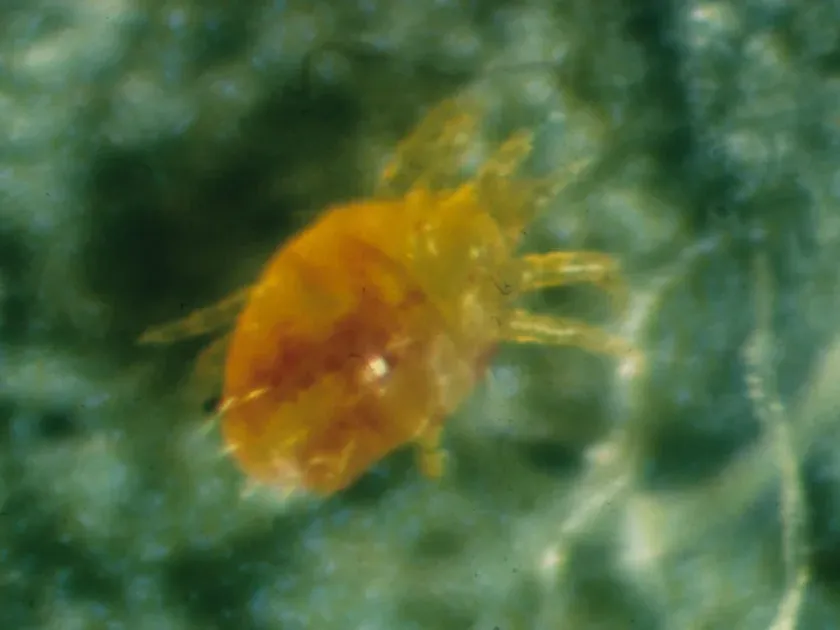
Zetzellia mali, commonly known as the yellow mite, belongs to the family Stigmaeidae. This species is unique in the orchard ecosystem as it can exhibit both predatory behavior, feeding on other mites, and phytophagous behavior by feeding on plant tissues.
Adults have a distinctive lemon-yellow or bright orange appearance, which makes them distinguishable from other common spider mites. They are highly active and relatively small, requiring magnification for accurate identification in the field.
The taxonomic classification places it in the order Trombidiformes. These mites are well-adapted to commercial orchard environments and can fluctuate in population based on the availability of both prey and plant resources.
The life cycle encompasses egg, larva, protonymph, deutonymph, and adult stages. Depending on the environmental temperature, the developmental period can vary significantly, facilitating rapid population growth during warm summer months.
A notable aspect of Zetzellia mali is its ability to survive periods of prey scarcity by feeding on plant sap, allowing it to maintain a stable presence in trees throughout the entire growing season.
What it damages
This mite primarily infests pome fruits, with apples and pears being the most susceptible hosts. Occasionally, it may also be found on stone fruits when conditions are favorable for their development.
Although Zetzellia mali is often considered a minor pest or even a beneficial predator, heavy infestations can lead to significant damage to the foliage, reducing the overall photosynthetic capacity of the tree.
The damage is caused by piercing and sucking cell contents from the leaves. This results in chlorosis, bronzing, and in severe cases, premature leaf drop, which stresses the tree significantly.
Economic damage is typically associated with a decline in fruit quality and yield reduction, particularly in orchards where the trees are already compromised by environmental stress or poor nutrition.
In many integrated pest management (IPM) programs, it is critical to assess the population density of these mites to determine whether they are contributing to biological control or reaching levels where they cause net negative impacts.
When it appears
Activity begins in the spring, coinciding with bud break and the emergence of new leaves. Overwintered females emerge from their hibernacula located in bark crevices and protected areas on the tree trunk and scaffold branches.
The peak activity period occurs during the heat of the summer, as higher temperatures accelerate the reproductive cycle of the mite. During these periods, monitoring becomes essential to track population trends.
Multiple generations occur throughout the growing season. The exact number of generations is strictly dependent on the accumulation of degree-days and the specific weather patterns of the geographic region.
As the days shorten and temperatures drop in the autumn, fertilized females begin to seek overwintering sites. They migrate to protected bark crevices where they will remain dormant until the following spring.
This species exhibits strong cold tolerance, enabling it to survive harsh winter conditions and successfully restart its population cycle as soon as favorable conditions return in the spring.
Signs of infestation
Initial signs of infestation include the gradual yellowing or bronzing of the leaves. This discoloration is often irregular across the canopy and should be checked for the presence of mites.
Eggs are often deposited along the main veins of the leaves. Finding these eggs, alongside the presence of yellow or orange adult mites, is a key diagnostic indicator for orchard health assessments.
Unlike common spider mites, Zetzellia mali does not produce noticeable webbing. This lack of silk webbing can sometimes lead to misidentification, as the presence of the pest might be overlooked.
Field monitoring is best conducted using a hand lens to examine the underside of leaves or by tapping branches over a white surface to dislodge and observe the mites for density counting.
Necrotic spots on leaves are indicative of advanced infestation levels. At this point, the tree is under physiological stress, and intervention may be necessary to prevent further loss of photosynthetic surface area.
Control measures
The management strategy for Zetzellia mali focuses on maintaining a balanced ecosystem. Preserving natural enemies and utilizing selective pesticides are key pillars of a successful control program.
Chemical intervention should be restricted to situations where the population exceeds economic thresholds. Using broad-spectrum insecticides can often lead to flare-ups of this mite by killing off its natural predators.
Cultural practices, such as proper pruning and keeping tree trunks free of excessive dead bark, can reduce the available overwintering habitat for the mite, effectively lowering the spring population levels.
Promoting general orchard health through adequate irrigation and balanced fertilization helps trees tolerate feeding pressure, reducing the overall need for chemical sprays.
- Regular population monitoring using beat-sheet samples.
- Use of selective acaricides to protect beneficial predatory insects.
- Enhancement of biological control through habitat management.
- Removal of infested pruned wood to reduce population density.
Taxonomy
- Latin name
- Zetzellia mali
- Order
- Mites
- Family
- Stigmaeidae
- EPPO code
- ZETZMA
Discussion
No discussions yet — be the first.