
Agistemus fleschneri
Agistemus fleschneri
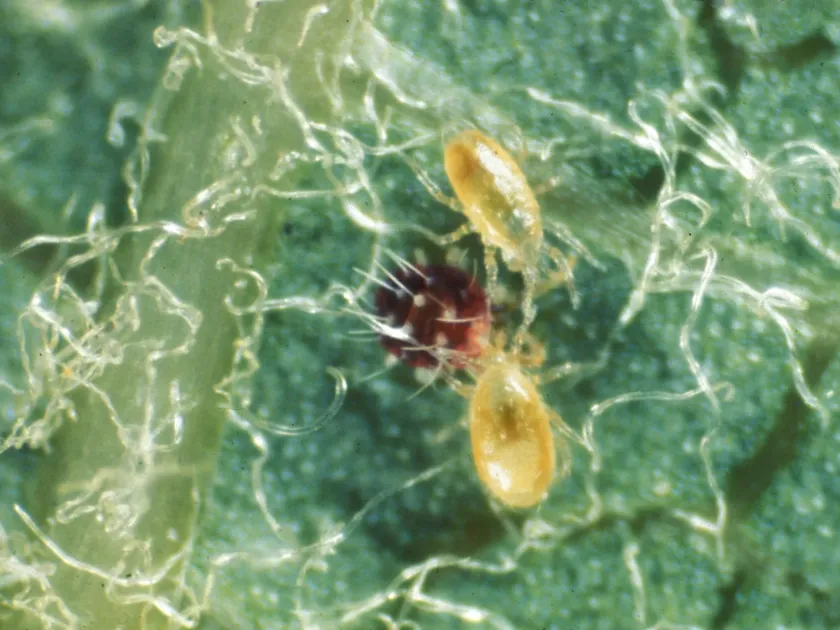
Description
How to identify
Agistemus fleschneri is a species of predatory mite belonging to the family Stigmaeidae. Unlike plant-feeding mites, this species is a beneficial predator that plays an important role in managing phytophagous populations in orchards and gardens.
Adult mites are typically small and exhibit a yellowish to reddish-orange coloration. Identification usually requires high-magnification tools or a microscope to distinguish specific setal patterns characteristic of the Stigmaeidae family.
The life cycle involves egg, larva, protonymph, deutonymph, and adult stages. The speed of development is highly dependent on ambient temperature and the availability of prey items within the immediate vicinity of the mite.
These mites are highly mobile and are often found on the underside of leaves, where they actively search for spider mite eggs and larvae. Their distribution is primarily governed by the location of prey colonies.
As a predatory species, it occupies a specific niche in the ecosystem. Understanding its classification is crucial for growers who aim to implement biological or integrated pest management strategies.
What it damages
Agistemus fleschneri is not a plant pest. It does not cause damage to plant tissues, nor does it feed on plant sap. Labeling this mite as a pest is a common agricultural misconception that can lead to improper treatment.
The mite acts as a natural control agent for spider mites (Tetranychidae). By consuming the eggs and young stages of destructive pests, it helps reduce the pressure on crops and lowers the need for chemical intervention.
There are no signs of physical damage such as chlorosis, leaf stippling, or webbing caused by this species. If a plant shows signs of distress, it is invariably caused by other phytophagous organisms present in the colony.
Treating Agistemus fleschneri with broad-spectrum acaricides is counterproductive. Eliminating these beneficial predators often leads to "pest resurgences," where spider mite populations explode due to the lack of natural regulation.
Recognizing the difference between beneficial mites and pests is a cornerstone of professional horticultural practice. This species is a valuable ally rather than a threat to agricultural productivity.
When it appears
The seasonal activity of Agistemus fleschneri typically begins in the early spring as temperatures rise above 12-15°C. At this point, the mites emerge from their overwintering sites and begin searching for emerging prey.
The highest levels of activity are recorded during the summer months when spider mite populations are at their peak. During this period, the predator exploits the abundant food supply to maximize its own population size.
As the autumn approaches and photoperiods shorten, the mites begin preparing for dormancy. They move toward protected areas like bark crevices, leaf litter, or debris to survive the winter temperatures.
Developmental rates fluctuate based on the regional climate. Warmer regions may support a larger number of generations per year compared to cooler climates, which significantly impacts the biological control potential.
Maintaining the continuity of the habitat is essential. Disrupting the environment during the transition seasons can reduce the survival rate of the overwintering population.
Control measures
There is no need to control Agistemus fleschneri, as it provides free biological services. Instead, the focus should be on creating conditions that favor its presence and survival in the orchard.
When chemical control is necessary for other pests, growers should utilize selective pesticides that are classified as safe for beneficial predatory mites. Always consult pesticide toxicity databases for non-target organisms.
Integrating cultural practices, such as maintaining cover crops or biodiversity in the orchard edges, can provide refuge for predators. This stability ensures that the predator remains on site even when the pest density is low.
Regular field scouting is highly recommended. By identifying the presence of predators alongside pests, an agronomist can make informed decisions about whether to spray or to wait for the biological control to take effect.
- Prioritize integrated pest management (IPM) protocols.
- Select pesticide products with low toxicity to Stigmaeidae.
- Avoid prophylactic chemical spraying.
- Use hand lenses for accurate population monitoring.
- Enhance orchard biodiversity to support beneficial fauna.
Taxonomy
- Latin name
- Agistemus fleschneri
- Order
- Mites
- Family
- Stigmaeidae
- EPPO code
- AGISFL
Discussion
No discussions yet — be the first.