
Agistemus mite
Agistemus
Description
How to identify
Mites of the genus Agistemus belong to the family Stigmaeidae. These microscopic organisms are recognized in agriculture for their diverse ecological roles, ranging from predatory behavior to potential damage on specific host plants.
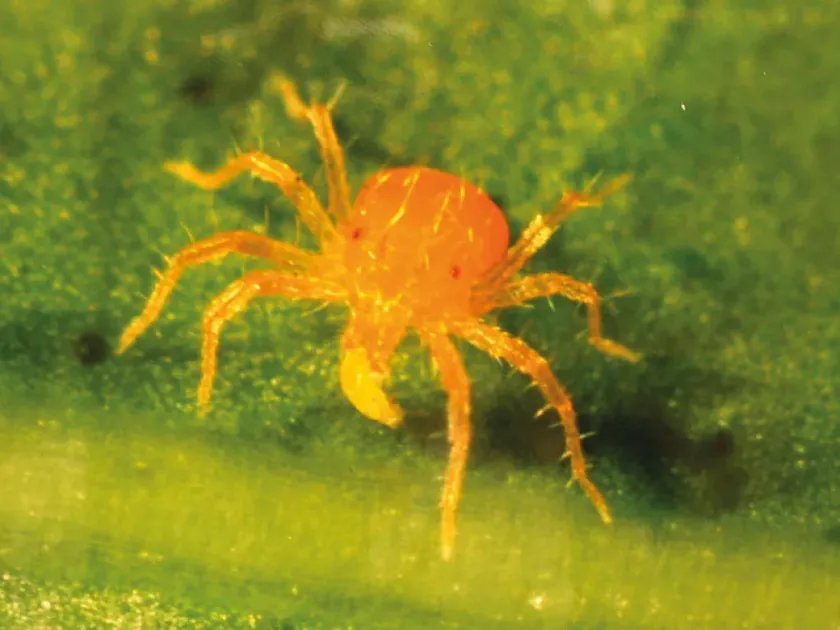
Adult mites typically exhibit an oval, slightly flattened body shape, with colors varying from pale yellow to reddish-orange depending on the species and nutritional intake.
They possess well-developed legs, enabling them to move rapidly across leaf surfaces, a characteristic that aids in their dispersal across the canopy of host plants.
Identification at the species level requires professional microscopic examination, focusing on the specific chaetotaxy, or the arrangement of setae on the dorsal shield of the mite.
Unlike tetranychid spider mites, Agistemus mites do not produce noticeable webbing, a key visual feature for distinguishing them during field inspections.
What it damages
The damage caused by these mites results primarily from their feeding activity, during which they pierce epidermal cells to extract plant sap.
Major crops affected include various fruit trees, citrus, and grapevines, particularly in warmer climates where mite populations can flourish rapidly.
Feeding lesions manifest as chlorotic spots, which eventually coalesce, leading to extensive tissue degradation and a significant reduction in photosynthetic efficiency.
Host plants subjected to heavy infestations may show reduced vigor, stunted growth of shoots, and an overall decline in plant health, making them susceptible to other stressors.
Chronic damage reduces the plant's ability to produce high-quality fruits, leading to decreased yields and long-term vitality issues for the orchard or vineyard.
When it appears
The active life cycle of Agistemus begins in the spring as temperatures rise, signaling the emergence of overwintering females from their protected sites.
Peak population densities are typically observed during mid-to-late summer, driven by high ambient temperatures and dry conditions which accelerate the mite's reproductive rate.
Their life cycle is relatively short, often completing a generation in less than two weeks under optimal environmental conditions, facilitating rapid outbreaks.
Overwintering occurs primarily in protected crevices such as tree bark, under fallen leaves, or within the bud scales of the host plant.
As autumn temperatures decrease, the metabolic rate of the mites drops, and they enter a quiescent state to survive the cold winter months until the following spring.
Signs of infestation
The primary symptom of an infestation is the appearance of small, pale-yellow, or silvery pin-prick lesions on the surface of the leaves.
Under magnification, the presence of mites and their small, spherical eggs, often laid along the leaf veins, can be detected before severe damage becomes visible.
Leaves affected by high population levels may exhibit a bronze-like appearance, a classic sign of massive chlorophyll loss and cellular structural damage.
Stunted leaf growth, curling, and premature yellowing (chlorosis) are common indicators that the mite population has exceeded a tolerable threshold.
In severe cases, defoliation may occur early in the season, preventing the plant from storing sufficient nutrients for the subsequent growing year.
Control measures
Effective management requires an integrated approach that balances biological, cultural, and chemical tactics to maintain mite populations below economic thresholds.
Encouraging natural predators, such as other predatory mites and lacewings, is a foundational strategy for sustainable control within orchards.
Cultural practices, including proper irrigation and removal of infested plant debris, significantly reduce the success of mite colonization.
- Pruning crowns to improve light and air circulation.
- Eliminating weeds that may serve as alternative hosts.
- Regular field scouting to monitor population fluctuations.
- Using selective acaricides that spare beneficial insect populations.
Chemical intervention should be reserved for periods of high risk, using products that provide maximum efficacy against the target mite while minimizing adverse impacts on the environment.
Taxonomy
- Latin name
- Agistemus
- Order
- Mites
- Family
- Stigmaeidae
- EPPO code
- AGISSP
Discussion
No discussions yet — be the first.