

Pest · Coleoptera (beetles) · affects Vegetables, Fruit crops, Marsh mallow
Especially harmful
Strawberry blossom weevil
Anthonomus rubi
Description
How to identify
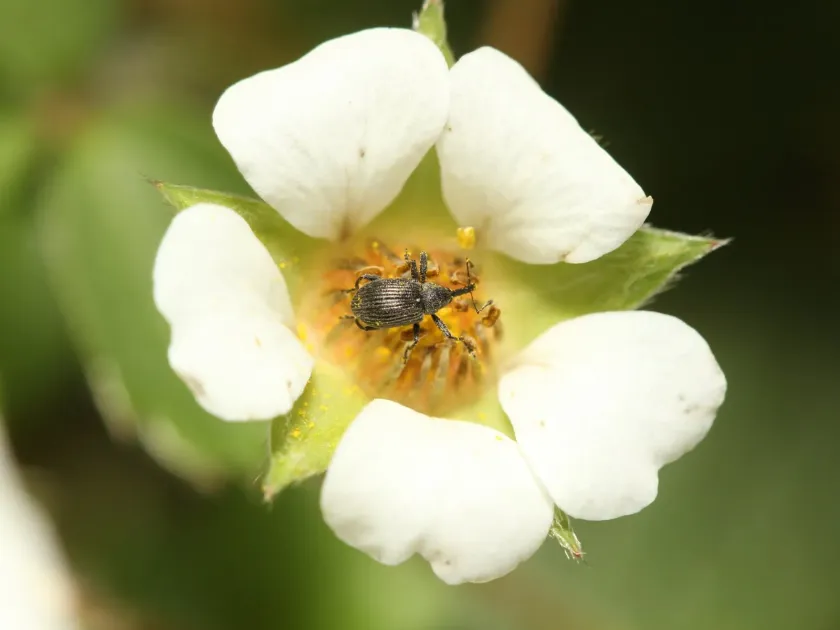
The strawberry blossom weevil (Anthonomus rubi) is a small beetle belonging to the Curculionidae family. Adults are approximately 2–3 mm long, with a distinct black or dark grey color and a long, slender snout.
Their bodies are covered in fine, greyish hairs, giving them a dull appearance. They are capable of flight and are highly mobile, allowing them to migrate between berry patches.
The larvae are small, legless, cream-colored grubs with a brownish head capsule. They develop exclusively within the flower buds, making them difficult to detect without careful inspection.
Pupation occurs within the withered bud, where the insect remains until it emerges as a young adult in early summer to feed and prepare for overwintering.
Knowledge of their life cycle is crucial for effective management, as timing interventions relative to the bud development stage is the most important factor in control.
What it damages
This pest primarily attacks strawberry and raspberry plants, though it can also infest loganberries and various other plants within the Rosaceae family.
Economic damage is caused by both the adults, which feed on foliage, and the larvae, which destroy the reproductive parts of the flower buds, significantly reducing yield.
The female weevil uses her snout to pierce a bud and lay an egg inside. She then severes the pedicel (stalk), causing the bud to droop, wither, and eventually fall to the ground.
Yield losses can be severe, often exceeding 50% in untreated fields, as the dropped buds represent the season's fruit potential being lost directly to the pest.
Young adults emerging in the summer feed on the leaves, creating small, regular holes, which can weaken the plants and reduce their vigor for the following growing season.
When it appears
Weevils emerge from hibernation in the spring when temperatures consistently rise above 10–12°C, usually coinciding with the onset of the strawberry or raspberry growing season.
The most critical window for damage is during the bud development (pre-flowering) phase, as this is the exact time when females are active and laying eggs.
After egg-laying, the larval stage lasts about 2–3 weeks. Once fully grown, the larvae pupate inside the bud, emerging as new adults by mid-summer.
Summer activity involves adult feeding on foliage, followed by a period of diapause when the insects seek sheltered places in the soil or under debris to survive the winter.
Early spring weather patterns play a major role in determining the severity of the infestation, as warm, dry springs often favor rapid population growth and expansion.
Signs of infestation
The most recognizable sign of an infestation is the presence of drooping or withered flower buds, often hanging by a small thread of tissue from the main stem.
Careful inspection of the plantation will reveal severed stalks, which appear as clean, sharp cuts as if done by a small blade, usually occurring right beneath the bud.
Leaves on infested plants will show numerous small, circular, or irregular perforations, which are clear indicators of adult feeding activity throughout the foliage.
During the early morning, adults can be found by shaking the plants over a white sheet or container; the beetles will often freeze and drop to the ground when startled.
A high density of dried-up, fallen buds on the ground around the base of the plants is a definitive indicator of an active and potentially destructive infestation.
Control measures
Integrated pest management begins with cultural practices, such as removing plant debris and plowing or rototilling the soil between rows to disrupt overwintering sites.
- Hand-picking and disposing of affected buds before the new generation of beetles emerges.
- Planting resistant or late-flowering varieties to escape the peak activity period of the weevil.
- Using row covers (agrofibre) to physically prevent the insects from accessing the plants during the vulnerable budding phase.
- Applying biological controls, such as entomopathogenic nematodes or fungi, that target the larvae and pupae in the soil.
- Utilizing contact or systemic insecticides in accordance with regional regulations, ensuring applications occur strictly before the flowering stage to protect pollinators.
Monitoring the fields with sticky traps or regular visual scouting allows for timely action, preventing the population from reaching the economic threshold of damage.
Always rotate chemical groups if multiple sprays are necessary to minimize the risk of developing insecticide resistance in the weevil population.
Reference
Connections · Strawberry blossom weevil
Most often together:
Marketplace
Products · 1
Biology
Taxonomy
- Latin name
- Anthonomus rubi
- Order
- Coleoptera (beetles)
- Family
- Curculionidae
- EPPO code
- ANTHRU
Community
Discussion
No discussions yet — be the first.