
Xyloterinus politus
Xyloterinus politus
Description
How to identify
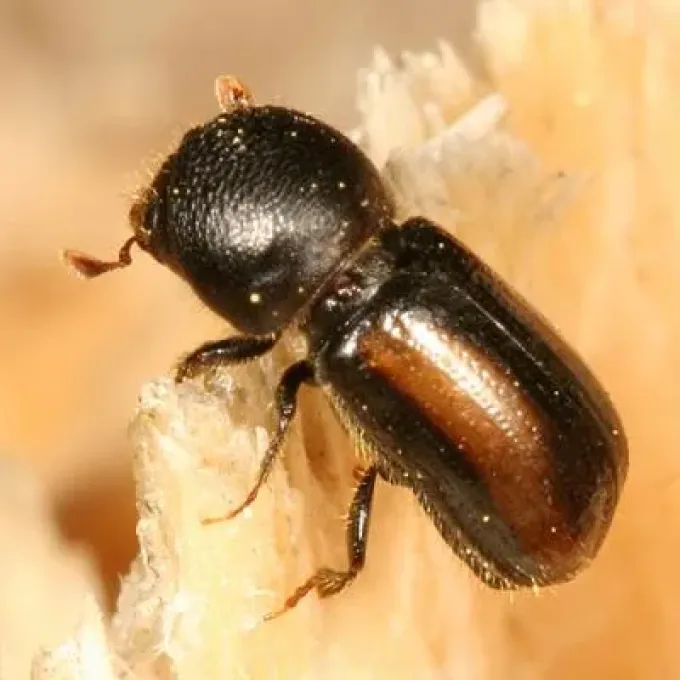
Xyloterinus politus, commonly referred to as the glossy ambrosia beetle, is a species of bark beetle belonging to the Curculionidae family. Adult beetles are small, cylindrical, and typically measure 3 to 3.5 mm in length, sporting a dark brown to black coloration with a distinct glossy finish.
This beetle is classified as an ambrosia beetle, which refers to its unique biological habit. They do not feed on wood tissues directly but instead farm specific symbiotic fungi within the tunnels they bore into the trees. These fungi provide the necessary nutrition for both larvae and adults.
The life cycle of Xyloterinus politus is highly dependent on wood moisture. Unlike many other bark beetles that attack dry materials, this species requires sufficiently damp wood to support the growth of their fungal gardens, making them a primary threat to fresh timber.
Adults are strong fliers and are attracted to volatile chemical signals emitted by stressed or dying deciduous trees. They use these signals to locate suitable hosts for gallery construction and fungal inoculation.
Their galleries are excavated deep into the sapwood and heartwood. The social structure within these tunnels involves cooperative behavior between the parents to keep the galleries clean and optimized for fungal growth, showing a level of parental care uncommon in many other insect groups.
What it damages
The beetle primarily attacks a wide range of deciduous hardwoods, including maple, oak, beech, ash, and alder. It is a significant pest for both stressed living trees and freshly felled logs, causing substantial economic loss in forestry.
In lumber yards, the damage is severe as the beetles bore deep into the timber. Their tunnels compromise the structural integrity of the wood, rendering it unsuitable for high-quality furniture making or precision carpentry work.
The symbiotic fungi introduced by the beetles cause dark, irreversible staining of the wood. This defect, often called "ambrosia staining," significantly reduces the commercial value of the hardwood, as the wood becomes discolored and aesthetically unappealing.
Living trees that are already suffering from drought, mechanical injuries, or diseases are the most susceptible to colonization. Once a tree is infested, the beetle activity can lead to a rapid decline in health, often resulting in death if the infestation is heavy enough.
Although they rarely attack perfectly healthy trees, environmental stressors in urban landscapes make ornamental trees highly vulnerable. Large infestations can eventually lead to canopy dieback and structural weakness in shade trees.
Signs of infestation
The most reliable sign of an infestation is the presence of small, round entry holes on the bark surface. A telltale indicator is the fine, light-colored boring dust (frass) that accumulates near these holes or at the base of the tree.
Upon visual inspection, the absence of excessive sap flow is typical, as this species prefers hardwoods and does not trigger the same defense mechanisms as some conifer-infesting bark beetles. This makes the initial stage of attack relatively subtle.
Cross-sectioning infested timber reveals distinct, branched gallery systems that are lined with a dark fungal layer. This "oiling" of the tunnel walls is a characteristic diagnostic feature that confirms the presence of ambrosia beetles rather than other types of wood borers.
Trees that are under siege often show signs of generalized decline, including chlorosis or wilting leaves. This occurs because the internal galleries disrupt the vascular system's ability to transport water and nutrients effectively to the canopy.
During the peak flight periods, one might observe adult beetles landing on the bark. Additionally, the characteristic musty odor associated with fungal growth inside the galleries can sometimes be detected in the immediate vicinity of heavily infested logs.
Control measures
Effective management begins with strict sanitation practices. In forest settings, prompt removal and processing of freshly cut logs are essential to prevent the buildup of beetle populations during their peak flight seasons in the spring and summer.
For ornamental or high-value trees, insecticide sprays containing pyrethroids can be applied to the bark to create a chemical barrier that deters beetles from boring into the tree. This is best done as a preventive measure before an attack begins.
- Maintain tree vigor through proper watering and soil management to reduce attractiveness.
- Sanitize the area by removing and destroying heavily infested, dying trees.
- Utilize monitoring traps to detect early adult beetle activity.
- Accelerate the drying process of timber to discourage fungal growth.
Stored lumber should be stacked in well-ventilated areas off the ground. By keeping the wood dry, you inhibit the beetle's ability to farm its food source, effectively stopping the infestation and protecting the value of the stored resources.
Regular monitoring of forest edges and storage facilities is critical. If early signs of boring are detected, immediate action to process or protect the wood can save significant portions of the stock from the deep staining and structural damage caused by this insect.
Taxonomy
- Latin name
- Xyloterinus politus
- Order
- Coleoptera (beetles)
- Family
- Curculionidae
- EPPO code
- XYORPO
Discussion
No discussions yet — be the first.