
Viburnum aphid
Wahlgreniella viburni
Description
How to identify
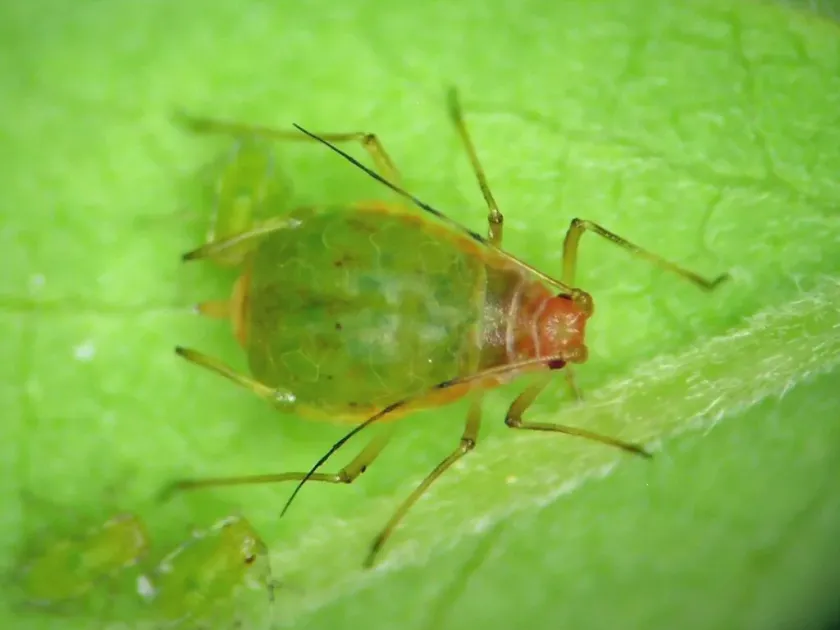
The viburnum aphid Wahlgreniella viburni is a small sap-sucking insect belonging to the order Hemiptera and the family Aphididae. Adults typically measure between 1 and 2 millimeters in length.
Their bodies range in color from pale green to yellowish-green, providing excellent camouflage on the underside of viburnum leaves. A key identifying feature is their long antennae, which can be as long as their entire body.
The population grows through parthenogenesis, with females producing live young without mating. This allows for extremely rapid colonization of host plants during the spring months.
Winged forms (alatae) are produced periodically, especially when a colony becomes overcrowded, enabling them to fly to healthy plants and spread the infestation.
Overwintering occurs in the egg stage, with eggs firmly attached to the bark or near the buds of viburnum twigs, where they remain protected until spring.
What it damages
The viburnum aphid primarily feeds on various species of the Viburnum genus. They show a strong preference for the succulent, tender growth found at the tips of new shoots.
By extracting plant cell sap, the aphids drain energy from the plant, which leads to the severe curling and distortion of young foliage.
In addition to leaf damage, the aphids often colonize the flower buds and emerging flower heads, causing them to wither or fail to bloom properly.
The constant drain of nutrients weakens the entire shrub, making it more susceptible to other biotic and abiotic stressors, including drought and frost.
Over time, a heavy infestation can cause stunted growth and a significant reduction in the overall aesthetic appeal of the ornamental viburnum plant.
When it appears
The life cycle begins in early spring as temperatures rise, triggering the eggs to hatch. The first nymphs immediately seek out the newly unfurling buds to feed.
The period of maximum activity and colony expansion occurs throughout May and June, coinciding with the most rapid growth phase of the viburnum shrubs.
During the peak of summer, if the weather becomes excessively hot and dry, colony growth may slow, but they continue to exist on the plant until autumn.
As the weather cools in late autumn, sexual forms appear and mate, after which the females lay the eggs that will survive the winter.
Understanding these seasonal patterns is crucial for timing interventions, as the most effective control measures are applied just as the buds begin to break.
Signs of infestation
The most visible symptom of a viburnum aphid attack is the tight curling and wrinkling of new leaves at the ends of branches, forming clusters often referred to as leaf-curls.
Small, pale-green insects can be found in large, dense colonies nestled within the folds of the curled leaves or on the undersides of leaves.
The presence of honeydew, a sticky, sugary substance secreted by the aphids, is a tell-tale sign that colonization is well underway.
Sooty mold often grows on the honeydew deposits, creating a black, dusty appearance on the leaves that further inhibits the plant's ability to photosynthesize.
- Distorted and curled young leaves.
- Sticky residue on stems and leaves.
- Increased ant activity on the shrub.
- Premature yellowing of new growth.
Control measures
Effective management begins with regular monitoring starting in early spring. If caught early, small infestations can be removed by physical pruning of the affected shoots.
Biological control agents, such as ladybugs, lacewings, and hoverfly larvae, are natural predators of aphids and should be encouraged by avoiding broad-spectrum pesticides.
For chemical control, systemic insecticides are highly effective as they travel through the plant's vascular system, reaching the aphids even deep inside curled leaves.
Horticultural oils or insecticidal soaps can be used as a contact treatment, provided they are applied thoroughly to the underside of the leaves where the aphids reside.
To reduce future pressure, ensure the plants are healthy and not over-fertilized with nitrogen, as excess nitrogen can lead to softer growth that attracts more aphids.
Taxonomy
- Latin name
- Wahlgreniella viburni
- Order
- Hemiptera (bugs, aphids, leafhoppers)
- Family
- Aphididae
- EPPO code
- WAHLVI
Discussion
No discussions yet — be the first.