
Rose aphid
Wahlgreniella nervata
Description
How to identify
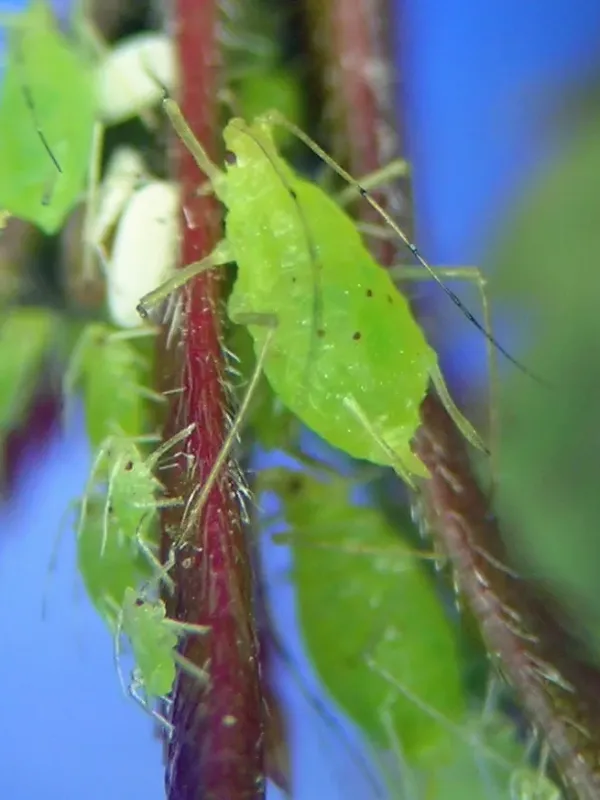
The rose aphid (Wahlgreniella nervata) is a small insect belonging to the family Aphididae, order Hemiptera. Adult specimens typically measure between 1.5 and 2.5 mm in length.
Their coloration ranges from light green to yellowish-brown, which provides excellent camouflage against the foliage and succulent stems of rose plants.
Like other aphids, they possess a piercing-sucking mouthpart called a stylet, designed to extract sap directly from the vascular tissue of the host plant.
The species exhibits a complex lifecycle, including both wingless forms and winged migratory forms that appear when local resources become scarce.
Overwintering occurs primarily in the egg stage, with eggs deposited on the bark of young shoots, ensuring the continuation of the colony when temperatures rise in spring.
What it damages
The primary hosts of this aphid species are plants in the Rosaceae family, with garden roses being the most commonly affected and economically important group.
The pests concentrate on the most tender parts of the plant, including developing apical shoots and unopened flower buds, leading to stunted growth.
By constantly extracting sap, these aphids cause significant physiological stress, which manifests as curled, yellowing, or necrotic leaf tissue.
Beyond direct feeding damage, they act as vectors for various plant viruses, potentially introducing pathogens that lead to long-term decline of the plant.
The excretion of honeydew serves as a substrate for the development of sooty mold, which physically blocks sunlight from reaching the leaves, further inhibiting photosynthesis.
Signs of infestation
The most immediate sign of infestation is the curling or distortion of young leaves, which often lose their glossy, healthy appearance.
Affected flower buds may fail to open properly, or the resulting flowers may be small, discolored, and malformed due to the loss of nutrients.
Visible stickiness on the foliage and surrounding stems is a clear indicator of heavy aphid activity and excessive honeydew secretion.
The presence of ants patrolling the stems is a common indirect sign, as ants farm aphids to harvest the honeydew they produce.
Close inspection of the undersides of leaves and the junction of stem growth will reveal the dense, overlapping clusters of these small insects.
Control measures
Systemic insecticides are highly effective against this pest, as the chemical is absorbed into the plant's vascular system, killing aphids during their feeding process.
Biological control remains a vital component of integrated pest management, encouraging natural predators like ladybugs, lacewings, and hoverflies.
Cultural practices, such as providing optimal watering and avoiding excessive nitrogen fertilization, help keep plants vigorous and less attractive to aphids.
For minor infestations, mechanical removal using a steady stream of water can physically displace a large portion of the aphid population.
- Apply systemic pesticides (e.g., imidacloprid or acetamiprid) when necessary.
- Monitor rose bushes weekly during the early growing season.
- Use insecticidal soaps for localized, non-toxic contact control.
- Promote biodiversity in the garden to support natural aphid predators.
- Prune and dispose of heavily infested apical stems immediately.
Taxonomy
- Latin name
- Wahlgreniella nervata
- Order
- Hemiptera (bugs, aphids, leafhoppers)
- Family
- Aphididae
- EPPO code
- AMPHNE
Discussion
No discussions yet — be the first.