
Lesser fiddler crab
Uca specialis
Description
How to identify
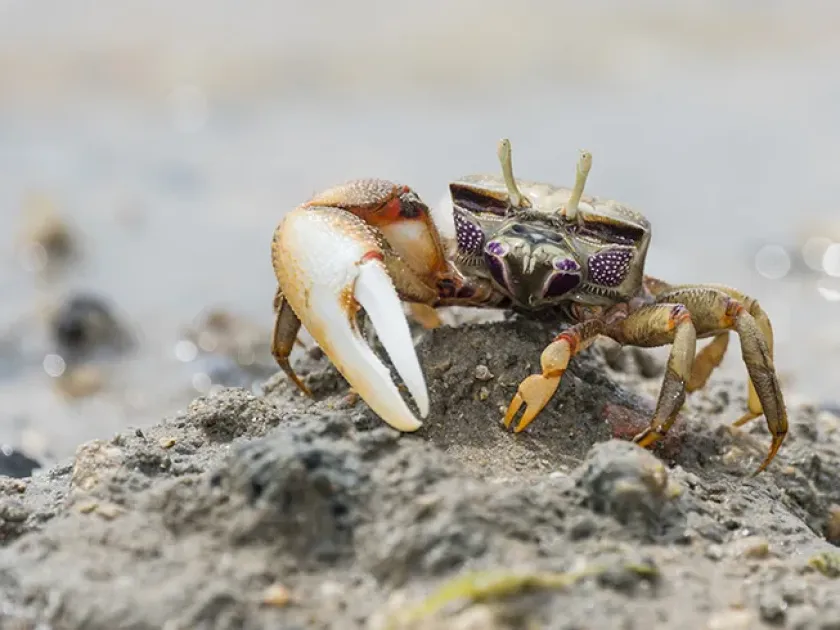
The lesser fiddler crab (Uca specialis) is a member of the Ocypodidae family, known for its distinct asymmetrical claws. The males possess one enlarged claw, while the other remains small and delicate.
Adults are typically small, with a carapace size ranging from 2 to 4 centimeters. Their coloration usually mimics the wet mud, allowing them to remain camouflaged in agricultural ditches.
The life cycle is semi-aquatic, involving a larval stage in open water before moving to the shoreline or flooded fields where they spend their adult life digging burrows.
As a pest, they are recognized by their intense burrowing behavior, which can undermine the stability of field embankments and irrigation infrastructure.
Field identification is easiest during the day, when males perform their signature "fiddling" motion, waving their large claw to attract females along the muddy banks.
What it damages
The primary agricultural damage caused by Uca specialis occurs in paddy rice fields, where their burrowing activities destroy the integrity of the soil layer.
Crabs directly feed on young rice shoots, cutting through roots and stems, which leads to plant death and reduced crop stand density across the field.
Damage to irrigation embankments is a major issue; the complex tunnel networks lead to massive water leakage, effectively draining fields and killing rice plants through dehydration.
By constantly turning the soil, they interfere with the nutrient uptake of rice plants and disperse the applied fertilizers, leading to uneven crop growth and reduced yields.
Indirect costs include the high labor and material expenses required to repair the damage to irrigation channels and dikes throughout the growing season.
When it appears
The activity of the lesser fiddler crab is highly correlated with the local climate, specifically temperature and moisture levels, which define their metabolic activity.
In most regions, peak activity occurs during the warm summer months when rice is actively growing, providing the perfect environment for crab reproduction and foraging.
During the winter or cooler months, activity levels drop significantly, and the crabs tend to hibernate in deeper burrows or migrate toward larger, permanent bodies of water.
Rice planting time, usually in late spring, is a period of high vulnerability for the crop, as hungry crabs move into newly flooded fields seeking fresh vegetation.
Environmental factors such as rainfall patterns and tides also influence the daily movement of these crabs, as they rely on water to survive and facilitate their social behaviors.
Signs of infestation
The most prominent sign of a crab infestation is the presence of numerous circular burrow holes, usually concentrated along the base of irrigation canals.
Evidence of digging can be seen in small, neat pellets of excavated mud piled up near the entrances of the burrows, which are distinct from other subterranean animal activity.
Visual symptoms on rice plants include cut roots and fallen plants, which indicate that crabs are actively foraging on the crop within the flooded paddies.
Water loss that cannot be explained by irrigation malfunctions or evaporation is a strong indicator of heavy crab activity within the field dikes.
Sightings of crabs moving in and out of water, or the sight of males waving claws, serves as a confirmation of high pest density and the need for immediate action.
Control measures
Effective management includes reinforcing irrigation dikes with compacted clay or geomembranes to prevent crabs from successfully excavating their tunnels.
Implementing a crop rotation or field drying regime can disrupt the crab life cycle and force them to migrate away from the cultivation area due to lack of water.
Biological controls, such as encouraging local predatory fish species or wading birds, can significantly lower the overall population pressure on the field.
When necessary, the application of targeted molluscicides or specialized baits can be used, provided they are applied according to strict agricultural safety standards.
Continuous monitoring and immediate repair of burrow entrances in dikes help prevent minor damage from escalating into large-scale irrigation system failures.
Taxonomy
- Latin name
- Uca specialis
- Family
- Ocypodidae
- EPPO code
- UCASSE
Discussion
No discussions yet — be the first.