
Citrus nematode
Tylenchulus semipenetrans
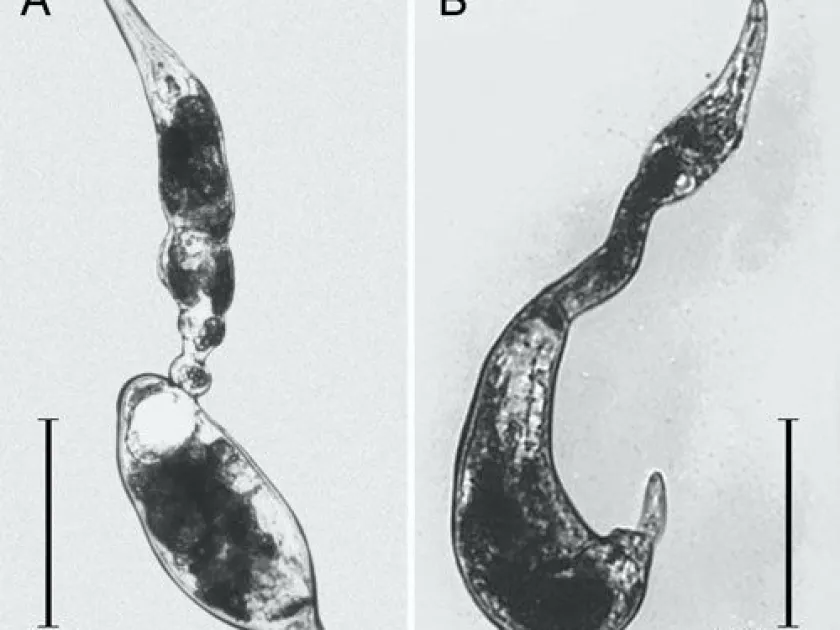
Description
How to identify
The citrus nematode, Tylenchulus semipenetrans, is a specialized plant-parasitic roundworm belonging to the family Tylenchulidae. It is a major global pest affecting commercial citrus production.
The parasite exhibits significant sexual dimorphism: females become sedentary after embedding their heads into the host roots, while males remain worm-like and do not feed during their adult stage.
Their life cycle typically lasts around six to eight weeks. They thrive in warm soil conditions, with optimal development occurring between 24 and 28 degrees Celsius.
Second-stage juveniles serve as the infective agents, actively moving through soil pores to locate new, healthy root tissues for penetration and feeding.
The persistence of this nematode is high, as it can survive for long periods in the soil even in the absence of a host crop, making it difficult to eradicate.
What it damages
Citrus species, including oranges, lemons, grapefruit, and mandarins, are the primary hosts. Other crops like grapes and olives can also be affected by this nematode species.
Nematodes feed on cortical cells, which disrupts the normal translocation of water and essential nutrients to the upper parts of the tree, leading to stunted overall development.
Chronic infestation results in the "slow decline" syndrome, characterized by reduced canopy density, yellowing of leaves, and a significant decrease in fruit size and total yield.
The root system becomes severely compromised due to necrosis and the presence of soil particles sticking to the gel-like matrix produced by the adult females.
Damage to the roots increases susceptibility to secondary soil-borne pathogens, leading to a synergistic effect that significantly shortens the lifespan of the orchard.
Signs of infestation
Trees infested with T. semipenetrans often show signs of general malnutrition. The foliage becomes sparse, pale, and may exhibit signs of chlorosis despite adequate fertilization.
Growth flushes are minimal, and the trees demonstrate a diminished ability to recover from environmental stresses such as heat waves or drought conditions.
The root system shows characteristic soil adhesion, where soil particles are glued to the roots by the gelatinous matrix of the female nematodes, creating a dirty appearance.
Root surfaces may become dark and necrotic, and in severe cases, the fine feeder roots die off completely, leaving the plant unable to sustain its vegetative load.
Field diagnosis should always be confirmed by professional nematode assay, as symptoms are frequently indistinguishable from other root health issues or mineral deficiencies.
Control measures
Prevention remains the most effective management tool. Growers must insist on using only certified, nematode-free nursery stock to avoid introducing the pest to new land.
Hot water treatment of rootstock before planting is a proven method to eliminate nematodes within the root tissues without compromising the plant's viability.
Cultural management includes proper sanitation of all equipment used in the orchard and ensuring that irrigation water is not contaminated with soil from infested areas.
Improving soil health through the addition of organic matter can help trees tolerate nematode populations by promoting beneficial soil microfauna that antagonize the pests.
- Certified clean nursery stock.
- Strict soil sanitation protocols.
- Avoidance of reusing infested land for citrus.
- Periodic soil testing for population monitoring.
Taxonomy
- Latin name
- Tylenchulus semipenetrans
- Order
- Nematodes
- Family
- Tylenchulidae
- EPPO code
- TYLESE
Discussion
No discussions yet — be the first.