
Tropilaelaps mite
Tropilaelaps clareae
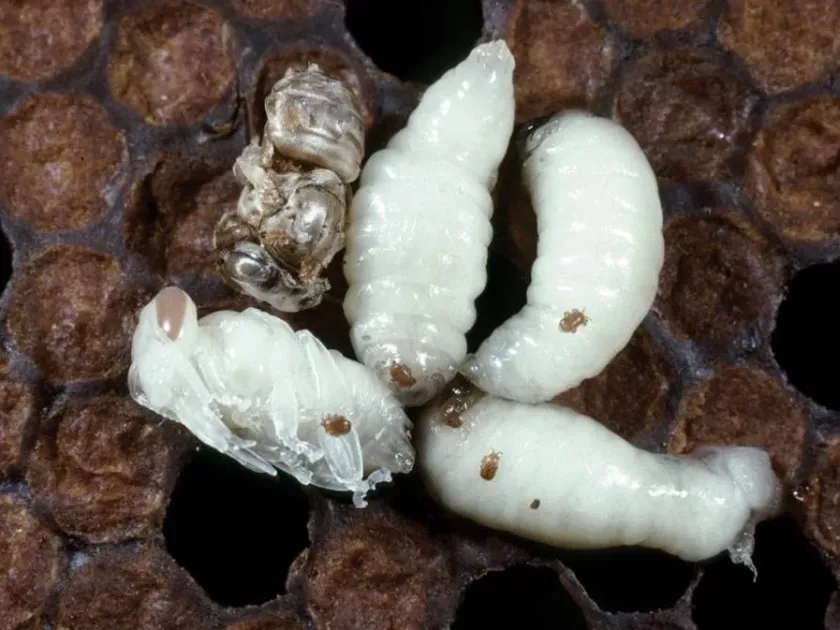
Description
How to identify
The Tropilaelaps mite (Tropilaelaps clareae) belongs to the phylum Arthropoda, class Arachnida, order Mesostigmata, and family Laelapidae. It is a parasitic mite that specifically targets honey bee colonies.
Adult female mites are approximately 0.9–1.0 mm long and about 0.5 mm wide, with a light brown to reddish-brown body. They are notably more mobile and faster-moving than the Varroa mite.
The mite's lifecycle is inextricably linked to the bee brood. Because they rely on bee larvae for nutrition, they have very limited survival time when away from the brood.
Male mites are significantly smaller than females and do not feed on bee hemolymph, serving solely for reproductive purposes within the hive environment.
Identification is best achieved by inspecting sealed brood cells, where the mites reproduce and congregate during the larval and pupal stages of the bees.
What it damages
Tropilaelaps mites parasitize the brood of both Apis mellifera and Apis dorsata. They feed on the hemolymph of developing bee larvae and pupae.
Feeding by these mites causes severe physiological stress to the developing bees, often resulting in deformed wings, shortened legs, or death before emergence.
The infestation significantly weakens the colony structure by reducing the number of healthy, emerging workers and shortening the lifespan of adult bees.
Infested colonies suffer from decreased honey production and poor pollination efficiency due to the general loss of worker force and colony vitality.
Without intervention, the rapid reproductive cycle of Tropilaelaps can lead to colony collapse in a short period, especially during peak brood-rearing seasons.
Signs of infestation
A primary indicator of infestation is a "spotty" or irregular brood pattern, where sealed cells appear inconsistent, and some caps show holes or damage.
Visual observation of the combs often reveals mites moving rapidly across the frame, a behavior distinct from the more stationary Varroa mite.
Dead or dying larvae may be found on the bottom board of the hive, as the mites cause significant trauma during the development of the bees.
Adult bees may show signs of physical deformities, such as stunted wings or a shriveled abdomen, indicating that they were parasitized during their development.
Increased mortality and a decline in population despite large amounts of brood are classic symptoms of a severe Tropilaelaps infestation.
Control measures
Management focuses on breaking the brood cycle, as the mite cannot survive for long periods without bee larvae to feed upon.
Chemical control using approved acaricides is effective if administered according to regional beekeeping regulations and safety guidelines.
Isolating the queen for a set duration creates a broodless period, which is highly effective in starving the mite population by preventing reproduction.
Monitoring using mesh inserts on the hive floor allows beekeepers to track mite drop and assess the necessity of treatment measures.
- Brood cycle interruption via queen isolation
- Application of approved acaricidal treatments
- Regular inspection of hive debris for mite presence
- Strict biosecurity measures when moving bee packages
Taxonomy
- Latin name
- Tropilaelaps clareae
- Order
- Mites
- Family
- Laelapidae
- EPPO code
- TRLLCL
Discussion
No discussions yet — be the first.