
Gaeolaelaps
Gaeolaelaps
Description
How to identify
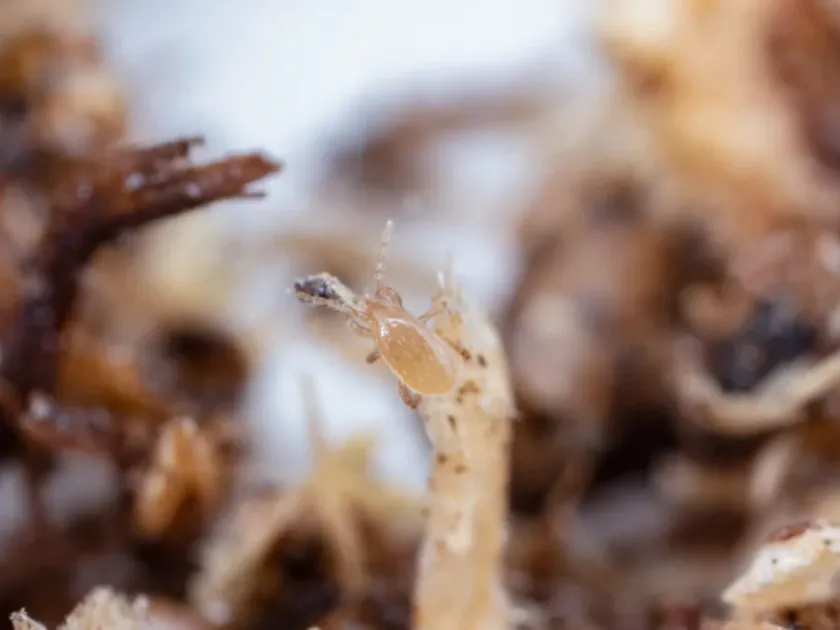
Gaeolaelaps (specifically the species Gaeolaelaps aculeifer) is a soil-dwelling predatory mite belonging to the family Laelapidae. Adult individuals possess an oval body measuring approximately 0.5–1 mm and exhibit a light brown or reddish-brown coloration.
These mites are active predators that move primarily across the substrate surface or within the top layers of the soil. Unlike many plant-feeding mites, they are equipped with well-developed legs that allow them to move rapidly in search of prey.
Systematically, this genus belongs to the order Mesostigmata. It is crucial to distinguish them from phytophagous species: they do not feed on plant sap but rather lead a predatory lifestyle, consuming small insects and their larvae.
In their natural habitat, they prefer moist soil areas with high organic matter content. Their population density depends directly on the availability of prey, which makes their numbers dynamic throughout the growing season.
Accurate identification in agronomic settings often requires microscopic examination, as they bear a strong resemblance to other members of the Mesostigmata order inhabiting the soil profile.
What it damages
Although Gaeolaelaps is primarily considered a beneficial entomophage, a risk of damage to young plant roots may arise in greenhouse conditions if prey is completely absent or if the mite concentration in the substrate becomes excessively high.
The primary damage is often indirect, occurring when the predator population grows disproportionately in seedling trays where typical prey, such as sciarid fly larvae or thrips, are unavailable.
Under standard cultivation conditions, Gaeolaelaps is not a primary crop pest. On the contrary, it actively destroys harmful soil-dwelling insects, providing significant benefits to the agrocenosis.
Cases of damage are extremely rare and usually localized to very young or weakened seedlings. Mature plants are virtually unaffected by the presence of these mites in the soil.
The main crops where this species is frequently found include greenhouse vegetable crops and ornamental plants grown in peat-based mixes or rockwool.
When it appears
Mite activity is observed throughout the entire plant growing season, provided that optimal soil moisture and air temperatures between +15 and +25 degrees Celsius are maintained.
In greenhouse environments where the microclimate is controlled, Gaeolaelaps is capable of maintaining high biological activity year-round by sustaining its population through available food sources.
In open fields, peak activity occurs during the spring and summer periods when the soil is sufficiently warm. As temperatures drop, mites retreat into deeper soil layers or enter diapause.
The life cycle from egg to adult takes approximately 10–14 days under favorable conditions, allowing the population to recover quickly following any drop in numbers.
Reproductive intensity is directly correlated with the abundance of prey objects. During the winter period in greenhouses, it is necessary to monitor moisture levels, as substrate desiccation is lethal to all developmental stages.
Control measures
Since Gaeolaelaps is frequently utilized as a beneficial entomophage, specific control measures against it are rarely required. In most cases, their population is intentionally supported through artificial inoculation of the soil.
If the mite population reaches critical levels that cause root damage, it is recommended to normalize irrigation practices, as excessive moisture promotes mite development.
The use of broad-spectrum soil insecticides effectively eliminates the population, but this often causes collateral damage to beneficial soil fauna, which is not always justifiable.
- Optimization of agrotechnical conditions.
- Control of substrate moisture levels.
- Application of fungal-based biological preparations to regulate populations.
- Targeted use of insecticides only when strictly necessary.
To prevent excessive population growth, one should avoid the over-application of organic fertilizers, which create a favorable environment for the breeding of small soil insects—the primary food source for these mites.
Taxonomy
- Latin name
- Gaeolaelaps
- Order
- Mites
- Family
- Laelapidae
- EPPO code
- GAEOSP
Discussion
No discussions yet — be the first.