
Androlaelaps casalis
Androlaelaps casalis
Description
How to identify
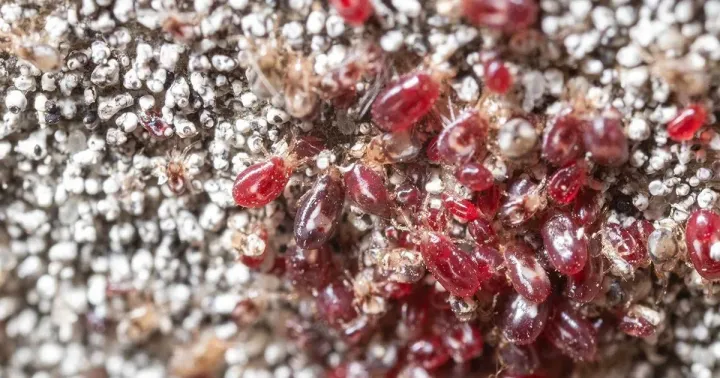
Androlaelaps casalis is a mite species belonging to the order Mesostigmata, family Laelapidae. It is a free-living gamasid mite often found in soil, organic debris, and bird nests.
Visually, the mite has an oval-shaped body with a brownish or yellowish hue, with adults measuring approximately 0.5–0.7 mm. The body surface is protected by a chitinized shield.
Although many members of this family are predators, A. casalis is capable of adapting to saprophagy and mycophagy, which allows it to thrive in various environments.
Reproduction occurs in the soil or substrate. Females lay eggs in sheltered areas, from which six-legged larvae hatch, quickly developing into eight-legged protonymphs.
The entire life cycle from egg to adult takes between 7 and 14 days under favorable temperatures (approx. 25°C), leading to a high rate of population growth.
What it damages
Significant damage occurs when population density is high in greenhouse conditions. The mites can damage young seedlings by feeding on plant tissues, which leads to stunted growth.
In agriculture, this species is often found in seedling containers, where it actively migrates to the root zone. Weakened plants become more susceptible to fungal infections.
Furthermore, Androlaelaps casalis acts as a vector for various phytopathogens, including fungal spores, which it carries on its body while moving across the substrate surface.
Agricultural reports indicate cases of root damage in vegetable crops and ornamental plants, particularly in conditions with high humidity and stagnant air.
While the mite is often considered a facultative pest, its mass presence in greenhouses requires immediate control to prevent the loss of marketable product quality.
When it appears
The mite's activity is directly dependent on the microclimate within the soil or greenhouse. Favorable conditions for development are most common during the spring and summer periods.
In heated greenhouses and nurseries, A. casalis can reproduce year-round, provided that humidity levels in the air and soil are maintained.
Population peaks often coincide with periods of heavy irrigation and the application of organic fertilizers, which serve as an additional food source for the mites.
During the autumn, the pest may migrate to deeper layers of the substrate to survive unfavorable low-temperature conditions.
The rapid generation time allows the pest to recover its population density quickly once temperature conditions stabilize in the spring.
Signs of infestation
Signs of infestation often go unnoticed in early stages, as these mites lead a predominantly hidden, soil-dwelling lifestyle.
The first indicator is slow wilting of seedlings without visible damage to the aerial parts, which is often misdiagnosed as root system issues.
When examining the root ball, one may notice microscopic, fast-moving mites that begin to actively burrow deeper into the substrate when exposed to light.
The presence of the mite is often accompanied by a specific dust-like residue on the soil surface, consisting of waste products and mite exuviae (cast skins).
- Yellowing of seedling leaf margins.
- Death of fine root hairs.
- Stunted development of young plants.
- Presence of powdery particles on the substrate.
Control measures
Managing Androlaelaps casalis requires a comprehensive approach, incorporating both chemical and cultural control methods.
The primary control method is thermal sterilization of the substrate before planting, as this effectively eliminates both eggs and adult mites.
The application of broad-spectrum acaricides via root zone drenching can significantly reduce population density in affected containers.
It is important to maintain optimal moisture levels, avoiding excessive waterlogging, which creates ideal conditions for mite reproduction.
The use of biological control agents, such as predatory phytoseiid mites, can also help regulate A. casalis populations in environmentally conscious operations.
Taxonomy
- Latin name
- Androlaelaps casalis
- Order
- Mites
- Family
- Laelapidae
- EPPO code
- ANDLCA
Discussion
No discussions yet — be the first.