
Trichius fasciatus
Trichius fasciatus
Description
How to identify
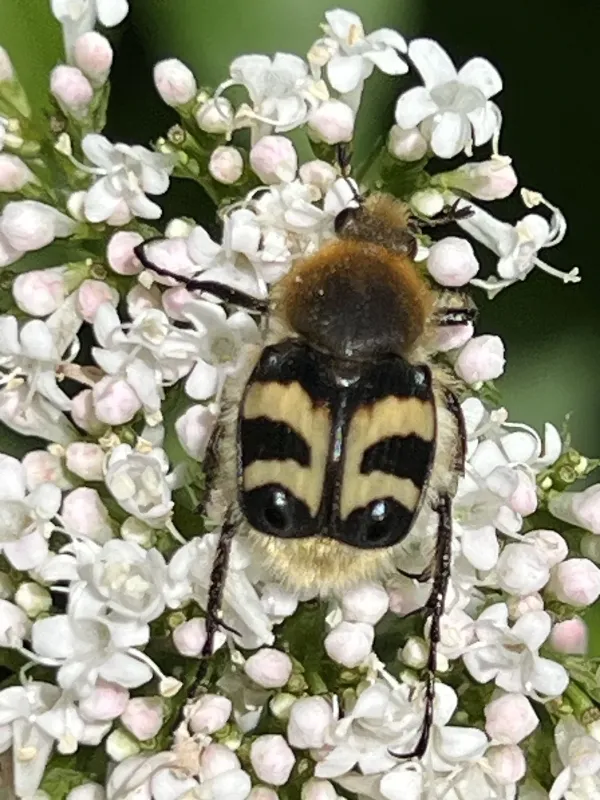
Trichius fasciatus, commonly known as the bee beetle, belongs to the family Scarabaeidae. It is a striking beetle that mimics the appearance of a bumblebee, featuring a dense covering of hair on its body.
The adult beetle typically measures between 10 and 15 mm in length. Its elytra are characterized by black transverse bands against a yellowish or white background, giving it a very distinctive, patterned look.
The larvae develop in rotting wood or decaying organic matter. They have a classic scarabaeid C-shaped body, appearing thick, white, or cream-colored with a distinct brown head capsule.
Adults are strong fliers and are most active on warm, sunny days. Their flight is accompanied by a buzzing sound, which, combined with their appearance, serves as an effective mimicry mechanism.
The life cycle typically spans two years. Most of this time is spent in the larval stage, feeding within logs or soil before reaching maturity and emerging as an adult beetle.
What it damages
The primary damage is caused by the adults, which feed on the floral parts of plants. They consume petals, stamens, and pistils, often destroying the entire flower bud in the process.
Fruit and berry crops, such as apples, pears, raspberries, and strawberries, are frequent targets. The beetle is also commonly found on various ornamental shrubs and wild flowers.
Because the beetles target the reproductive organs of the plants, their feeding prevents effective pollination and fruit set, leading to significant yield losses in commercial and private gardens.
When present in large numbers, these beetles can severely disfigure blossoms and leave plants without the capacity to develop fruit for the season.
The economic impact can be noticeable in fruit orchards located near woodland areas where the beetles have abundant breeding grounds in decaying wood.
When it appears
Adult beetles typically emerge in late spring, usually May, and their activity lasts through mid-summer. Their presence perfectly overlaps with the flowering period of many fruit crops.
They are most frequently sighted on sunny days when they actively fly between flowers to feed and mate. Their lifespan as adults is relatively short, focused entirely on reproduction.
After mating, females lay eggs in moist, decomposing woody material, including old stumps, fallen branches, or compost heaps, which provide the necessary nutrients for larval development.
Larvae develop throughout the summer and the following season. They are cold-hardy and remain in their substrate during winter, continuing their development when temperatures rise.
The duration of the pupal stage depends on ambient temperatures, with warmer springs typically resulting in earlier emergence of the next generation of beetles.
Control measures
The most effective long-term management strategy is cultural. This includes removing old stumps, logs, and decaying woody debris from the vicinity of fruit crops to eliminate breeding sites.
Chemical control is generally discouraged during the flowering season because it poses a high risk to bees and other essential pollinators. Biodiversity and ecological balance should be prioritized.
Manual collection of adults in the early morning is highly effective in small gardens. At this time, beetles are sluggish and can be easily collected from flowers and disposed of.
Protective netting can be used to cover particularly vulnerable plants during the peak flowering stage to prevent beetles from reaching the blooms.
- Sanitary maintenance of the orchard and surrounding areas.
- Avoidance of woodpiles near sensitive crops.
- Monitoring beetle presence using specialized lure traps.
- Encouraging natural predators such as birds and predatory insects.
Taxonomy
- Latin name
- Trichius fasciatus
- Order
- Coleoptera (beetles)
- Family
- Scarabaeidae
- EPPO code
- TRCIFA
Discussion
No discussions yet — be the first.