
Ash sawfly
Tomostethus nigritus
Description
How to identify
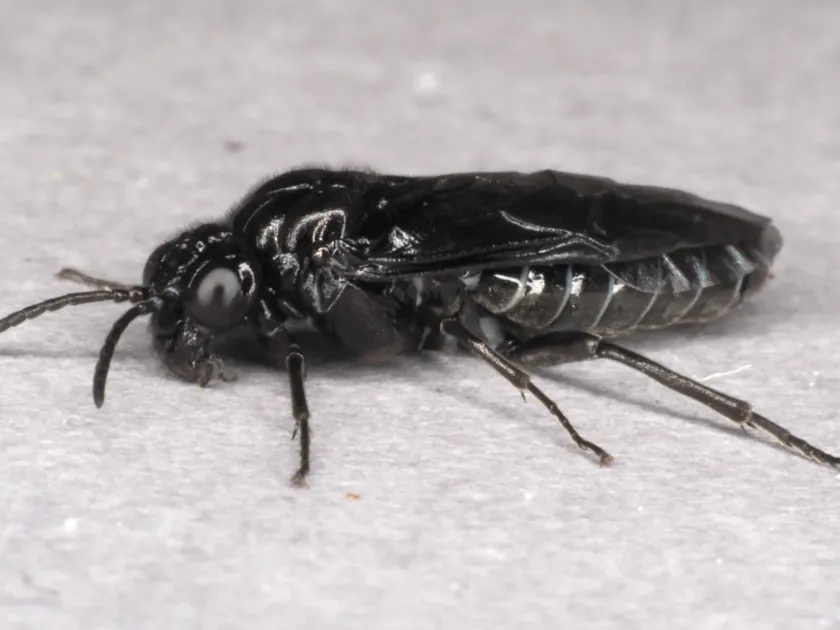
The Ash sawfly (Tomostethus nigritus) belongs to the order Hymenoptera and the family Tenthredinidae. Adult insects are small, black-colored wasps with transparent wings, measuring approximately 6–8 mm in length.
The larvae, often referred to as false caterpillars, are segmented. In their early larval stages, they appear light or yellowish-green, which allows them to blend in with the leaf surface of the ash tree.
As they grow and undergo several molts, the larvae become more robust and typically develop a deeper green coloration. Their dark heads serve as a key morphological feature for field identification.
The life cycle of this pest is synchronized with the phenology of the ash tree. Adults typically emerge in early spring, coinciding with the opening of ash buds and the appearance of fresh leaves.
Reproduction is sexual, and females lay their eggs directly into the leaf tissue. This species is univoltine, meaning it produces only one generation per year, overwintering as a pre-pupa in the soil.
What it damages
The primary host for Tomostethus nigritus is the common ash (Fraxinus excelsior). It is particularly detrimental to young plantations, shelterbelts, and urban ornamental plantings.
Damage is caused exclusively by the larval stage. Upon hatching, the larvae begin to feed, initially skeletonizing the leaves and eventually consuming the entire leaf blade, leaving only the veins intact.
During periods of high population density, these sawflies can cause nearly total defoliation of the tree crown by mid-summer, severely reducing the tree's photosynthetic capacity.
Constant, repetitive feeding by these pests weakens the tree's health, leading to decreased vigor and increased susceptibility to secondary infections and wood-boring insects.
In severe cases, the cumulative stress from defoliation can lead to dieback of branches, stunt tree growth, and significantly reduce the lifespan of the affected ash trees.
When it appears
Adults emerge from the soil in early spring, generally during April or early May, depending on regional temperature patterns and the rate of soil warming.
The flight period of the adults is relatively short, lasting about two to three weeks. During this time, females actively search for suitable foliage to lay their eggs.
Larval development occurs primarily during May and June. This is the period when the most significant damage to the tree's foliage is observed due to the larvae's high metabolic rate and food consumption.
Once feeding is complete, the larvae drop to the ground and burrow several centimeters into the soil to construct overwintering chambers.
The larvae spend the remainder of the summer, autumn, and winter in the soil in a state of diapause, awaiting the return of favorable environmental conditions in the following spring.
Signs of infestation
The first signs of infestation are tiny holes or "windows" appearing on young leaves, which expand as the larvae increase in size and consume more tissue.
Careful inspection of the undersides of leaves during the late spring often reveals the presence of larvae, which tend to congregate near the leaf veins while feeding.
The accumulation of frass (dark, granular excrement) on the leaf surface or on the ground beneath the tree serves as a clear indicator of active pest feeding.
Heavy defoliation, where the canopy appears thin or completely stripped of leaves long before autumn, is a hallmark of a major ash sawfly outbreak.
In high-density populations, one may hear the distinct sound of larvae feeding on the foliage, and the larvae may be observed dropping from the canopy when branches are disturbed.
Control measures
Cultural control methods include cultivating the soil around the base of the trees in autumn, which helps disturb or destroy the overwintering chambers, reducing the next year's population.
Biological control involves the use of environmentally friendly insecticides based on bacteria or fungi, which are effective against larvae while preserving beneficial predatory insects.
Chemical control is recommended when monitoring indicates that the larval population exceeds the economic threshold, typically utilizing systemic insecticides applied during the early larval stages.
Proper timing is essential for effective management; applications should target young larvae before significant foliage loss occurs and before they reach their final growth stages.
- Regular monitoring of tree health and early foliage inspections.
- Encouraging natural predators, such as birds and beneficial insects, in managed landscapes.
- Removing severely damaged or dying wood to improve overall tree vigor and resilience.
Taxonomy
- Latin name
- Tomostethus nigritus
- Order
- Hymenoptera
- Family
- Tenthredinidae
- EPPO code
- TOMONI
Discussion
No discussions yet — be the first.