
Hornbill
Tockus
Description
How to identify
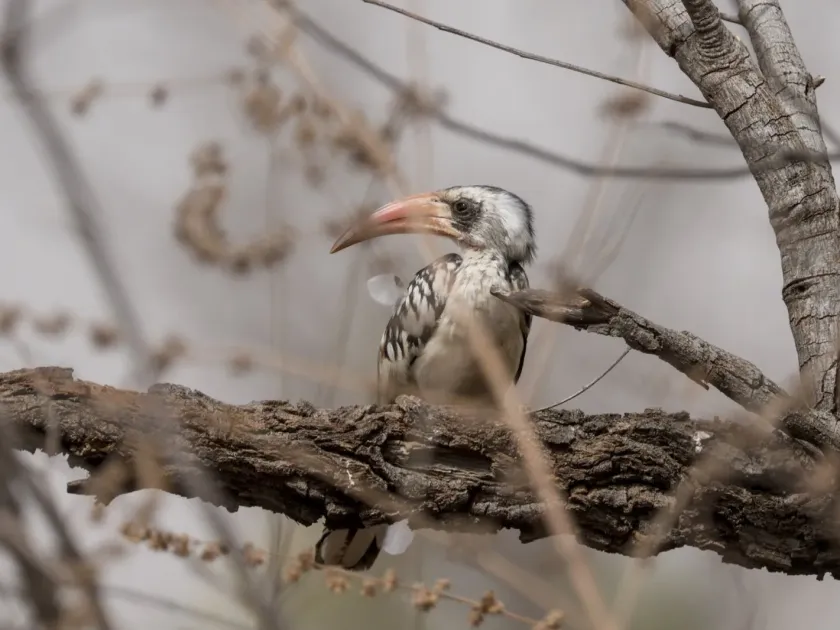
The Tockus genus, commonly known as hornbills, belongs to the Bucerotidae family. These birds are easily identified by their large, curved bills, which often feature a prominent casque or bony outgrowth.
Physically, they are medium-sized birds with distinctive plumage. In agricultural settings, they are known for being alert and highly adaptable to human-modified landscapes.
Taxonomically, they are classified under the order Bucerotiformes. Their ability to forage both on the ground and in trees allows them to exploit a wide range of agricultural resources.
They are social birds, often seen in pairs or small flocks. Their flight patterns and habit of nesting in nearby trees make them frequent visitors to adjacent farm fields.
Their beak structure is remarkably powerful, designed for crushing seeds and fruits, which makes them particularly efficient at consuming tough agricultural products like maize or sorghum.
What it damages
Hornbills primarily target cereal crops, including sorghum, millet, and maize. They are opportunistic feeders that capitalize on the high energy content of ripening grains.
The physical damage caused by their bills is significant. They can snap corn stalks and break off cobs, leading to heavy losses even before the grain is fully consumed.
Besides cereals, they may damage fruit and vegetable plantations. They often peck into juicy, fleshy fruits, rendering them unsuitable for market sale.
Damage is often cumulative, as flocks of hornbills can strip entire sections of a field of their grain content in a very short period of time.
They also contribute to the spread of weeds by transporting seeds in their digestive tracts and depositing them across cultivated fields during their feeding activity.
When it appears
The period of peak damage coincides with the milk and dough stages of grain development. During this time, the seeds are soft and highly accessible to the birds' beaks.
Seasonal migration patterns play a role, as birds may congregate near irrigation schemes during the dry season when natural food sources are scarce in the savanna.
Breeding cycles also dictate their activity levels, as the adults forage intensely to provide high-protein diets for their nestlings during the main growing season.
Once the crops are harvested and fields are cleared, the hornbills typically retreat to wilder areas, ending the period of agricultural conflict.
Early warning signs usually appear a few weeks before harvest, necessitating proactive monitoring to prevent significant economic losses to the farmer.
Signs of infestation
Clear evidence of their presence includes broken stalks, scattered debris, and partially consumed cobs or panicles left on the ground.
Visual inspection of the crop canopy often reveals missing kernels in the grain heads, with the outer husks or scales left intact but empty.
Droppings found in the inter-row spaces or on the leaves of plants are definitive indicators of bird roosting or feeding activity on the plot.
Their distinctive, loud vocalizations provide auditory confirmation of their arrival at the plantation, usually occurring at dawn or dusk.
- Snapped stalks and stems.
- Hollowed-out grain heads.
- Deep beak-mark indentations on fruit.
Control measures
Acoustic deterrents, such as the playback of distress calls or the use of propane cannons, are standard practices to discourage hornbills from landing in fields.
For high-value plots, physical exclusion using agricultural netting is the most reliable method to ensure that the harvest remains untouched by avian pests.
Visual scare tactics, like reflective tape or mock raptors, can be effective in the short term but usually require regular repositioning to avoid habituation.
Agricultural management should prioritize prompt harvesting as soon as the crop reaches maturity to minimize the exposure time for potential bird damage.
Manual patrols during the critical ripening stages, while labor-intensive, remain one of the most effective ways to manage bird pressure in large-scale farming.
Taxonomy
- Latin name
- Tockus
- Family
- Bucerotidae
- EPPO code
- TOCKSP
Discussion
No discussions yet — be the first.