
Great hornbill
Buceros bicornis
Description
How to identify
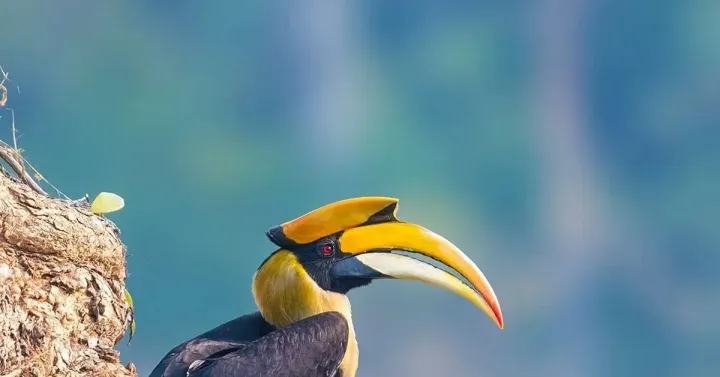
The great hornbill (Buceros bicornis) is a large bird species belonging to the Bucerotidae family within the order Bucerotiformes. It is easily identified by its massive body, black and white plumage, and a large, prominent yellow casque on its beak.
This species exhibits sexual dimorphism in terms of size, with males being larger, but both sexes possess the same distinctive pattern of coloration that allows them to blend into the forest canopy.
Biologically, the species is known for its high intelligence and social structure, often moving in small family groups or pairs across their habitat to search for food sources.
While often celebrated as a cultural icon, in agricultural areas located near tropical forests, it is considered a pest due to its habit of feeding on commercially grown fruits.
Their long lifespan and high survival rate in the wild make them a persistent challenge for farmers who need to balance environmental conservation with the protection of their crops.
What it damages
The primary damage caused by great hornbills in agricultural settings involves the destruction of fruit crops, including papayas, bananas, and other tropical tree fruits preferred by the birds.
Beyond the direct consumption of fruit flesh, the birds cause mechanical injury to tree branches. Due to their large size, they can break limbs, resulting in reduced long-term yield for the orchards.
The damage is often concentrated in high-yield patches, where a group of birds can quickly strip a tree of its ripening fruit, leading to significant economic losses for the producer.
Fruits punctured by the heavy bills of the hornbills are no longer marketable and are susceptible to secondary infections by pathogens, further worsening the harvest quality.
In certain regions, intensive feeding behavior during the peak fruiting season can threaten the viability of small-scale fruit farming operations.
When it appears
The peak activity of the great hornbill in orchards occurs during the fruiting season, when crops have reached the stage of optimal ripeness and sugar content.
The birds' feeding activity is particularly intense during their breeding season, as they require high-calorie food sources to support their growing offspring in the nests.
Great hornbills are diurnal birds, and their foraging activity is usually most intense during the early morning and late afternoon hours, coinciding with standard labor schedules.
During dry spells, when the natural forest food sources become scarce, the birds tend to shift their focus towards human-cultivated orchards for sustenance.
Consistent monitoring during the pre-harvest phase is essential to predict bird pressure and implement necessary repellent strategies before damage levels become critical.
Signs of infestation
The most obvious sign of an infestation is the presence of fallen, partially consumed fruits on the orchard floor, featuring deep, characteristic puncture marks from the birds' bills.
Loud, vocal calls and the sound of large wings flapping in the canopy are typical precursors to a hornbill feeding session on the property.
Damaged or snapped twigs in the upper canopy serve as evidence of the birds using branches as perches while feeding, which can be spotted during regular tree health assessments.
Fecal deposits under the trees, which often contain seeds from the fruit consumed, are a clear indicator that the specific section of the orchard has been targeted.
Visual confirmation of birds resting or foraging in the upper canopy is relatively straightforward given their large size and striking silhouette.
Control measures
Visual deterrents such as reflective tape, shiny wind-spinners, and realistic raptor models are effective at discouraging hornbills from settling in the orchard area.
Acoustic deterrents, which involve the playback of alarm calls or predatory bird sounds, are highly recommended for larger orchards to disturb the birds' sense of security.
Physical exclusion methods, such as installing netting over high-value trees, provide the most reliable protection against fruit loss during the sensitive ripening stage.
Proper harvest management, including the early collection of fruit at the start of technical maturity, significantly limits the time available for birds to access the produce.
- Installation of automated noise-based bird scaring systems.
- Maintenance of natural buffers to provide alternative forest food.
- Regular canopy pruning to reduce perching opportunities.
- Collaborative community monitoring to track flock movements.
Taxonomy
- Latin name
- Buceros bicornis
- Family
- Bucerotidae
- EPPO code
- BCERBI
Discussion
No discussions yet — be the first.