
Pine needle gall midge
Thecodiplosis brachyntera
Description
How to identify
The pine needle gall midge (Thecodiplosis brachyntera) is a tiny dipteran insect belonging to the Cecidomyiidae family. Adult midges are very small, fragile, and fly during the spring season.
The life cycle of this pest is highly specialized and synchronized with the growth of pine needles. The emergence of adults occurs exactly when the new needle buds are bursting.
Females lay their eggs in clusters at the base of developing needles. Once the larvae hatch, they crawl into the tight spaces between the needle pairs to feed.
The larvae are small, orange-colored creatures that remain hidden within the base of the needle, protected from external environmental factors and many predators.
After their development is complete, the larvae drop to the forest floor or soil to pupate. They remain in the soil as cocoons throughout the winter until the next spring.
What it damages
The primary host for this pest is the Scots pine (Pinus sylvestris), although other pine species can also be affected in forest plantations and landscape settings.
The damage is specific to the current year's needles. Because the larvae feed at the base, the needle development is stunted and the tissues become pathologically altered.
This feeding prevents the needles from growing to their full length, causing them to remain short, twisted, and brittle, which significantly affects the tree's photosynthesis.
In high-density nurseries or young plantations, this pest can cause substantial economic losses by reducing the quality and growth rate of young pine saplings.
Persistent attacks over several consecutive years can lead to severe weakening of the trees, making them susceptible to secondary pests like bark beetles.
Signs of infestation
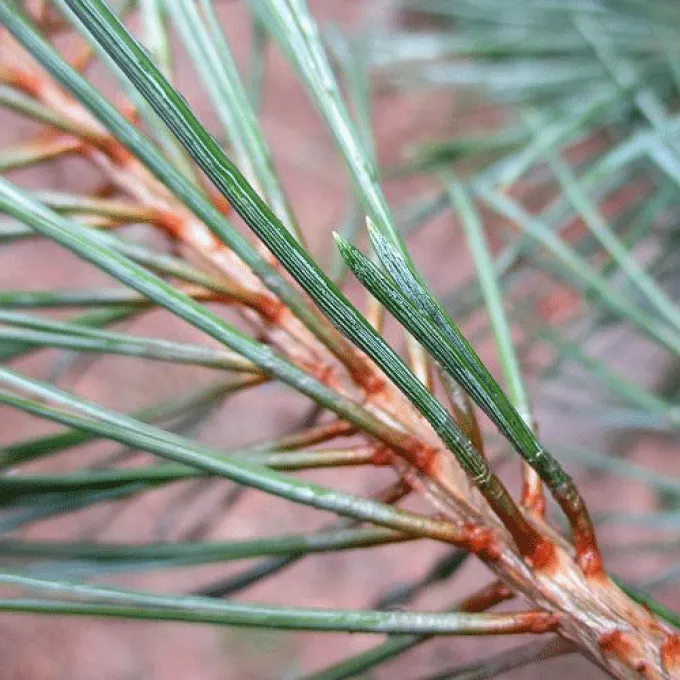
The most distinctive symptom is the swelling at the base of the needle fascicle, often called a gall. This swelling restricts the growth of the needles within the bundle.
The needles typically show clear signs of deformation: they are much shorter than normal, often bent or twisted, and may show yellowing or browning as the season progresses.
During mid-summer, heavily infested needles turn brown and drop prematurely. This results in the characteristic sparse appearance of the tree canopy.
If you examine the base of a discolored needle bundle, you will find a small, pouch-like cavity containing the larvae of the gall midge.
The overall appearance of the tree looks thinning, with significant loss of the new growth flush, making the branches look bare towards the tips.
Control measures
Management of the pine needle gall midge requires careful timing of insecticide application, specifically during the period when adult midges are laying eggs.
Systemic insecticides are the most effective way to reach the larvae hidden within the needle bases before the formation of the hardened gall tissue.
Sanitation is a vital control measure; collecting and destroying the fallen needles beneath the trees can eliminate the pupating larvae and reduce the next year's population.
Encouraging natural biological control agents, such as parasitoid wasps that hunt the midge larvae, is a key strategy in sustainable forest management.
- Use of pheromone traps to monitor adult flight patterns.
- Application of approved insecticides at the onset of bud break.
- Removal and burning of needle litter to disrupt the life cycle.
- Thinning plantations to reduce the density of host trees.
- Enhancing tree vigor through proper fertilization to recover from infestation.
Taxonomy
- Latin name
- Thecodiplosis brachyntera
- Order
- Diptera (flies)
- Family
- Cecidomyiidae
- EPPO code
- THEOBR
Discussion
No discussions yet — be the first.