
Black sawfly
Tenthredo atra
Description
How to identify
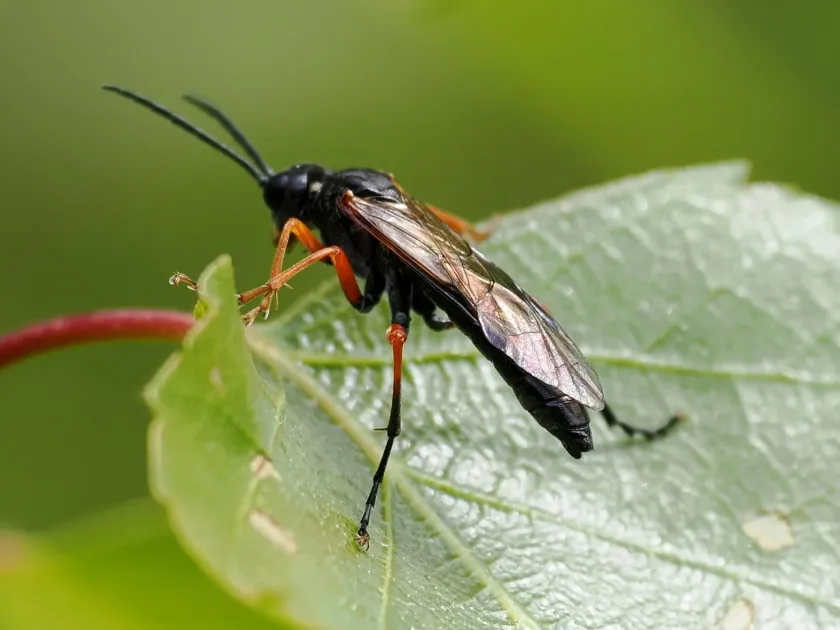
The black sawfly (Tenthredo atra) belongs to the order Hymenoptera, family Tenthredinidae. Adult insects reach 10–13 mm in length and are characterized by a glossy black body with light-colored markings on their legs.
The wings of the imago are transparent with a well-developed venation pattern typical of this family. The abdomen is elongated and cylindrical, which helps distinguish it from other Hymenoptera species.
The larvae, often called false caterpillars, have three pairs of thoracic legs and several pairs of abdominal prolegs. Their bodies are typically grayish-green or brownish, often with a dark dorsal stripe and fine wrinkles.
A key difference between sawfly larvae and true moth caterpillars is the number of prolegs: sawfly larvae usually have seven or more pairs, whereas true caterpillars have no more than five.
The biology of this species is closely tied to host vegetation, where adults feed on nectar and pollen, while larvae lead an open, foliage-consuming lifestyle on the leaves.
What it damages
The black sawfly is a polyphagous pest, damaging a wide range of herbaceous and woody plants. In agriculture, it causes significant damage to members of the Rosaceae and Asteraceae families.
Larvae primarily consume leaves, feeding from the edges or creating irregular holes in the leaf blade. In cases of high population density, they can completely defoliate a plant, leaving only the primary veins.
Damage results in reduced photosynthetic activity, leading to stunted plant growth, weakened immunity, and substantial yield losses in ornamental and fruit crops.
Young plantings and seedlings are particularly vulnerable, as massive infestations can lead to the death of the plant within a very short timeframe.
The damaged leaf surface also provides entry points for secondary infections, including fungal and bacterial pathogens, which further exacerbates the overall plant damage.
When it appears
The life cycle of the black sawfly is generally univoltine (one generation per year). The pest overwinters primarily in the pre-pupa stage, enclosed in dense cocoons buried 5–10 cm deep in the soil.
Adult emergence occurs in spring, synchronized with the onset of host plant growth. The flight period is extended, usually spanning from May to June, which is the time for mating and oviposition.
The female uses her ovipositor to make incisions in leaf or stem tissues, where she deposits her eggs. Embryonic development lasts between 7 and 14 days, depending on temperature conditions.
Larval development proceeds through 5-6 instars and lasts about a month. During this period, the larvae are most voracious and cause the most significant damage to crops.
By mid-summer, mature larvae descend into the soil to pupate, where they remain in diapause until the following spring.
Signs of infestation
The first sign of infestation is the appearance of characteristic ragged feeding marks along leaf edges. Unlike beetles, sawflies often start feeding from the margins and move toward the midrib.
Inspecting the underside of leaves or stems can reveal egg clutches hidden within plant tissues, or the larvae themselves, which curl into a spiral shape when threatened.
The presence of larval frass (excrement) on the leaf surface and beneath the plant is also a clear indicator of pest activity in the area.
Gradual drying of damaged leaves and overall deformation of vegetative organs suggest an advanced stage of infestation that requires immediate management action.
Observing adults visiting flowers of host plants during the blooming period can serve as a warning of upcoming oviposition and the resulting larval population.
Control measures
Cultural control measures include deep autumn tilling of soil around base areas and between rows, which helps destroy overwintering cocoons by mechanical disturbance and exposure to predators.
Regular monitoring of plants and manual removal of larvae are effective during the early stages of infestation in smaller gardens. Pruning and removing infested plant parts helps contain the spread.
Biological control using entomopathogenic fungi or bacterial agents (such as bio-insecticides based on Bacillus thuringiensis) provides an effective way to manage larvae without harming beneficial insects.
In cases of major outbreaks, use of contact-stomach insecticides registered for the specific crop is recommended, ensuring strict adherence to pre-harvest intervals.
Encouraging natural predators such as predatory bugs, spiders, and parasitic wasps on the property is a vital component of integrated pest management to ensure long-term population control.
Taxonomy
- Latin name
- Tenthredo atra
- Order
- Hymenoptera
- Family
- Tenthredinidae
- EPPO code
- TENTAT
Discussion
No discussions yet — be the first.