
Common sawfly
Tenthredo
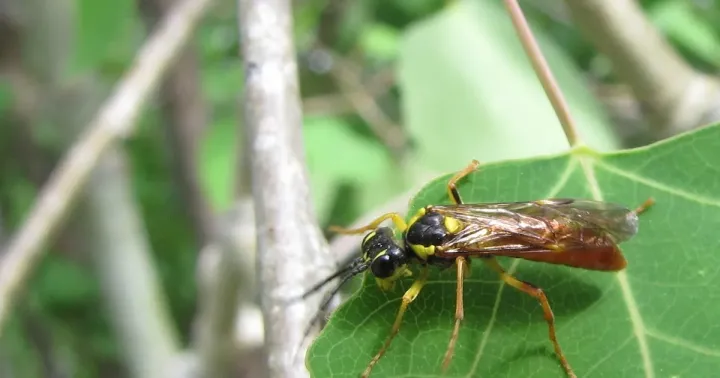
Description
How to identify
The common sawfly belongs to the order Hymenoptera, family Tenthredinidae. Despite being related to wasps and bees, they lack the distinct narrow waist, as their abdomen is broadly joined to the thorax.
Adults are often brightly colored with yellow, orange, or black bands. They have two pairs of transparent wings with well-defined veins, which they use for active flight during the sunny periods of the day.
The larvae, often called false caterpillars, are the primary damaging stage. They can be distinguished from butterfly caterpillars by having six or more pairs of prolegs on their abdomen.
The head of the larva is sclerotized and dark, featuring strong mandibles for chewing plant tissue. Their body surface may be smooth or covered with fine hairs, serving as a defense mechanism.
The name "sawfly" comes from the female's specialized ovipositor, which is serrated like a saw. This allows them to cut into plant tissue to deposit eggs safely inside leaves or stems.
What it damages
Sawflies are notorious pests that attack a wide variety of ornamental plants, fruit trees, and vegetables. Their damage can range from minor cosmetic issues to total defoliation of the plant.
Larvae are extremely voracious. In the early stages, they cause "windowpane" damage by eating the leaf tissue while leaving the epidermis intact, before eventually skeletonizing the leaf completely.
Heavy infestations can lead to significant stress for the host plant. The loss of foliage reduces the plant's ability to photosynthesize, which can cause stunted growth or failure to produce fruit.
Certain species are specialized in damaging buds and developing fruit. By boring into the fruit, larvae destroy the internal structure, often causing premature fruit drop and complete yield loss.
In ornamental gardens, the aesthetic impact is severe. Rose bushes and other flowering shrubs can be stripped of their leaves in a matter of days if the population is not monitored.
When it appears
Adult sawflies typically emerge in early spring, coinciding with the first flush of leaf growth and blossoming of fruit trees. They thrive in mild, warm temperatures.
The mating and egg-laying period usually lasts for several weeks. During this time, females fly from plant to plant, carefully selecting spots to insert their eggs into fresh green tissue.
Larval development occurs during the spring and early summer months. Depending on the latitude and species, there may be one or several generations produced within a single growing season.
Overwintering occurs in the pupal stage. Most species spend the winter inside a protective cocoon buried in the soil or hidden within leaf litter, where they remain dormant until the following spring.
This life cycle is highly adaptive, allowing the pest to survive harsh winters and synchronize its emergence with the availability of fresh food sources for their offspring.
Signs of infestation
The most recognizable sign is the presence of irregular holes in leaves. As the larvae grow, these holes expand until only the primary veins of the leaf remain.
Closely inspecting the undersides of leaves will often reveal rows of tiny, yellowish eggs inserted into the leaf tissue, sometimes causing small swellings or discoloration.
When disturbed, sawfly larvae often exhibit a characteristic defensive behavior, such as curling into an S-shape or dropping from the leaf to the ground.
Accumulations of frass, which appears as small dark pellets, can often be found on the leaves below the feeding larvae or on the ground surface underneath the infested plants.
Curled or deformed leaves and the presence of premature buds falling off the plant are strong indicators of an active sawfly infestation that requires immediate attention.
Control measures
Cultural control is very effective for sawflies. Tilling the soil around the base of trees and shrubs in autumn disrupts the pupal cells and exposes them to predators and freezing temperatures.
For smaller infestations, handpicking larvae is a practical solution. Because they are gregarious in early stages, you can remove large groups by pruning off the infested leaf or twig.
Biological control agents, such as Neem oil or insecticidal soaps, can be used to treat early-stage larvae without causing significant harm to beneficial insects and pollinators.
In cases of severe outbreaks, systemic or contact insecticides may be necessary. Always check the label to ensure safety for specific plants and follow local regulations regarding harvest intervals.
- Perform regular scouting to detect larvae before they cause widespread damage.
- Encourage natural predators like ladybugs, lacewings, and predatory wasps.
- Maintain plant health with proper irrigation and fertilization to help them withstand minor feeding.
Taxonomy
- Latin name
- Tenthredo
- Order
- Hymenoptera
- Family
- Tenthredinidae
- EPPO code
- TENTSP
Discussion
No discussions yet — be the first.