
Temnoscheila virescens
Temnoscheila virescens
Description
How to identify
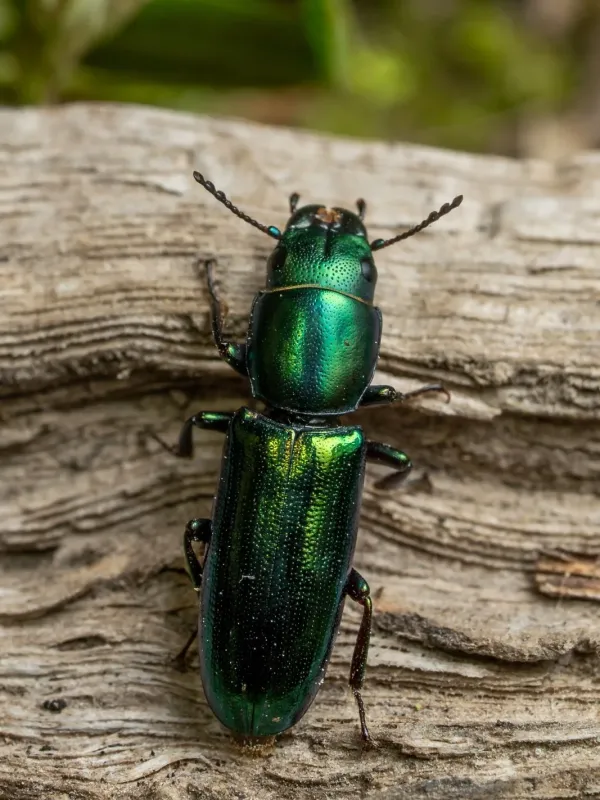
Temnoscheila virescens belongs to the family Trogossitidae, within the order Coleoptera. This beetle is characterized by its distinct metallic green or bluish-green sheen and a flattened, elongated body shape, which is perfectly adapted for life under tree bark.
The adults are equipped with strong mouthparts, serving as effective tools for their predatory lifestyle. The larvae also possess an elongated morphology with functional thoracic legs, allowing them to navigate through wood tunnels and bark crevices with ease.
The life cycle of this species is intrinsically linked to weakened or dying coniferous and deciduous trees. Adults are most active during warm weather and are frequently found in areas where other bark-dwelling insects are present.
Biologically, this species is primarily known as a predator of other insects. However, in high population densities, it can be found in association with secondary tree pests, acting as a potential indicator of a larger forest health issue.
To identify this pest, one must inspect the trunk of the tree for characteristic holes in the bark. Spotting an adult beetle with its metallic luster under loose bark or in exit holes is the most reliable diagnostic sign for foresters.
What it damages
Temnoscheila virescens primarily affects coniferous trees, such as pines and spruces, as well as some broadleaf species like oaks. It thrives in environments where the tree's defensive systems are already compromised.
While the beetle itself is a predator of other insects, its presence is often tied to tree mortality caused by bark beetles and wood borers. It inhabits the tunnels created by these primary pests, often extending or widening them.
Economic damage occurs when infested trees become hotspots for secondary pest colonization. This can lead to the overall decline of tree stands, causing significant loss of timber quality and potential hazards in commercial forest operations.
In orchards located near woodlands, these beetles may occasionally migrate to young saplings. Although they are not primary orchard pests, their burrowing activity can create entry points for secondary pathogens and other wood-damaging insects.
The primary concern regarding this species is its role as a biological marker for unhealthy tree stands. Controlling its population is often part of a broader strategy to maintain forest sanitation and prevent large-scale pest outbreaks.
When it appears
Adult activity typically begins in late spring, usually May, as temperatures rise. During this phase, the beetles emerge from their overwintering sites to search for hosts, prey, and suitable locations for mating and oviposition.
The mating and egg-laying period spans the summer months. This is the peak time when adults are most visible on the surface of bark, as they actively patrol the tree trunks in search of prey or favorable sites for their larvae.
Larval development occurs throughout the summer, driven by the warm ambient temperatures which accelerate their metabolic rate. Larvae remain active underneath the bark, constantly preparing their tunnels for the upcoming pupation stage.
By autumn, the majority of the population enters the pupal stage, followed by the emergence of new adults that seek secure locations for the winter. Overwintering occurs in bark crevices, leaf litter, or deep within old galleries in the wood.
The annual population dynamics are highly dependent on regional weather patterns. Extended periods of cool or wet weather may reduce the activity of adults, whereas hot, dry summers promote faster generation cycles for this beetle species.
Signs of infestation
The most immediate sign of an infestation is the presence of small, round exit holes on the tree trunk. These holes indicate that beetles have been actively boring into or emerging from the tree's outer layer.
Peeling back small sections of dead or dying bark often reveals the presence of galleries or the insects themselves. The metallic sheen of the adults makes them relatively easy to spot if they are present under the bark surface.
The accumulation of fine sawdust or "frass" at the base of the tree is a strong indicator of boring activity. This signifies that insects are actively feeding or tunneling inside the wood and requires immediate further inspection.
Crown dieback or the premature browning of needles/leaves is a common symptom associated with the presence of Trogossitidae insects. This indicates that the tree's vascular system has been compromised by insect activity.
On conifers, the exudation of resin—often appearing as sticky patches on the bark—is a classic tree defense mechanism. These "resin funnels" form when the tree attempts to push out invaders, marking the sites of beetle penetration.
Control measures
Sanitation logging remains the primary method of control. Removing infested, weakened, or dead trees eliminates the breeding ground for the pest and stops the cycle of colonization within the forest stand.
Regular forest health monitoring using pheromone traps can help detect infestations in their early stages. Early detection is crucial for implementing targeted control measures before the population reaches epidemic levels.
Chemical control is generally reserved for high-value ornamental trees or urban park settings. In commercial forestry, the focus remains on silvicultural practices that maintain tree vigor and resistance to colonization.
Proper forest management, including maintaining soil health and providing adequate water for orchards or ornamental plantations, enhances natural tree resilience against wood-boring insects.
- Removal and disposal of logging debris.
- Promotion of natural predatory bird habitats.
- Application of biological insecticides in high-risk areas.
- Maintaining species diversity to limit the spread of host-specific pests.
Taxonomy
- Latin name
- Temnoscheila virescens
- Order
- Coleoptera (beetles)
- Family
- Trogossitidae
- EPPO code
- TEMNVI
Discussion
No discussions yet — be the first.