
Great bark beetle
Peltis grossa
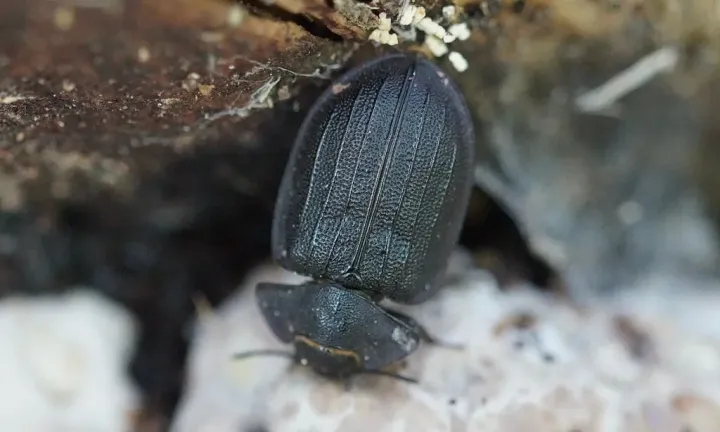
Description
How to identify
Peltis grossa is a notable member of the family Trogossitidae, known for its distinct flat, shield-like body shape that helps it inhabit narrow spaces under tree bark.
Adult beetles usually measure between 12 and 18 millimeters in length and have a robust appearance with a dark brown or blackish color.
The pronotum is particularly wide and often covers the head, a common morphological trait for many species in this taxonomic group.
Larvae of this species are elongated and possess strong mandibles adapted for mining and feeding on decaying wood tissues.
This beetle is typically found in old-growth forests, where large amounts of deadwood provide a suitable habitat for all stages of its lifecycle.
What it damages
The primary diet of Peltis grossa consists of dead or dying wood, which places it in the category of saproxylic insects rather than primary pests.
It does not pose a threat to healthy, growing crops or living trees, as it lacks the physiological drive to attack living tissue.
The economic impact of this beetle is negligible, as its activity is concentrated on wood that has already lost its structural and commercial value.
In forest ecosystems, this species acts as a beneficial recycler, speeding up the breakdown of woody debris and returning nutrients to the soil.
Occasionally, large infestations may be found in stockpiled timber if the wood is stored in moist conditions for an extended period.
When it appears
The activity of adult beetles typically increases during the warmer months, as they emerge from overwintering sites to mate and find hosts.
These insects are primarily nocturnal, making them difficult to observe during the daytime hours when they remain hidden beneath tree bark.
The developmental cycle of the beetle is long, with larvae often spending multiple years within the wood before pupating into adults.
Hibernation occurs during the cold season, with individuals finding shelter deep within wood cracks or beneath the bark of decaying logs.
Warm, stable weather conditions during spring and early summer are critical for the successful survival and spread of the beetle population.
Signs of infestation
The presence of Peltis grossa is usually indicated by the observation of larval galleries found beneath the bark of dead or fallen trees.
Accumulation of coarse, woody frass found in the crevices of bark is a common indicator of active larval feeding in the underlying wood.
Exit holes, which are typically small and oval-shaped, can often be seen on the surfaces of logs that have been colonized by the larvae.
The decay process of the wood is visibly accelerated in areas where larvae have been actively mining for a prolonged period.
Adults may occasionally be spotted on the surface of colonized logs at night, particularly during the peak of the mating season.
Control measures
Control measures for Peltis grossa are generally not necessary, as it is considered an ecologically beneficial forest insect.
Forest management practices, such as removing excess slash and fallen timber, are usually sufficient to prevent overpopulation of saproxylic beetles.
Proper storage of cut logs, keeping them dry and well-ventilated, prevents the infestation of timber products by wood-boring species.
There is no need for chemical intervention in natural forest environments, as this would disrupt the balance of wood-decomposing communities.
Focusing on the general health and sanitation of timber stands is the most effective way to manage the presence of these beetles in forestry.
Taxonomy
- Latin name
- Peltis grossa
- Order
- Coleoptera (beetles)
- Family
- Trogossitidae
- EPPO code
- PETSGR
Discussion
No discussions yet — be the first.