
Temnoscheila japonica
Temnoscheila japonica
Description
How to identify
Temnoscheila japonica is a species of beetle belonging to the family Trogossitidae, often referred to as the cadelle family. These insects are characterized by their flattened body shape and relatively large size, which allows them to thrive under bark.
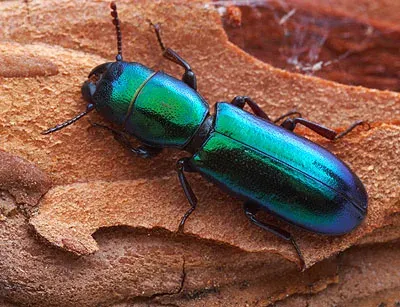
The adult beetles typically exhibit a metallic appearance, displaying deep blue, green, or coppery shades, which is a distinctive morphological trait for the species.
The larval stage is elongated with a robust head and strong mandibles designed for navigating and feeding within the dense tissues beneath the bark of trees.
Systematically, the species is part of the order Coleoptera, and its body structure is highly specialized for a subcortical lifestyle in coniferous forest environments.
The life cycle follows complete metamorphosis, progressing through egg, larval, pupal, and adult stages, with each phase tailored to the tree's internal environment.
What it damages
This species is primarily associated with coniferous trees, including species of Pinus and Picea, which are often stressed by environmental factors or primary infestations.
Temnoscheila japonica is recognized as an entomophagous predator, consuming bark beetles and other wood-boring pests that threaten tree health.
While the beetle itself is beneficial in controlling pest populations, the larvae can inadvertently damage the cambium layer when foraging for their prey.
Damage typically manifests as extensive tunnels beneath the bark, which can weaken the tree's transport systems if the population density becomes excessively high.
The dual nature of its role—as a predator and a minor wood-borer—makes it a significant subject for forest protection research and ecological management.
When it appears
The active season for adult Temnoscheila japonica begins in early spring, following the emergence from overwintering sites as temperatures rise.
Spring and early summer are critical periods for mating and searching for suitable host trees, often identified by the presence of bark beetle infestations.
Larval development occurs throughout the summer months, a period that coincides with the peak life cycle stages of their primary prey.
Pupation usually takes place in late summer or early autumn, after which the new generation of adults is formed before entering a dormant phase.
Overwintering occurs at the adult stage, with the beetles finding refuge in bark crevices, the duff layer, or abandoned beetle galleries until the following year.
Signs of infestation
The presence of Temnoscheila japonica is often indicated by exit holes in the bark, which can be distinguished from those of primary bark beetles by their unique dimensions.
Removing a portion of the bark often reveals the larvae or adults, as well as the remnants of their prey, which is a definitive sign of their activity.
Frass, or wood dust mixed with fecal pellets, is often found in the tunnels, signaling that the insect is actively feeding within the wood structure.
Signs of tree decline, such as yellowing needles or resin flow, often draw both the primary pests and their predators, including Temnoscheila japonica, to the area.
Visual identification of the metallic sheen of the adult beetle on the bark surface is a reliable indicator of its presence in infested stands.
Control measures
Management of this beetle is rarely focused on eradication, as it serves as a natural biological control agent for more destructive bark beetle populations.
- Maintain forest health through regular sanitary cuttings to remove heavily infested trees.
- Avoid leaving logging debris that can attract primary bark pests, which in turn attract predators.
- Monitor the forest for bark beetle population surges, as these often predict the presence of Temnoscheila japonica.
- Preserve diverse forest structures to sustain natural predator populations that provide ecosystem services.
- Implement integrated pest management (IPM) practices to prevent excessive outbreaks of wood-boring insects.
Taxonomy
- Latin name
- Temnoscheila japonica
- Order
- Coleoptera (beetles)
- Family
- Trogossitidae
- EPPO code
- TEMNJA
Discussion
No discussions yet — be the first.