
Dock sawfly
Taxonus glabratus
Description
How to identify
The dock sawfly (Taxonus glabratus) belongs to the order Hymenoptera and the family Tenthredinidae. Adult insects are characterized by a dark body and a wingspan of approximately 10-15 mm.
The larvae, known as false caterpillars, are yellowish-green with a darker head. They are highly active and demonstrate a unique defensive behavior by curling into a spiral when disturbed.
The life cycle involves complete metamorphosis. Depending on climatic conditions, the insect can produce several generations during a single growing season.
Overwintering occurs as mature larvae inside cocoons, typically located within the soil or in debris near host plants, providing protection against environmental stress.
Taxonomically, they are distinct from lepidopteran caterpillars due to the number of prolegs, a key feature for precise identification by professionals.
What it damages
The primary host plant for this species is sorrel (Rumex species). Infestations can significantly impact the quality of the green harvest.
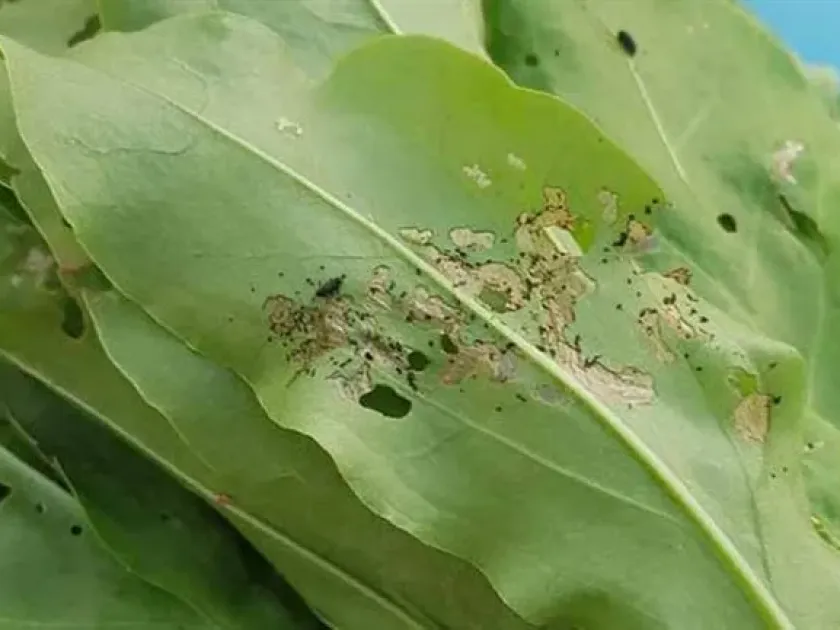
The larvae are voracious feeders that consume the leaf tissue, often leaving only the midribs and lateral veins, a process known as skeletonization.
Heavy feeding pressure leads to severe yield losses, as the damaged leaves become unsuitable for consumption or market sales due to their tattered appearance.
Continuous defoliation stresses the plant, reducing its photosynthetic capacity and hindering the development of the root system, which is crucial for perennial survival.
In cases of unchecked outbreaks, the entire crop may be decimated, leading to stunted growth and potentially plant mortality during the peak season.
When it appears
The emergence of adult sawflies usually occurs in late spring, coinciding with the fresh flush of sorrel foliage.
Females deposit eggs individually into the leaf tissue. This cryptic oviposition makes it difficult to detect early-stage infestations without careful inspection.
Larval activity peaks in early summer. Given the multiple generations per year, the risk remains present from May through August in many temperate regions.
Monitoring for larvae should be performed regularly, as their rapid development means that thresholds for intervention can be reached within just a few days.
Weather patterns significantly influence population dynamics, with warm and dry summers typically favoring higher survival rates for younger instars.
Signs of infestation
The first indicator of an infestation is the appearance of small, irregular holes or 'windows' within the leaf blades.
The presence of fine, dark granular frass on the leaves is a definitive sign that the sawfly larvae are actively feeding on the plant.
By inspecting the underside of the foliage, gardeners can locate the larvae, which typically rest along the veins when they are not actively consuming tissue.
Gradual yellowing and the lace-like appearance of the leaves indicate severe damage that requires immediate action to protect the remaining crop.
- Holes and thinning of leaf tissue.
- Skeletonized leaf structure.
- Presence of larvae on the leaf undersides.
Control measures
Cultural control methods, such as deep cultivation of the soil, can effectively disrupt the overwintering pupae and reduce the next year's population.
Sanitation is key; removing related wild weeds in the vicinity helps eliminate alternative host plants and reduces the breeding grounds for the sawfly.
Biological control, using specific entomopathogenic agents or encouraging natural predators like parasitic wasps, provides a sustainable management approach.
Chemical intervention should be considered a last resort. If insecticides are necessary, selecting products with short harvest intervals is essential for edible crops.
For small-scale gardeners, hand-picking the larvae in the early morning is highly effective, as it prevents chemical usage on plants intended for direct consumption.
Taxonomy
- Latin name
- Taxonus glabratus
- Order
- Hymenoptera
- Family
- Tenthredinidae
- EPPO code
- TAXOGL
Discussion
No discussions yet — be the first.