
Common sawfly
Taxonus agrorum
Description
How to identify
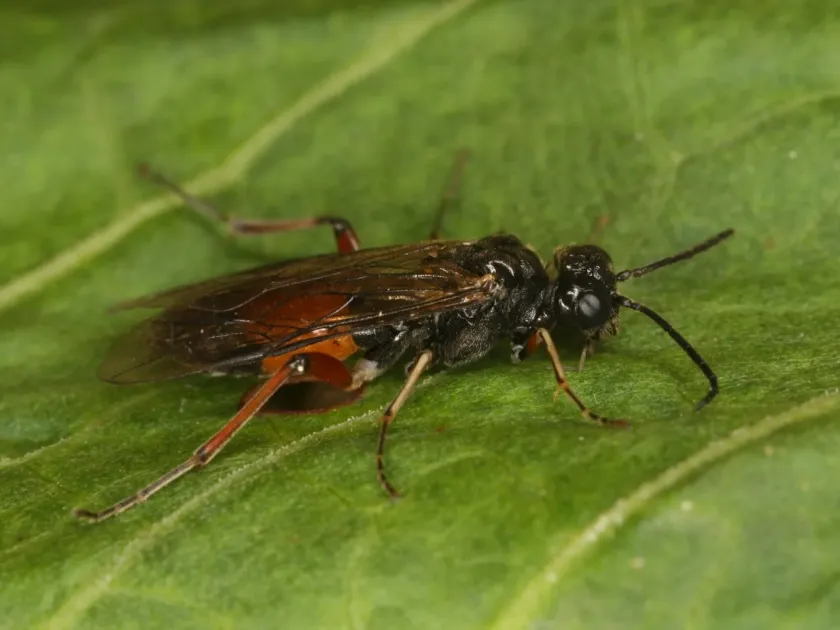
The common sawfly (scientific name Taxonus agrorum) is a member of the Hymenoptera order, specifically the Tenthredinidae family. Adults are small, wasp-like insects that are often overlooked due to their size and coloration, which allows them to blend in with their environment.
The larval stage, often referred to as a false caterpillar, is the most recognizable phase of the insect. These larvae have a distinct head capsule and several pairs of legs, which differentiates them from true butterfly caterpillars that have different leg arrangements.
The species follows a complete metamorphosis life cycle including egg, larva, pupa, and adult stages. They typically overwinter as pupae within cocoons hidden in the soil or among organic debris, which provides them protection against fluctuating winter temperatures.
Adults emerge during late spring and early summer, where they feed on nectar and pollen. During this time, the females use their serrated ovipositor to insert eggs into the leaf tissue of host plants, marking the beginning of a new infestation cycle.
Correct identification often requires examining the larval characteristics, such as the number of abdominal segments and specific behavioral traits like how they react when disturbed, which can help in distinguishing Taxonus agrorum from other leaf-feeding insects.
What it damages
The larvae are specialized herbivores that feed primarily on the leaves of specific host plants. Their feeding behavior often leads to severe skeletonization, where the soft tissue of the leaf is consumed while the tougher veins remain intact.
Heavy infestations can significantly reduce the photosynthetic capacity of the plant. By consuming large portions of the foliage, the larvae deprive the plant of the energy needed for growth, flower development, and fruit or seed production.
In addition to direct consumption, the feeding process can weaken the plant's overall vigor, making it more susceptible to secondary environmental stresses or diseases that could further compromise the yield and survival of the crop.
Young plants or nursery stock are particularly vulnerable to sawfly damage. Because they have a limited amount of foliage, even moderate feeding pressure can lead to severe stunting or, in extreme cases, the total death of the young plant.
Effective management requires understanding the timing of larval development, as damage is often concentrated in waves corresponding to the hatching of larvae after the eggs have been deposited by the adult sawflies.
Signs of infestation
One of the earliest signs of a common sawfly presence is the appearance of small, irregular holes or notches in the leaves. As the larvae grow larger, these holes expand and connect, resulting in the characteristic skeletonized appearance.
Another indicator is the presence of frass (larval excrement) on the leaves or on the ground beneath the plant. The accumulation of these dark, granular droppings is a clear signal that larvae are actively feeding nearby.
When disturbed, the larvae often exhibit a defense mechanism where they curl their bodies or drop from the leaf to the ground. Observing this reaction is a reliable way to confirm the presence of the sawfly and distinguish it from other herbivores.
Foliage that turns yellow and drops prematurely is another sign of significant infestation. This happens because the heavy loss of leaf surface area triggers a stress response in the plant, causing it to discard damaged leaves.
Look for egg-laying sites where the female has made tiny slits in the leaf tissue. While these are small, they can sometimes cause slight deformation or necrosis of the leaf, providing an early warning of a developing population.
Control measures
Managing the common sawfly involves a strategy that combines monitoring, physical removal, and the judicious use of pest control agents to maintain the population below the economic threshold.
- Tilling the soil around plants in late autumn to disrupt the pupation sites and expose larvae to predators.
- Removing and disposing of infested plant debris to eliminate overwintering cocoons from the garden or field.
- Promoting biodiversity by planting flowers that attract parasitic wasps, which are natural enemies of sawfly larvae.
- Hand-picking larvae from leaves in small-scale gardens during the early stages of infestation.
- Applying targeted insecticides only when necessary and during times when they are least likely to impact beneficial pollinators.
Biological control using specific entomopathogenic fungi or bacteria can be a sustainable alternative to chemical sprays, provided that application timing aligns with the most vulnerable larval stages.
Regular monitoring using pheromone traps or sticky boards can provide crucial data on adult activity, allowing growers to time their control efforts precisely to prevent a widespread outbreak of the pest.
Taxonomy
- Latin name
- Taxonus agrorum
- Order
- Hymenoptera
- Family
- Tenthredinidae
- EPPO code
- TAXOAG
Discussion
No discussions yet — be the first.