
Apple fruit weevil
Tatianaerhynchites aequatus
Description
How to identify
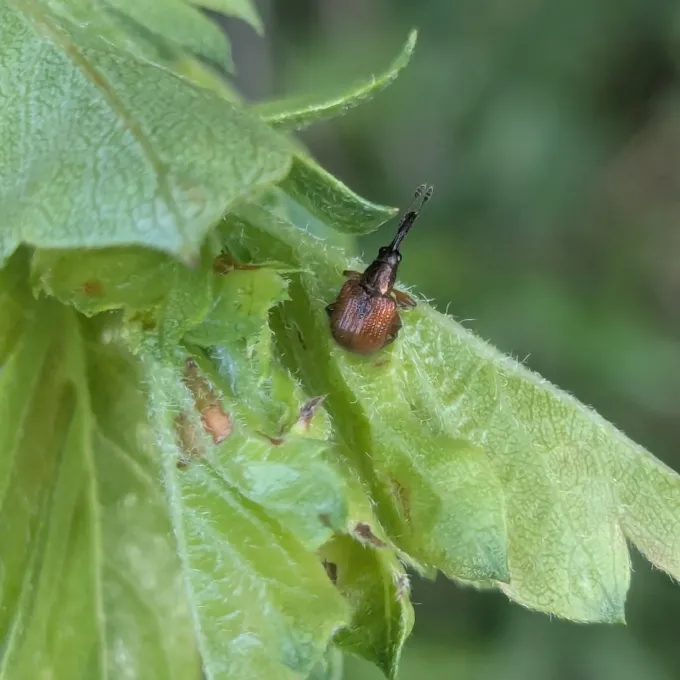
The apple fruit weevil (Tatianaerhynchites aequatus) belongs to the Attelabidae family. It is a small beetle measuring 4–6 mm in length, known for its distinct metallic purple or copper sheen.
The head of the beetle extends into a characteristic snout, which is typical for the Curculionoidea superfamily. The body is covered with sparse hairs, giving it a somewhat matte appearance under close inspection.
The larva is legless, cream-colored, and curved in shape, with a light brown head capsule. It spends its entire growth period inside the fruit, which protects it from most environmental factors.
Pupation occurs in the soil at a depth of up to 15 cm. The pupa is yellowish-white and possesses visible limbs, transitioning into an adult form after several weeks in the earth.
Adult weevils are highly active during warm days. When disturbed, they typically exhibit thanatosis, dropping from branches to the ground to blend in with soil or foliage.
What it damages
The damage is caused by both adults and larvae. The apple fruit weevil primarily targets pome fruits like apples and pears, as well as stone fruits such as cherries, plums, and apricots.
In early spring, adults feed on swelling buds, boring holes that cause the buds to wither and die before they can bloom. This significantly reduces the potential fruit yield.
During the fruit-setting stage, females pierce young fruits to deposit eggs. They also chew the fruit stems, which often leads to the premature dropping of the affected fruit.
Larvae develop inside the fruit, feeding on the flesh. This creates irregular tunnels that fill with waste, promoting the rapid development of rot and fungal diseases within the fruit.
Economic damage is severe when the weevil population is high, as a large percentage of the crop may be lost to premature fruit drop and decay caused by larval infestation.
When it appears
Adults emerge from their overwintering sites in the soil during early spring, when temperatures reach approximately 8–10 degrees Celsius, coinciding with bud burst.
The peak feeding period for adults occurs during the pre-flowering and flowering stages of the trees. This is the critical window for monitoring and management actions.
Egg-laying takes place from late spring through early summer as fruits begin to develop. Warmer, stable weather conditions favor the rapid progression of this life cycle.
Larvae feed within the fruit for about 3–4 weeks. Once fully developed, they exit the fallen fruit and burrow into the ground to prepare for pupation.
The species typically overwinters as an adult within the soil or protected crevices. Some individuals may remain in the soil for a full year before emerging as adults.
Signs of infestation
The first signs of infestation are small puncture wounds on buds, which eventually turn brown and shrivel. These damaged buds often fail to open entirely.
Prematurely dropped fruit is a primary indicator of an infestation. These fruits often have small, dark punctures on their surface where the female inserted her ovipositor.
Cutting open a fallen fruit usually reveals an internal cavity and a small, white, curved larva. The tissue around these tunnels is typically decayed and dark.
Damaged stems often show clear marks of feeding, resulting in a loss of sap flow to the fruit, which causes the fruit to shrivel even while still attached.
- Brown punctures on young fruit.
- Premature fruit drop in early summer.
- Dried or shriveled buds in spring.
Control measures
Effective management begins with the systematic collection and disposal of all fallen fruit. This removes the larvae from the orchard before they can re-enter the soil.
Tilling the soil under the tree canopy in late autumn or early spring can physically destroy overwintering adults and pupae, reducing the next generation's population.
In small gardens, shaking branches over a sheet in the cool morning hours is an effective way to collect and destroy the adults manually.
Insecticide treatments should be applied strictly before and immediately after flowering. Target the adults during their active feeding period to prevent egg-laying.
Integrated pest management also involves encouraging predatory insects and birds, which can naturally regulate weevil numbers and reduce the reliance on chemical control.
Taxonomy
- Latin name
- Tatianaerhynchites aequatus
- Order
- Coleoptera (beetles)
- Family
- Attelabidae
- EPPO code
- COENAQ
Discussion
No discussions yet — be the first.