
South American tapir
Tapirus terrestris
Description
How to identify
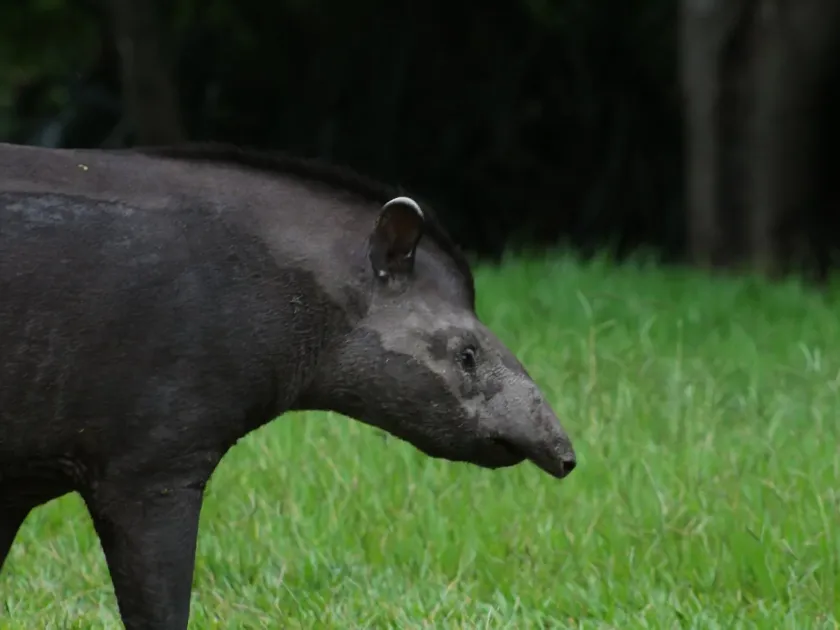
The South American tapir (Tapirus terrestris) belongs to the order Perissodactyla, family Tapiridae. It is a large mammal weighing up to 250 kg, characterized by a flexible proboscis and a robust body structure.
These animals are primarily nocturnal or crepuscular, making them difficult to spot on agricultural lands during daylight hours. They rely on their acute sense of smell and hearing to avoid detection.
The reproduction rate of the tapir is very slow; females give birth to a single calf after a gestation period of about 13 months. Although their population density is generally low, their localized presence near forest edges can significantly impact farming.
Tapirs are physically recognizable by their short, dark brown coat and a mane extending from the head to the shoulders. Their limbs are adapted for traversing soft, swampy soils as well as dense forest terrain.
From an agronomic perspective, the South American tapir is considered a non-traditional pest that utilizes agricultural fields as a supplemental feeding ground, especially when natural food sources are scarce.
What it damages
Tapirs are strictly herbivorous and pose a threat to various crops, particularly sugarcane, maize, and beans. They favor succulent plant parts and young shoots, which are often found on commercial farms.
Physical damage is caused not only by ingestion but also by trampling. When tapirs move through a field, their heavy hooves compact the soil and crush plants, leading to reduced overall crop yield.
In orchards and plantations, tapirs are known to strip the bark off young saplings. This stripping behavior exposes the tree's inner tissues, often leading to the death of the young plant due to nutrient blockages.
Nocturnal raids on vegetable patches can lead to significant crop loss in a short period. Tapirs eat both the foliage and the fruits, frequently ruining the quality of produce intended for the market.
The economic impact is aggravated by the disruption of the field structure, which makes it challenging for farmers to perform automated harvesting operations on the damaged areas.
Signs of infestation
The primary sign of tapir presence is their large, distinct hoof prints. These tracks feature a characteristic three-toed shape, with front prints being noticeably larger than the rear ones.
Damaged corn or sugarcane stalks often appear broken or flattened. The bite marks left on the vegetation have jagged edges due to the animal's strong incisors designed for cutting through fibrous plant tissues.
Farmers can often identify well-trodden paths along the borders of forests and fields. These trails are used repeatedly by the animals as they move from their habitat to the agricultural areas.
Fecal samples are a reliable indicator for identification; they are large, fibrous, and often contain undigested seeds, confirming the presence of a large herbivore in the field.
Occasional whistling sounds, typically heard at night near the forest edge, are vocalizations made by tapirs that signal their proximity to the crops.
Control measures
The most effective method for controlling tapir activity is the installation of robust fencing. High, sturdy wire mesh or reinforced barriers are often required to prevent these powerful animals from entering the fields.
Electric fencing, or "electric shepherds," can be highly effective if maintained correctly. It provides a deterrent that keeps tapirs away without causing permanent injury, though it requires regular monitoring.
Buffer zones, where crops are not planted immediately adjacent to the forest, can reduce the frequency of visits. Motion-activated lights and sound emitters can also serve as temporary deterrents during high-risk seasons.
Effective farm management practices, such as clearing crop residues promptly after harvest, minimize the attractiveness of the field to wildlife during the off-season.
- Installing heavy-duty perimeter fencing.
- Utilizing motion-activated deterrent systems.
- Maintaining cleared buffer zones near forested areas.
Taxonomy
- Latin name
- Tapirus terrestris
- Family
- Tapiridae
- EPPO code
- TPIRTE
Discussion
No discussions yet — be the first.