
Malayan tapir
Tapirus indicus
Description
How to identify
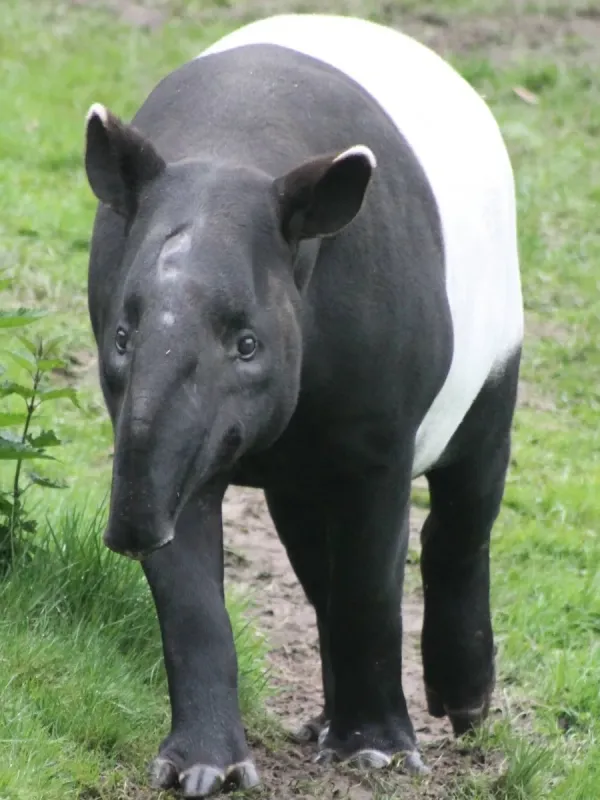
The Malayan tapir (Tapirus indicus) belongs to the order Perissodactyla, family Tapiridae. It is a large mammal, weighing up to 300 kg, easily identified by its distinctive black and white pattern and a flexible, prehensile snout.
This species is predominantly nocturnal, which makes monitoring their presence in agricultural areas challenging. They prefer humid tropical forests but may venture into adjacent farmland when food sources are limited.
The biology of the species involves a slow reproductive cycle. Tapirs are solitary animals with excellent hearing and sense of smell, allowing them to locate food efficiently within dense undergrowth.
Although they are a rare and protected species, in an agronomic context, adults may cause localized damage to young plantations, which requires consideration when planning agricultural management strategies.
The appearance of an adult is massive with short legs. It is important to distinguish tapir tracks from those of other ungulates; they have three toes on the hind feet and four on the front, creating a unique footprint in the soil.
What it damages
The main crops susceptible to damage include young shrub shoots, fruit tree saplings, and certain technical crops cultivated near forest borders.
Tapirs feed on leaves, twigs, and young shoots. When natural food is scarce, they may browse the lower branches of cultivated plants, leading to crown deformation and reduced plant productivity.
The greatest damage occurs in the buffer zones of farms bordering jungle areas. Animals are not prone to mass destruction of crops, but their selective browsing can be critical for nurseries and young seedlings.
Root damage is rare, but during movement on soft soil, animals may trample small areas of crops, compacting the soil and disrupting the structure of the topsoil layer.
The level of damage is generally considered low to moderate. Economic losses are typically associated with the cost of replacing damaged saplings rather than total crop failure.
When it appears
Tapir activity is not tied to strict seasonal cycles; however, during dry periods, their movements can become more predictable due to the search for water and succulent food.
During periods of active shoot growth (the beginning of the rainy season), the risk of visiting agricultural land increases as animals are attracted to the tender vegetative mass of crops.
Nocturnal behavior means that damage is usually detected by agronomists in the morning hours. Monitoring should be reinforced when crops are most sensitive to physical stress.
The development cycle is long, with sexual maturity reached at 3–4 years, so population growth is slow, allowing for long-term risk assessment.
Assessing migration depends on the condition of the natural food base in the forest. If fruit is scarce, tapirs are more likely to migrate toward plantations.
Signs of infestation
The first sign of presence is footprints on moist soil along the field perimeter. The specific shape of the print helps identify the presence of a tapir rather than other wildlife.
A characteristic sign of browsing is the ragged edges of leaves and branches up to one meter high. Tapirs use their snout to grasp vegetation, leaving distinctive tooth marks on the wood.
The presence of feces near damaged crops is direct evidence of activity. Droppings are large and contain fibers of undigested plant material.
Well-trodden paths from the forest into the farm territory indicate regular visits. These "trails" may be used by the animals for long periods.
Occasionally, one may notice rubbing marks on young trunks or bark damage caused by the animal's attempts to reach the softer inner layers of the plant.
Control measures
Given the conservation status of the species, physical extermination is illegal and unethical, so the focus remains on humane deterrent methods.
Installing sturdy fencing around the perimeter is the most effective way to prevent access. The height of the fence must be sufficient to deter an adult tapir from entering.
The use of motion-activated light and noise deterrents helps prevent night-time visits, as tapirs have keen hearing and are naturally timid creatures.
Applying scent-based repellents can reduce the interest of tapirs in specific crops, although this method requires frequent renewal of the protective layer.
Creating buffer zones planted with less valuable vegetation between the forest and the main crops can help distract the tapirs, providing a safety barrier for the most expensive saplings.
Taxonomy
- Latin name
- Tapirus indicus
- Family
- Tapiridae
- EPPO code
- TPIRIN
Discussion
No discussions yet — be the first.