
Cedar wood wasp
Syntexis libocedrii
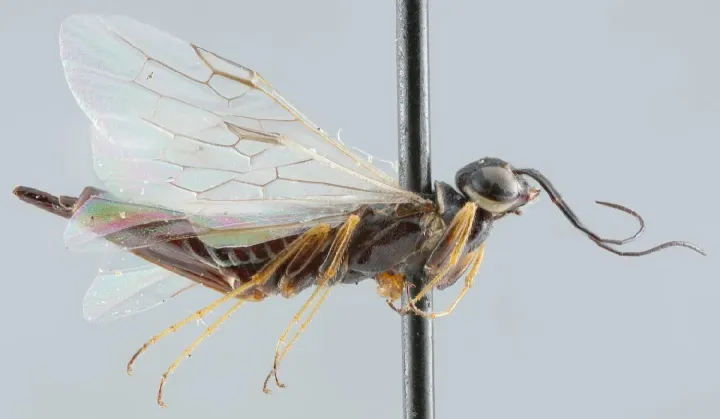
Description
How to identify
The cedar wood wasp (Syntexis libocedrii) is a unique insect belonging to the family Anaxyelidae within the order Hymenoptera. Unlike many other wood-boring insects, this species occupies a specific ecological niche associated with stressed conifer species.
The adult insect is generally dark-colored and modest in size, making it easily overlooked in a dense forest or nursery setting. The female is equipped with a specialized ovipositor designed for laying eggs deep into the wood of host trees.
The larvae are legless, whitish grubs that spend their entire development period inside the woody tissues of the tree. They tunnel longitudinally, creating intricate galleries that disrupt the tree's internal transport mechanisms.
The life cycle of this wasp is notably complex and often tied to the physiological stress of the host plant. They are primarily attracted to trees weakened by drought, fire, or other mechanical damages, which makes them indicators of forest health.
This species is found in regions where its specific host trees, such as incense cedar and related Cupressaceae species, are prevalent, reflecting a high degree of host specialization.
What it damages
This pest primarily attacks members of the cypress family, including cedars, junipers, and arborvitae. It poses a significant challenge both in forestry and in ornamental landscape management where high-value trees are planted.
The larvae cause structural damage by boring into the heartwood and sapwood. This boring activity physically severs the vascular system, preventing the efficient distribution of water and nutrients throughout the canopy of the tree.
Severe infestations lead to the decline and eventual death of the tree. In commercial forestry, this results in significant financial losses due to the degradation of timber quality, while in gardens, it destroys the aesthetic value of the planting.
Young trees are particularly vulnerable, as their smaller trunks mean that even a few larval galleries can girdle the stem, leading to the rapid death of the top section or the entire plant.
Additionally, the holes made by the wasps can serve as entry points for secondary fungal infections and other opportunistic pathogens, further weakening the tree's natural defenses.
Signs of infestation
The presence of Syntexis libocedrii is often first indicated by the exudation of resin or pitch from the bark. This is the tree's defensive response to the larva entering the wood and creates visible streaks on the trunk.
Accumulation of fine, powdery wood dust, often called frass, at the base of the tree or in branch axils is a clear diagnostic feature of active larval boring occurring deep inside the wood.
Foliar symptoms include a gradual yellowing or browning of the needles, which occurs as a result of the vascular damage caused by the internal galleries. This process can be slow, sometimes taking several seasons to become fully apparent.
On closer inspection, one may find small, circular exit holes on the surface of the bark, which indicate that adult wasps have already emerged and are ready to reproduce for the next cycle.
Professional identification often involves checking the trunk for sunken areas or bark necrosis, which are associated with the initial site of egg-laying or larval entry points.
Control measures
Effective management begins with rigorous monitoring of tree health. Removing and disposing of heavily infested or dead trees is essential to reduce the population density and prevent further spread to healthy neighbors.
Promoting tree vigor through proper irrigation, fertilization, and site management can increase the tree's natural resistance, making it less attractive to wood wasps looking for a vulnerable host.
Chemical control via contact insecticides can be applied during the adult flight period to prevent egg-laying, although this strategy requires careful timing and monitoring of local weather conditions.
Biological control options involve encouraging natural predators or parasitic wasps that might naturally suppress populations of wood-boring larvae in the ecosystem.
- Sanitary removal of infested and dying trees.
- Maintaining optimal soil moisture and site conditions.
- Targeted insecticide applications during the adult flight phase.
- Regular visual inspections for signs of frass and pitch.
- Monitoring using attractant or sticky traps in high-value areas.
Taxonomy
- Latin name
- Syntexis libocedrii
- Order
- Hymenoptera
- Family
- Anaxyelidae
- EPPO code
- SYNXLI
Discussion
No discussions yet — be the first.