
Wood wasp
Syntexis
Description
How to identify
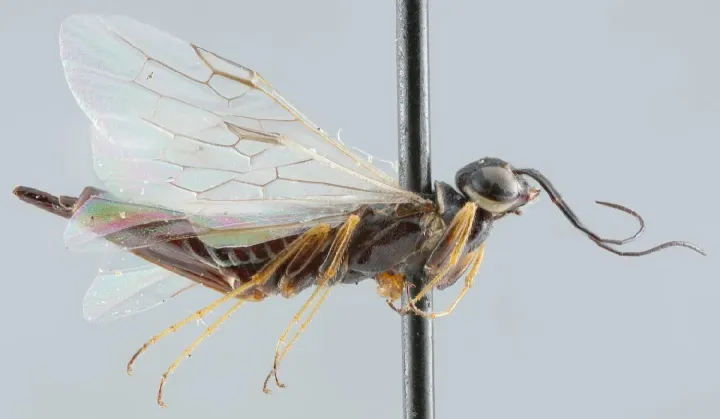
The wood wasp (Syntexis libocedrii) belongs to the Anaxyelidae family of the Hymenoptera order. It is a specialized insect, distinct from common horntails due to its unique biological requirements and size.
The adult insect typically ranges from 8 to 15 mm in length. Its body is primarily black, often with a subtle metallic sheen, and it possesses transparent wings that are highly functional for maneuvering through dense coniferous foliage.
The larvae are white, cylindrical in shape, and feature a robust head capsule designed for boring into wood. They are well-adapted to survive within the specific environment of the host tree's timber.
This species is highly specific, favoring stressed or dying conifer species, which makes it a crucial subject in the study of forest pathology and ecosystem health.
Unlike some wood-boring pests, Syntexis libocedrii is relatively rare, yet it can become a significant nuisance in nurseries and landscapes where its preferred host plants are cultivated.
What it damages
The wood wasp primarily attacks members of the Cupressaceae family, including Thuja, Juniperus, and Calocedrus, which are widely used in ornamental gardening.
Larvae bore deep galleries within the wood, which disrupts the tree's vascular system, preventing the transport of essential water and nutrients to the branches.
Visible damage includes localized dieback, yellowing needles, and eventually the death of infected limbs. In severe cases of infestation, the structural integrity of the plant is compromised.
Damage by wood wasps often serves as an entry point for secondary pathogens, including various wood-rotting fungi, which further accelerate the decline of the plant.
In ornamental landscaping, the presence of these insects ruins the aesthetic value of valuable specimens, making them unsuitable for public spaces or sale.
When it appears
Adult emergence typically occurs in the late spring or early summer, synchronized with favorable temperature conditions that allow for efficient mating and egg-laying.
Females seek out suitable hosts, often targeting trees with existing bark damage or drought stress, to deposit their eggs into the sapwood layer.
The larval development cycle is quite long, with the insects spending most of the autumn and winter protected inside the galleries they have constructed within the wood.
Pupation occurs in early spring, and once the adult wasp completes its development, it bores a clean, round hole in the bark to exit the tree and begin the next generation.
Environmental factors, such as unusually warm springs, can accelerate the life cycle, potentially leading to increased population density in favorable habitats.
Signs of infestation
The most reliable sign of a wood wasp infestation is the presence of perfectly round, small exit holes scattered across the bark of the trunk or larger branches.
Frass, which resembles fine sawdust, is often seen accumulating at the base of the tree or within bark crevices, indicating active larval boring inside the timber.
Unexplained branch dieback that does not respond to watering or fertilization is a strong indicator of internal structural damage caused by boring larvae.
Careful inspection of the trunk may reveal tiny, slit-like scars where the female wood wasp has used her ovipositor to insert eggs into the tree's vascular tissues.
Increased woodpecker activity on coniferous trees can serve as a biological indicator, as these birds often target the larvae living within the wood.
Control measures
- Prioritize the removal and destruction of heavily infested or dead trees to eliminate breeding sites.
- Maintain tree vigor through proper irrigation and balanced fertilization to help plants resist initial colonization.
- Use systemic insecticides applied during the peak flight season to protect healthy trees in high-risk areas.
- Seal mechanical wounds on bark with specialized wound dressings to prevent adult females from accessing the sapwood for egg-laying.
- Implement regular monitoring programs in nurseries to catch infestations early, before larvae penetrate deep into the woody tissues.
Taxonomy
- Latin name
- Syntexis
- Order
- Hymenoptera
- Family
- Anaxyelidae
- EPPO code
- SYNXSP
Discussion
No discussions yet — be the first.