
Window gnat
Sylvicola fenestralis
Description
How to identify
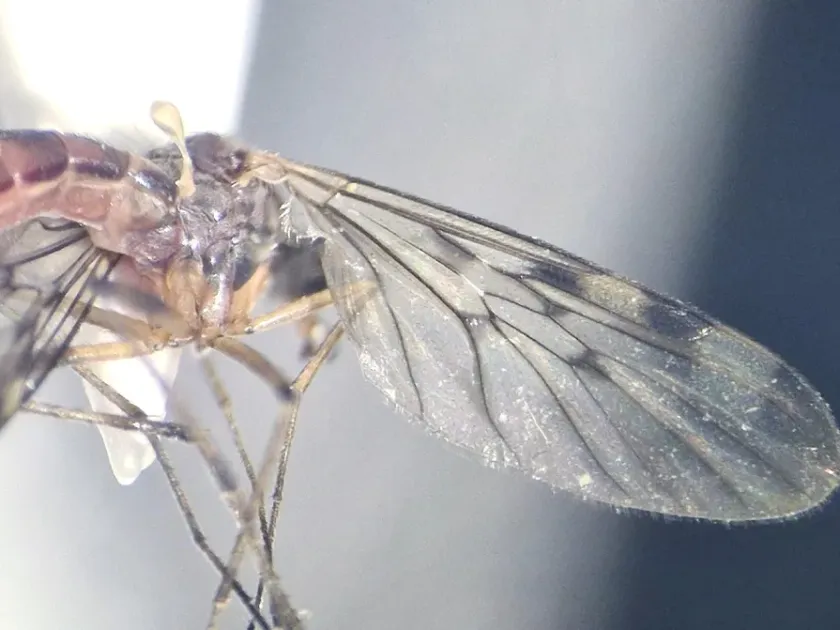
The window gnat, Sylvicola fenestralis, belongs to the family Anisopodidae within the order Diptera. Adult specimens are typically 5 to 8 mm long and exhibit distinctive dark markings on their transparent wings.
The body coloration ranges from brownish-grey to yellowish. A critical taxonomic feature for identification is the arrangement of the eyes: in males, they are contiguous, whereas in females, they are separated by the frons.
The larvae are cylindrical, pale in color, and primarily thrive in decaying organic matter or moist soil. They undergo several molting stages before reaching the pupal phase in protected environments.
While often found in forests, this species has successfully adapted to anthropogenic environments such as greenhouses, cellars, and warehouses, where consistent moisture levels support their population growth.
The name is derived from their common behavior of gathering on windowpanes of greenhouses or sheds, which serves as a primary visual indicator for farmers monitoring pest levels.
What it damages
The primary damage is caused by larvae, which feed on decaying tissues. In agricultural settings, they can attack the root systems of weakened seedlings, especially when the soil is overly moist.
In greenhouses, window gnats can affect vegetable crops such as tomatoes and cucumbers, leading to stunted growth. Their presence is often a secondary issue following improper irrigation or poor drainage.
In open fields, damage is localized to damp areas with high levels of humus. Larval feeding on roots becomes significant when the plants are already stressed by other environmental factors or pathogens.
Tubers and bulbs are susceptible to damage if stored in damp conditions with poor ventilation, as the decaying surfaces provide a perfect breeding ground and food source for the larvae.
Beyond direct damage, the gnats can act as mechanical vectors for fungal spores, facilitating the spread of root rot diseases, which further compromises the overall plant health.
When it appears
Adult gnats become active in early spring as soon as temperatures in greenhouses or sheltered areas reach approximately 10–12 degrees Celsius, signaling the start of their reproduction cycle.
The peak population density occurs during the warm, humid months, when optimal conditions allow for rapid generation turnover and high survival rates of the larvae in the soil.
As autumn approaches, the gnats seek shelter in heated buildings, storage facilities, or basements to escape cold weather, continuing their lifecycle in these stable microclimates.
The species typically overwinters in the larval or pupal stage buried within rich soil or organic debris, which provides necessary insulation against harsh winter temperatures.
The number of generations per year is largely dependent on management practices; consistent moisture and lack of hygiene in greenhouses can result in nearly continuous breeding cycles.
Signs of infestation
The most noticeable sign of infestation is the mass aggregation of adult gnats on greenhouse windows, which typically coincides with the presence of larvae in the growing medium.
Inspecting the top layer of the potting soil often reveals the presence of small, pale larvae, especially in areas where irrigation has been excessive or where organic fertilizers are decomposing.
Sudden wilting of seedlings, despite adequate water availability, is a strong indicator of root system damage caused by larvae feeding on the delicate root hairs of young plants.
The development of rot lesions at the base of the plant stem, occurring simultaneously with a visible presence of adult gnats, indicates an active infestation requiring immediate attention.
Discoloration or yellowing of leaves in young plants often suggests that the root system is impaired, preventing the proper uptake of nutrients and water from the soil.
Control measures
Effective management begins with strict irrigation control. Avoiding waterlogged soil and ensuring proper drainage makes the environment significantly less hospitable for larvae development.
Sanitation is paramount; farmers must regularly remove decaying plant matter, fallen leaves, and other organic debris that provide food and breeding sites for the gnats.
Utilizing sterilized, high-quality growing media for seedling production prevents the introduction of larvae into the production system, reducing the need for chemical intervention.
Yellow sticky traps are highly effective for monitoring and reducing adult populations, helping to break the reproductive cycle by capturing adults before they can lay eggs in the soil.
- Improving greenhouse ventilation to lower humidity levels.
- Regular cultivation and stirring of the topsoil to promote drying.
- Application of biological control agents like entomopathogenic nematodes to target larvae in the soil.
Taxonomy
- Latin name
- Sylvicola fenestralis
- Order
- Diptera (flies)
- Family
- Anisopodidae
- EPPO code
- PHRNFE
Discussion
No discussions yet — be the first.