
Window fly
Anisopus
Description
How to identify
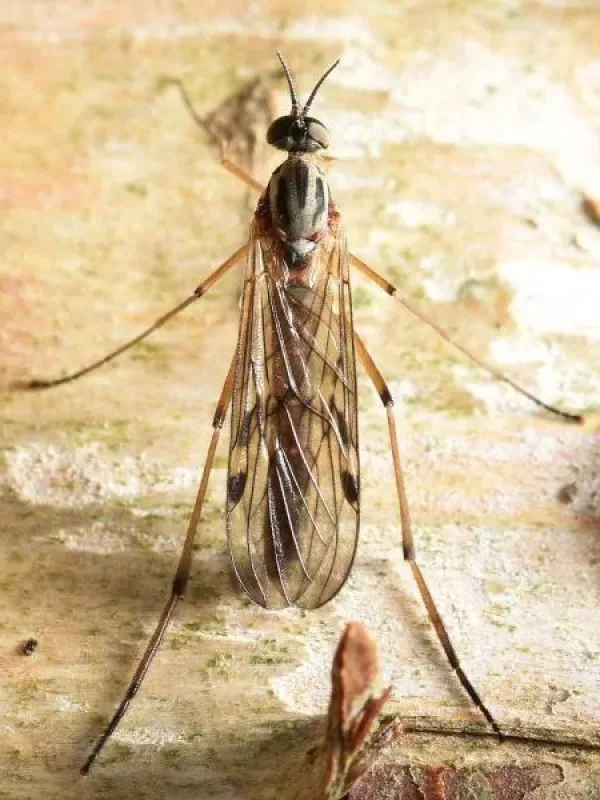
The window fly, scientifically known as Anisopus fenestralis, belongs to the family Anisopodidae within the order Diptera. It is frequently observed resting on window panes, which is the origin of its common name.
Adult flies resemble small house flies or gnats, featuring spotted wings and slender bodies approximately 5–7 mm in length. Their coloration is typically grayish-brown, aiding camouflage on tree bark or soil surfaces.
The larvae are legless, worm-like, and appear dirty white or yellowish in color, growing up to 10 mm. They possess specialized mouthparts adapted for feeding on decaying organic matter.
The life cycle includes egg, larva, pupa, and adult stages. While adults feed on nectar and plant secretions, the larvae are the life stage that poses a potential risk to crops.
This species is a cosmopolitan pest found near agricultural sites, compost piles, and greenhouses, where high humidity levels are maintained.
What it damages
Although window fly larvae are primarily saprophagous, they can damage living plant tissues when agricultural practices are poor. They are particularly troublesome for vegetable crops in greenhouses.
Onions, root vegetables, and seedlings are most susceptible, especially if incompletely composted manure or other raw organic matter is incorporated into the soil.
Damaged plants become highly vulnerable to secondary infections, such as fungal and bacterial rots, which spread rapidly through the tunnels created by the larvae.
The pest's impact increases in greenhouses where moisture levels are poorly managed and soil aeration is insufficient, creating a perfect breeding ground.
Affected crops often include:
- Onions and garlic
- Carrots and parsnips
- Cabbage and tomato seedlings
- Stored potato tubers
When it appears
Adult activity begins in early spring as soon as temperatures rise. They colonize areas with high concentrations of organic matter to lay their eggs.
The most favorable period for larval development is during a wet spring and early summer, when organic decomposition is at its peak in the soil.
Depending on local climatic conditions, several generations can develop throughout the season, necessitating ongoing vigilance and management.
As autumn approaches, adult numbers decline, though pupae can successfully overwinter in the soil or within agricultural storage facilities.
In temperature-controlled greenhouses, the development of the window fly can occur year-round, posing a constant threat to seedlings and transplants.
Signs of infestation
The primary indication of an infestation is the presence of adult flies on greenhouse glass or in storage sheds, signaling an active breeding population nearby.
Stunted growth and yellowing foliage in young plants are common indicators, resulting from larval feeding on roots or the plant collar.
Inspection of root vegetables or onions may reveal excavated lesions, which often begin to rot and produce a foul odor due to secondary decay.
In seedlings, damage often manifests as chewed stems at the soil surface, leading to wilting and sudden plant collapse.
In the soil substrate, one can often find numerous small, active larvae concentrated in areas with high levels of decomposing organic matter.
Control measures
The most important protective measure is strict adherence to good agricultural practices. Only fully composted organic fertilizers should be used to avoid attracting these flies.
Effective soil drainage in greenhouses is crucial to prevent waterlogging, which helps suppress larval survival and limits population growth.
Deep autumn plowing or soil cultivation helps destroy overwintering stages, significantly reducing the pest pressure for the following growing season.
Yellow sticky traps are highly effective in greenhouses for monitoring and catching adult flies, which helps prevent them from laying eggs in the substrate.
Chemical control should be considered a last resort. If necessary, soil-applied insecticides approved for the specific crop can be used to manage heavy infestations.
Taxonomy
- Latin name
- Anisopus
- Order
- Diptera (flies)
- Family
- Anisopodidae
- EPPO code
- ANSPSP
Discussion
No discussions yet — be the first.