
Strophosoma breviusculum
Strophosoma breviusculum
Description
How to identify
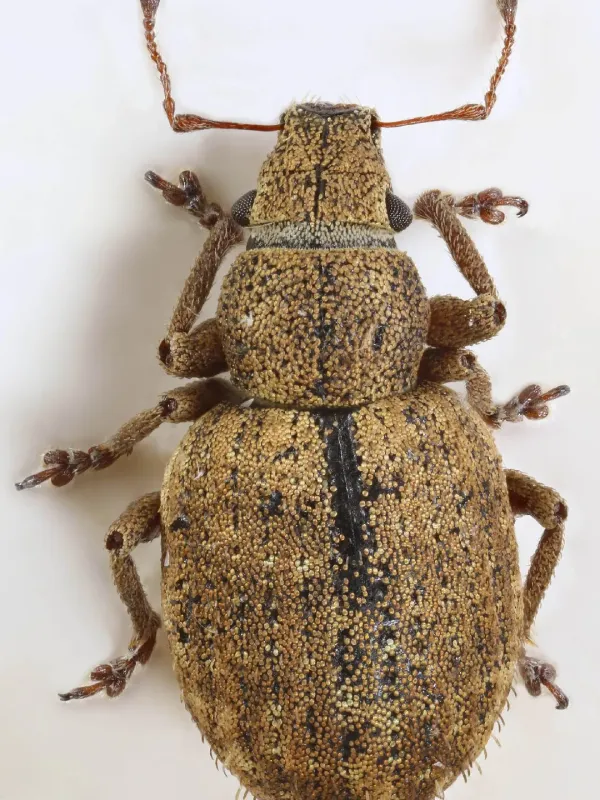
Strophosoma breviusculum is a species of weevil (Curculionidae) known for causing damage to various crops. The adult beetle is relatively small, measuring between 4 to 6 mm in length, and possesses a characteristic short, broad snout.
The beetle's body is covered in fine scales that provide a brownish or grayish mottled appearance, serving as excellent camouflage against soil or plant debris. Its elytra are oval-shaped and feature faint longitudinal lines.
The larvae are legless, curved, and creamy-white with a darker head capsule. They spend their entire developmental cycle within the soil, feeding on roots, which makes them difficult to monitor until significant plant damage has occurred.
These weevils are primarily nocturnal, remaining hidden under soil particles or plant litter during the day. This behavior often leads to an underestimation of their population density during field scouting.
Reproduction takes place in the soil, and the life cycle includes egg, larval, pupal, and adult stages. The species demonstrates high ecological adaptability, allowing it to survive in various agricultural environments.
What it damages
This pest is a polyphage, affecting a wide range of agricultural crops including cereals, legumes, and young nursery stock. Both adults and larvae contribute to the overall damage, though in different ways.
Adult beetles feed on the margins of leaves, creating distinctive irregular notches. In cases of high infestation, they can cause severe defoliation, particularly in young plants, which significantly stunts growth and development.
Larval damage is focused on the root system. By feeding on roots, larvae disrupt water and nutrient uptake, leading to the wilting, yellowing, and potential death of the plant, especially during sensitive growth stages.
Seedlings and recently transplanted crops are the most vulnerable. Often, entire patches of a field show reduced emergence or stunted growth due to the presence of larvae at the roots.
The damage is frequently patchy, typically starting from field margins near hedge rows or fallow land, where the population has a stable refuge before migrating into the crop.
When it appears
Adult activity typically begins in the early spring as soil temperatures rise. Peak activity for feeding and mating is usually observed in May and June, coinciding with the active growth phase of many crops.
During the summer, while adults continue to feed, their presence on foliage may fluctuate depending on humidity levels. A secondary peak of activity may occur in late summer and early autumn as the new generation emerges.
Larvae are present in the soil throughout the growing season, with peak feeding activity occurring from mid-spring until the end of summer. Pupation occurs in the soil, leading to the emergence of new adults.
Winter survival is achieved by both larvae in the soil and adults in sheltered locations. This dual-strategy overwintering ensures the population remains viable from year to year.
Monitoring should be conducted at dusk or dawn, as these are the most active hours for the adults. Utilizing light or pitfall traps can help indicate the start of a migration into the fields.
Signs of infestation
The most visible sign of infestation is the notched appearance of leaves, with irregular bits missing from the edges. This is a classic symptom of weevil feeding on foliage.
Sudden wilting of plants, which does not recover during cooler evening hours, is a strong indicator of root damage caused by larvae. Pulling up a wilted plant often reveals a compromised root system.
Nocturnal observations using a flashlight can confirm the presence of adults feeding on the stems and leaves. They are quick to drop to the ground and "play dead" when disturbed, making them hard to spot.
The presence of fecal pellets on leaves or soil surface beneath the plants is another sign of active feeding by a large population.
General yellowing or stunted patches in a field should prompt closer inspection of both the foliage for notches and the soil for larvae around the roots of the affected plants.
Control measures
Crop rotation is a fundamental cultural control measure. Avoiding the planting of susceptible crops in fields known to have high weevil pressure helps to break the life cycle of the pest.
Deep autumn plowing can help disrupt the soil, exposing larvae and pupae to predators and adverse weather conditions, effectively reducing the population in the overwintering stages.
Chemical control involving insecticides with contact or systemic action can be applied when adult activity is confirmed. Evening applications are generally more effective due to the nocturnal habits of the beetles.
Managing weeds around field edges and within margins reduces the availability of secondary host plants that allow the population to build up before moving into the main crop.
Biological control, including the application of entomopathogenic fungi or nematodes into the soil, offers an environmentally friendly alternative to reduce larval numbers and manage the pest population naturally.
Taxonomy
- Latin name
- Strophosoma breviusculum
- Order
- Coleoptera (beetles)
- Family
- Curculionidae
- EPPO code
- STROBR
Discussion
No discussions yet — be the first.