
Jerusalem cricket
Stenopelmatus fuscus
Description
How to identify
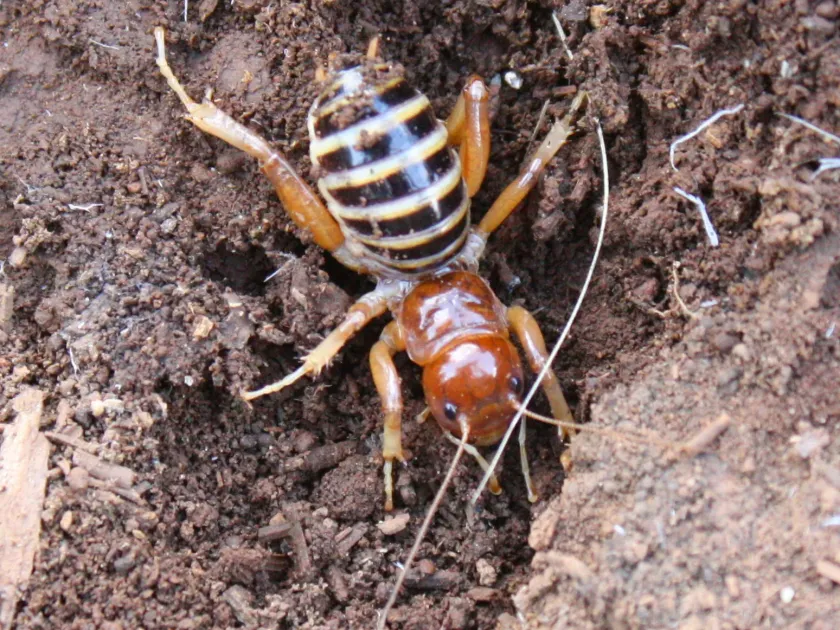
The Jerusalem cricket (Stenopelmatus fuscus) belongs to the order Orthoptera and the family Stenopelmatidae. Despite the common name, it is not a true cricket and has no association with Jerusalem.
These insects are characterized by a large, smooth, globular head and a powerful set of mandibles. They lack wings and are typically yellowish-brown to reddish-brown in color.
Adults can grow up to 5–8 cm in length. They are nocturnal by nature, spending their days in underground burrows, which makes them difficult to observe during daylight hours.
The life cycle is relatively long, often lasting several years. They undergo incomplete metamorphosis, and nymphs resemble smaller versions of adults, gradually increasing in size with each molt.
While they appear intimidating, Jerusalem crickets are not venomous. However, their strong jaws allow them to deliver a painful bite if handled improperly by humans or pets.
What it damages
Jerusalem crickets are generalist feeders and can be a significant nuisance in agricultural settings, particularly in home gardens and small-scale vegetable farms.
They feed on a variety of root systems, tubers, and succulents. Crops such as potatoes, onions, carrots, and beets are particularly vulnerable to their feeding habits.
By burrowing through the soil, they frequently damage the roots of young seedlings, leading to the sudden death of plants that seemed healthy the day before.
In addition to root damage, they may consume the stems of young plants at the soil line, acting similarly to cutworms but causing more extensive physical damage due to their size.
The damage caused by these insects often leaves crops susceptible to secondary pathogens, such as soil-borne fungi and bacteria, which further degrade the quality of the produce.
When it appears
Their activity levels are heavily dependent on soil temperature and moisture. They are most active during the warmer months of the year, from late spring through early autumn.
During dry spells, these insects may move towards irrigated areas of the garden, where the soil moisture is higher and succulent plant roots are more abundant.
As temperatures begin to drop in the autumn, Jerusalem crickets retreat deeper into the soil to hibernate, staying well below the frost line to survive the winter.
In Mediterranean or warmer climates, some activity may persist throughout the year, but the primary peak of nuisance corresponds with the active growing season of vegetables.
Observation of their activity is usually restricted to the night, as they prefer to hunt and feed when the risk of predation and dehydration is at its lowest.
Signs of infestation
The most common sign of an infestation is the sudden wilting or collapsing of plants in the garden without any visible symptoms on the foliage or leaves.
Careful inspection of the root zone will reveal clean-cut holes or tunnels within tubers and roots, which are a hallmark of the Jerusalem cricket’s strong biting mouthparts.
Small, irregular mounds or openings on the soil surface, often found near base of damaged plants, indicate the entrance to their elaborate subterranean burrow system.
Finding large, oval-shaped droppings in the soil near the damage sites provides further evidence of their presence in the affected area of the garden.
In some cases, digging into the soil during early morning hours may reveal the insects hiding in their burrows, confirming the source of the persistent plant loss.
Control measures
Management of the Jerusalem cricket relies heavily on cultural and mechanical control methods, as chemical intervention is often ineffective due to their underground lifestyle.
Deep cultivation of the soil, especially in the spring and autumn, can destroy burrows and expose the insects to natural predators like birds and small mammals.
Trapping is a highly effective method. Use containers buried flush with the soil surface filled with water or fruit-based baits to attract and capture the crickets at night.
Maintaining a clean garden by removing weeds and plant debris reduces the available hiding spots and food sources, making the environment less favorable for the population.
In cases of high infestation, soil-applied insecticides can be used, but these should be chosen carefully and applied according to local regulations to ensure safety.
Taxonomy
- Latin name
- Stenopelmatus fuscus
- Order
- Orthoptera (locusts)
- Family
- Stenopelmatidae
- EPPO code
- STEEFU
Discussion
No discussions yet — be the first.