
Sphaerularia bombi
Sphaerularia bombi
Description
How to identify
Sphaerularia bombi is a specialized entomoparasitic nematode belonging to the family Sphaerulariidae. It is a microscopic organism that has evolved to exclusively target bumblebee queens of the genus Bombus.
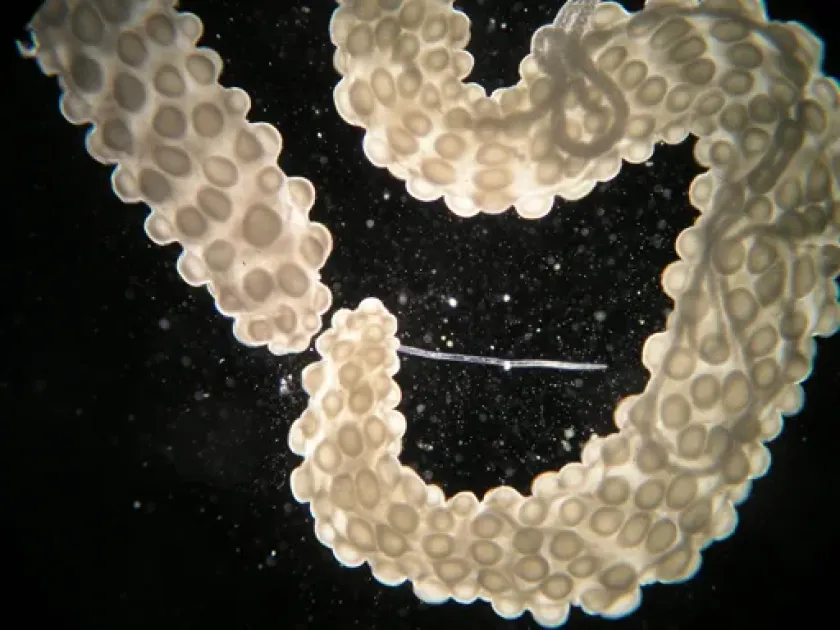
The defining morphological feature of the adult female nematode is its massively hypertrophied uterus. This organ expands dramatically within the host, allowing the parasite to absorb nutrients directly from the bumblebee's hemolymph.
Taxonomically, this species is classified within the order Tylenchida. Its life cycle is highly specialized, alternating between free-living stages in the soil and parasitic stages within the bumblebee host.
Identification is rarely possible in the field without dissection. Under a microscope, the white, sac-like uterus is easily distinguishable from the host's internal tissues, occupying most of the abdomen.
While often unnoticed, Sphaerularia bombi acts as a natural biological control agent. By limiting the reproductive success of bumblebees, it plays a complex role in regulating population dynamics within natural ecosystems.
What it damages
The primary damage caused by Sphaerularia bombi is the permanent sterilization of infected bumblebee queens. The parasite disrupts the hormonal balance and physiological development of the ovaries, rendering the queen unable to found a colony.
The nematode consumes the host's fat body, which is critical for winter survival and spring flight. Consequently, infected individuals often experience increased mortality rates before or shortly after the nesting phase begins.
In agricultural settings, the damage is indirect but significant. Since bumblebees are vital pollinators for many greenhouse and field crops, the loss of potential queens leads to reduced pollination efficiency and crop yields.
Infection alters the host's behavior. Infected queens typically show reduced foraging activity and eventually stop leaving their shelters, effectively removing them from their role as pollinators in the agroecosystem.
Because the nematode does not kill the host immediately, it survives long enough to complete its own reproductive cycle, ensuring the next generation of nematodes is ready for the following spring.
When it appears
The life cycle of Sphaerularia bombi is perfectly synchronized with the phenology of bumblebee queens. Infection occurs in early spring when queens emerge from hibernation and begin searching for nesting sites.
Infective larvae reside in the soil during the winter and autumn months. As the temperature rises and the soil moisture increases, the larvae move to the surface to penetrate the cuticle of passing bumblebees.
Development inside the host continues throughout the spring and early summer. The parasite grows steadily, utilizing the host's internal reserves to fuel its massive reproductive output.
By late summer, the nematode produces its own larvae, which exit the bumblebee's body to return to the soil. This timing ensures the parasites are settled in the environment before winter dormancy.
This creates a strictly annual cycle, where the survival of the parasite depends entirely on the availability of new queens emerging from hibernation each year.
Signs of infestation
Visible signs of infection in live bumblebees are almost non-existent. Most infected queens exhibit normal external morphology, making early detection extremely difficult for field biologists and farmers.
The most reliable sign of infection is internal, revealed upon dissection of the abdomen. The presence of the hypertrophied uterus, which appears as a white, coiling mass, is diagnostic for the species.
At the population level, an unusual scarcity of young workers in a colony during the peak season can be a clinical indicator of high infestation rates among the founding queens in the area.
Infected individuals may display reduced vitality. Researchers often note that infected queens have lighter body mass and less developed ovarian tissues compared to their uninfected counterparts.
In laboratory conditions, checking the hemolymph for the presence of nematode larvae can confirm an infection before the uterus reaches its full, destructive size.
Control measures
Currently, there are no direct chemical controls for Sphaerularia bombi that are safe for bumblebees. Any use of nematicides would likely be more toxic to the bees than the parasite itself.
Management focuses on prevention and maintaining ecological balance. Healthy habitats with rich floral diversity support robust bumblebee populations, which can better withstand the pressure of parasitic infections.
For commercial bumblebee producers, strict quarantine and screening protocols are essential. Ensuring that colonies are sourced from pathogen-free stock is the most effective way to prevent the spread of the nematode.
Preventing the over-concentration of bumblebee nests in small areas can reduce the density-dependent transmission of the parasite, as the nematodes would have a harder time finding hosts in a wider range.
Ongoing research focuses on understanding the immune response of bumblebees, which may eventually lead to better breeding practices aimed at creating more resistant pollinator lines for agricultural use.
Taxonomy
- Latin name
- Sphaerularia bombi
- Order
- Nematodes
- Family
- Sphaerulariidae
- EPPO code
- SPLRBO
Discussion
No discussions yet — be the first.