
Strawberry crimp nematode
Prothallonema hastatum
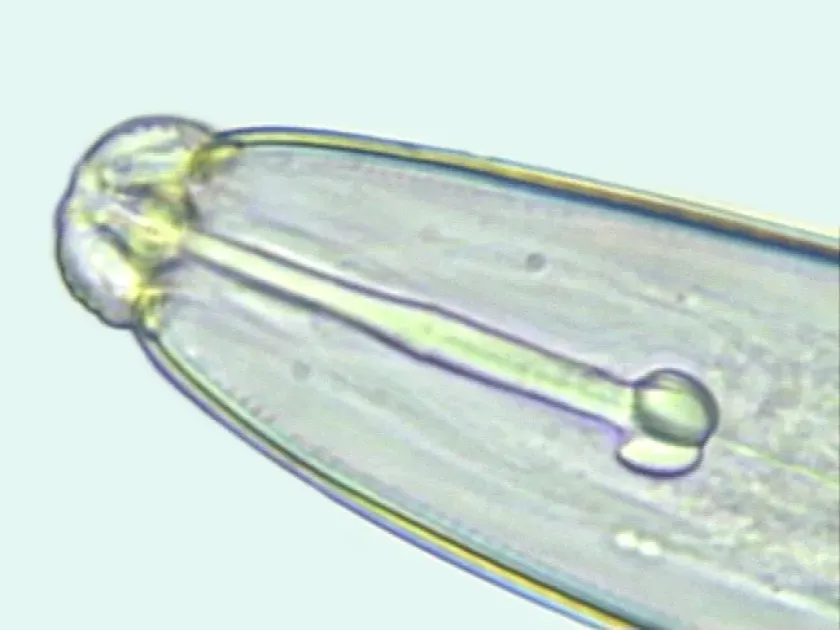
Description
How to identify
The strawberry crimp nematode is a microscopic, thread-like worm that parasitizes the aerial parts of plants. It is nearly transparent, making it impossible to detect with the naked eye, and it requires laboratory diagnosis for accurate identification.
Adults and larvae reside in leaf axils, buds, and within plant tissues. They move actively across the plant surface during periods of high humidity, such as after rainfall or heavy irrigation.
This pest belongs to the order Tylenchida and the family Aphelenchoididae. The nematode has a very short life cycle, which allows its population to multiply rapidly under favorable conditions.
To detect the pest, diagnostic analysis of plant samples is used, where nematodes are extracted from leaf tissues and identified under a microscope by their specific stomatal structure.
It is crucial to remember that the primary mode of transmission is the use of infested planting material, which may appear healthy to the observer.
What it damages
The strawberry crimp nematode primarily affects garden strawberries but can also damage many ornamental plants such as begonias, chrysanthemums, and violets.
The pest feeds on plant cell contents by injecting saliva containing enzymes that cause physiological disruptions and tissue deformation.
Severe infestation leads to a dramatic decrease in yields and deterioration of fruit quality, as the plant diverts its energy to fighting the invasion rather than fruit production.
Infested areas of the field gradually thin out, as weakened plants struggle to survive the winter and become more susceptible to secondary infections and fungal diseases.
In greenhouse conditions, the nematode can destroy up to 70-80% of the crop, causing total growth inhibition and the eventual death of the plants.
When it appears
Nematode activity begins in early spring as soon as positive temperatures are established and sap flow starts within the strawberry plants.
Intensive reproduction occurs during periods of high humidity and moderate temperatures (between 15 and 25 degrees Celsius), often coinciding with the flowering and fruit-setting stages.
During the summer, in the event of drought, the nematode may enter a state of anabiosis, remaining viable inside dried plant debris for long periods.
In the autumn, as temperatures drop, the pest migrates deep into the buds, preparing to overwinter within the tissues of the perennial plant.
The seasonal dynamics of the pest are strictly linked to the hydrothermal regime; the lack of moisture on leaf surfaces significantly limits the movement of the worms.
Signs of infestation
The first noticeable sign of infestation is a characteristic deformation of the leaf blades: they become twisted, crinkled, and reduced in size.
Leaf petioles often shorten, acquire a reddish hue, and the plants themselves appear stunted and severely depressed.
Excessive branching of flower stalks may be observed, yet the flowers often fail to develop properly or produce extremely small, deformed fruits.
- Yellowing or browning of leaf margins in early growth stages.
- Severe deformation of apical buds.
- Death or necrosis of the plant's central growing point.
- General developmental delay of the plant compared to healthy specimens.
When floral buds are infested, necrosis may occur, which visually resembles frost damage but spreads in distinct patches throughout the field.
Control measures
The fundamental control measure is the use of certified, nematode-free planting material sourced from reputable nurseries.
An effective preventive method is the heat treatment of seedlings: immersing the plants in hot water at 45-47 degrees Celsius for 15 minutes.
Strict crop rotation must be followed: strawberries should not be replanted in the same area for at least 4-5 years, avoiding fields previously occupied by nematode-host plants.
In infested areas, all affected plants must be removed and destroyed along with the root ball to prevent the spread of the pest to neighboring beds.
Chemical control options are limited; the primary focus is on soil improvement using cover crops like mustard or marigolds, which possess phytoncidal properties against nematodes.
Taxonomy
- Latin name
- Prothallonema hastatum
- Order
- Nematodes
- Family
- Sphaerulariidae
- EPPO code
- PTHAHA
Discussion
No discussions yet — be the first.