

Description
How to identify
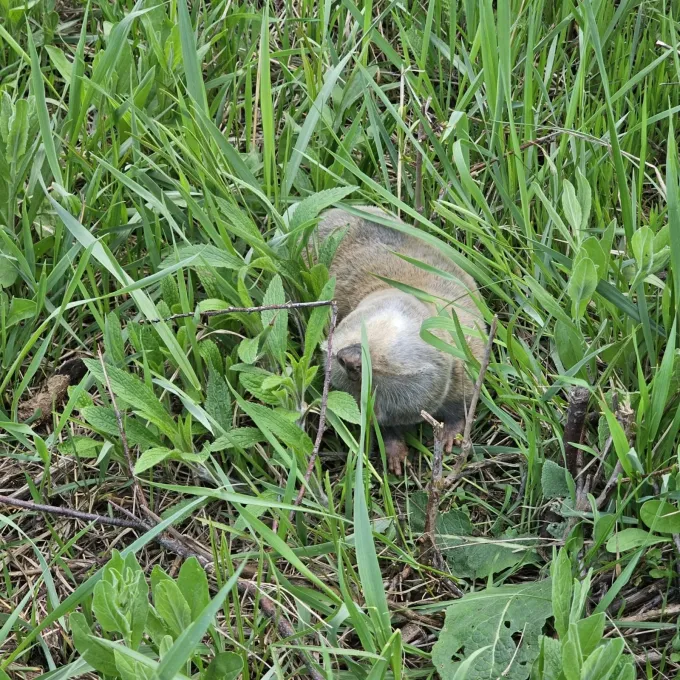
The mole-rat (genus Spalax) is a specialized subterranean rodent belonging to the family Spalacidae. It is uniquely evolved for a life spent entirely underground.
These animals have cylindrical, streamlined bodies ranging from 20 to 30 cm in length, with completely vestigial eyes covered by skin and no external ears.
Their most defining feature is a pair of massive, protruding incisors that extend beyond their lips, which they use as the primary tool for tunneling through hard soil.
Mole-rats are solitary creatures that maintain extensive and complex tunnel systems, creating distinct habitats that they defend vigorously against intruders.
Their fur is short, dense, and lacks a specific grain, allowing them to maneuver forward and backward within the confined spaces of their tunnels with ease.
What it damages
Mole-rats are significant agricultural pests that feed primarily on underground plant parts, causing devastating damage to potatoes, carrots, beets, and parsnips.
Beyond crop consumption, they frequently sever the taproots of young fruit trees and ornamental shrubs, leading to the rapid decline or death of the plants.
The extensive burrowing activity disrupts soil structure, creating large mounds of earth that interfere with harvesting machinery and overall agricultural field maintenance.
Damage to the root system not only kills the plant directly but also creates entry points for various soil-borne pathogens, leading to secondary rotting and infections.
In mature gardens, a single mole-rat can effectively hollow out entire rows of root vegetables in a matter of weeks by carrying them into deep storage chambers.
When it appears
Mole-rats remain active throughout the entire year, as they do not hibernate; their activity level is dictated by soil temperature and moisture conditions.
Spring is a period of peak activity when the soil is workable, coinciding with the beginning of the breeding season and the expansion of foraging tunnels.
During the heat of mid-summer, they tend to burrow deeper into the soil strata where moisture levels are higher, reducing their visible activity on the surface.
Autumn marks another surge in activity as the rodents engage in frantic foraging and storage efforts to secure food reserves for the upcoming winter months.
Throughout winter, they remain active in deep, temperature-stable layers of the earth, relying on the caches of root vegetables collected during the previous months.
Signs of infestation
The most prominent indicator of a mole-rat's presence is the occurrence of large, oval-shaped soil mounds that are significantly larger than typical mole hills.
A sudden loss or sinking of plants within a vegetable row is a classic sign, as the rodent pulls the entire plant down from below while feeding on its roots.
The presence of complex underground tunnel networks can often be detected by parallel tracks of wilting or yellowing vegetation, caused by root disruption.
If you encounter clean, hollowed-out sections of garden beds where vegetables have mysteriously vanished, this points directly to the harvest habits of the mole-rat.
Finding extensive caches of stored crops in deeper tunnels confirms the site is being used as a long-term habitat for these specialized underground rodents.
Control measures
Mechanical trapping is the most direct control method; traps must be placed strategically inside the main run after careful excavation and then concealed from light.
Ultrasonic vibration devices can be deployed to disturb the rodents' environment, though effectiveness varies as they may simply bypass the protected perimeter.
Installing physical barriers such as deep-buried wire mesh or solid metal sheeting (at least 80-100 cm deep) provides the most reliable protection for orchard areas.
Consistent agricultural practices, including frequent deep tilling of the soil, discourage permanent settlement by preventing the stabilization of tunnel networks.
Targeted baiting programs can be effective in agricultural settings, provided that the bait is placed securely within the active tunnels to avoid harming other wildlife.
Content graph
Connections · Mole-rat
Most often together:
Marketplace
Products · 1
Biology
Taxonomy
- Latin name
- Spalax
- Order
- Rodents
- Family
- Spalacidae
- EPPO code
- SPAXSP
Community
Discussion
No discussions yet — be the first.