
Lesser mole-rat
Spalax leucodon
Description
How to identify
The Lesser mole-rat (Spalax leucodon) is a subterranean rodent belonging to the Spalacidae family, perfectly adapted for life underground.
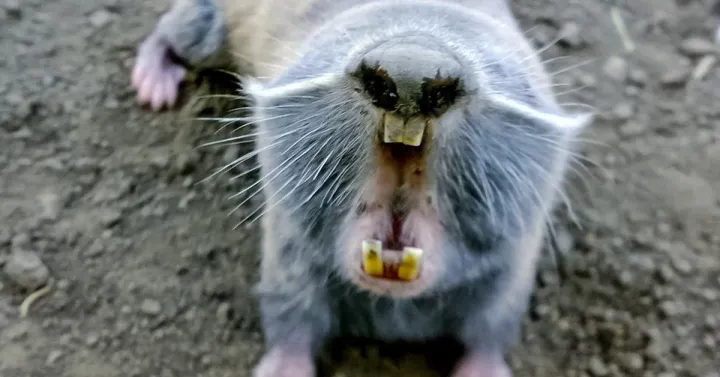
It possesses a cylindrical body without visible ears, a tail, or eyes, the latter being covered by a layer of skin and fur.
The most distinctive feature of the animal is its strong, protruding incisors, which are used as a primary tool for digging tunnels.
Its fur is thick and dense, allowing it to move easily in both directions within the narrow, dark tunnels of its habitat.
Lesser mole-rats are physically robust and specifically evolved to thrive in soil environments, rarely if ever coming to the surface.
What it damages
This species is a significant agricultural pest that primarily feeds on the underground parts of a wide range of plants.
It causes extensive damage to root crops such as potatoes, carrots, beets, and onions, often destroying large quantities of the harvest.
Besides vegetables, the animal can damage the root systems of fruit trees and shrubs, leading to their decline or complete death.
By creating extensive tunnel systems, they disrupt soil stability and interfere with the nutrient absorption of various crops.
In pastures and meadows, their burrowing activity creates large mounds of soil, making mechanical harvesting and mowing difficult.
When it appears
Lesser mole-rats do not hibernate, remaining active throughout the year, even during the coldest winter months under the frozen soil.
Peak digging activity occurs during the spring and autumn, when soil moisture makes it easier to excavate new foraging galleries.
In the heat of summer, the animals move to deeper, cooler soil layers where they can maintain stable conditions and avoid dehydration.
The breeding season typically occurs in early spring, leading to increased activity as young individuals seek out their own territories.
Autumn is another period of intense activity, as the animals prepare for winter by storing large amounts of food in their underground caches.
Signs of infestation
The most obvious sign of a Lesser mole-rat presence is the creation of large soil mounds, which are much larger than those of moles.
These mounds are often crescent-shaped or kidney-shaped, and the soil is usually pushed out in a specific, dense pattern.
Plants suddenly wilting or dying is a classic indicator, as the rodent has likely severed the main root system from below.
Collapsed soil sections or soft spots in the ground suggest the presence of main tunnel corridors beneath the surface.
- Fresh soil mounds appearing near vegetable beds.
- Missing root crops disappearing from under the soil surface.
- Visible chew marks on the remaining parts of damaged roots.
Control measures
Managing the Lesser mole-rat is challenging because the animal spends almost its entire life underground and is highly sensitive to disturbances.
Installing underground physical barriers, such as mesh or solid walls buried at least 50 cm deep, can prevent them from entering specific garden areas.
Trapping can be effective but requires precision and deep knowledge of their tunnel architecture to be successful.
Deep tillage or frequent plowing of the soil can help destroy their tunnel systems and disrupt their habitat, encouraging them to migrate elsewhere.
Constant vigilance and early identification of their tunnel activity are crucial for minimizing potential damage to fields and gardens.
Taxonomy
- Latin name
- Spalax leucodon
- Order
- Rodents
- Family
- Spalacidae
- EPPO code
- SPAXLE
Discussion
No discussions yet — be the first.