
Black springtail
Sminthurus niger
Description
How to identify
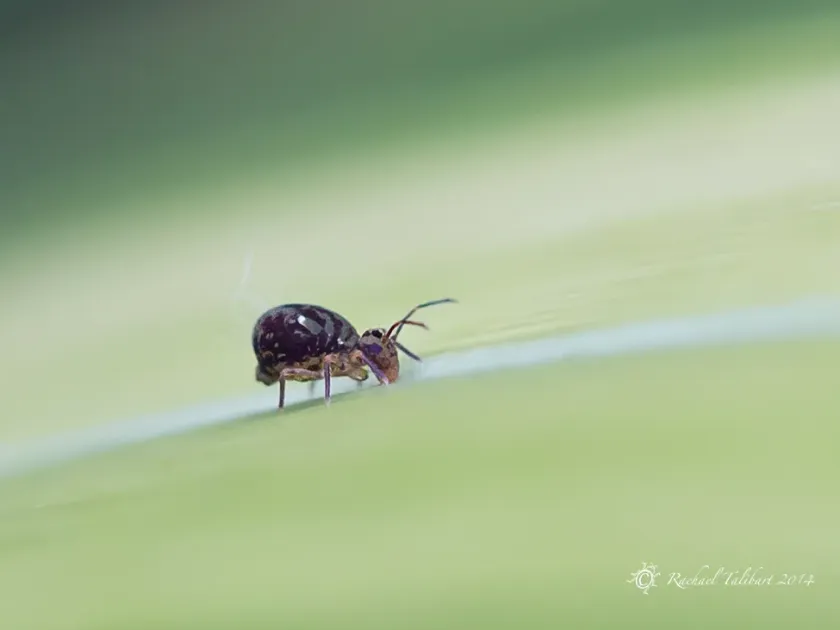
The black springtail (Sminthurus niger) belongs to the order Collembola and the family Sminthuridae. These organisms are tiny, typically measuring between 1 and 2 mm in length.
They possess a spherical body shape, ranging in color from dark gray to solid black. Unlike true insects, they have a unique appendage called a furcula, which acts as a jumping mechanism.
When disturbed, these pests use their furcula to leap rapidly away, making them elusive during field inspections. This jumping ability is a key diagnostic characteristic.
Their life cycle involves incomplete metamorphosis, with nymphs appearing as smaller versions of the adults. They thrive in moist, cool environments.
Because they breathe through their skin, they are highly dependent on soil and atmospheric moisture to survive and proliferate effectively.
What it damages
Sminthurus niger primarily attacks young seedlings of vegetables, technical crops, and cereals during their most tender developmental stages.
The pests feed on the epidermis and leaf tissue, creating small pits or holes that can severely impair the plant's ability to photosynthesize.
High populations of black springtails can devastate entire fields of emerging crops in a very short time, particularly under prolonged wet weather conditions.
In addition to physical tissue loss, the feeding process creates entry points for secondary pathogens like fungi, leading to seedling rot and wilting.
Seedlings with severely damaged cotyledons often fail to recover, resulting in significant stand loss and necessitating potential reseeding of the field.
Signs of infestation
The most evident sign of an infestation is the presence of numerous tiny holes or "window-pane" feeding patterns on the cotyledons and early true leaves.
In the field, you may notice active jumping behavior in the soil around the base of the plants, particularly during the early morning hours.
Affected leaves often show signs of desiccation, yellowing, and curling, as the damage interferes with the plant’s normal physiological functions.
The appearance of damaged seedlings may be mistaken for flea beetle feeding, but the specific jumping mechanism of the springtails is a distinct marker.
In cases of heavy infestation, the soil surface near the crop rows may look slightly disrupted or reveal small, dark particles moving upon closer inspection.
Control measures
Effective management of the black springtail involves a combination of cultural practices designed to reduce soil moisture and accelerate crop growth.
Regular cultivation and harrowing of the soil surface can disrupt the habitat of these pests and significantly reduce their local population density.
Selecting planting dates that favor vigorous seedling emergence allows crops to escape the peak infestation window of the springtails.
In situations where populations exceed economic thresholds, the application of registered insecticides effective against Collembola is recommended.
- Practice proper crop rotation to break the pest's life cycle.
- Ensure weed control, as weeds can act as alternative hosts and moisture reservoirs.
- Use yellow sticky traps to monitor for the presence and activity levels of the pests.
Taxonomy
- Latin name
- Sminthurus niger
- Family
- Sminthuridae
- EPPO code
- SMINNI
Discussion
No discussions yet — be the first.