
Spotted clover weevil
Sitona puncticollis
Description
How to identify
The spotted clover weevil (Sitona puncticollis) belongs to the family Curculionidae (order Coleoptera). It is a common insect pest known to target various legume crops throughout the growing season.
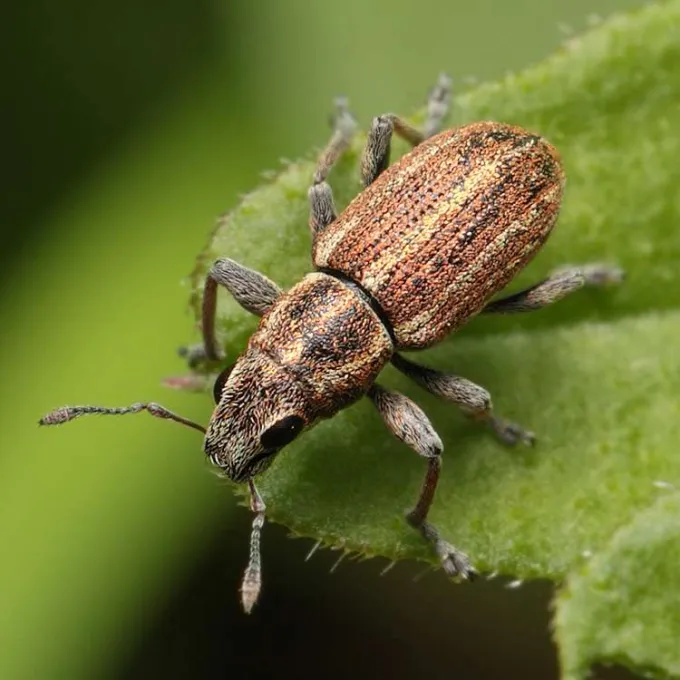
Adult beetles are relatively small, measuring approximately 3–4.5 mm in length. Their bodies are covered with brownish-grey scales and feature distinct small spots arranged in rows on their elytra.
Like other members of the genus Sitona, they possess a short, robust snout. The larvae are legless, creamy white, with a brownish head, and are typically found in the soil near the root systems.
The species completes one generation per year. They overwinter as adults, emerging in the spring when soil temperatures reach favorable levels, typically above 8–10 degrees Celsius.
The migration and active feeding phase begin early in the spring, coinciding with the seedling stage of many pulse crops, making the plants particularly vulnerable during this period.
What it damages
This weevil is a significant pest for various legumes, including peas, beans, alfalfa, clover, and vetch. Both adults and larvae contribute to overall crop damage.
Adult beetles feed on the margins of leaves, creating characteristic crescent-shaped notches. While this feeding rarely kills an established plant, it can cause severe stress to young seedlings.
The most severe damage is caused by the larvae, which live underground and feed on root nodules. By destroying these nodules, they inhibit nitrogen fixation, which is crucial for legume health.
Reduced nitrogen fixation leads to stunted growth, nutrient deficiencies, and decreased yields in both green forage and seed production, especially in nitrogen-poor soils.
Heavy infestations can result in significant economic losses, particularly when environmental conditions like drought further weaken the crop’s ability to recover from pest damage.
Signs of infestation
The most visible symptom is the presence of irregular, notched edges on leaves. This "notching" effect is a classic indicator of adult Sitona beetle feeding activity.
Symptoms of larval damage are less obvious but manifest as poor crop vigor, yellowing leaves (chlorosis), and an overall reduction in biomass compared to healthy plant stands.
Examination of the roots of affected plants typically reveals eaten or missing nodules, accompanied by the presence of small white larvae in the surrounding soil profile.
During the spring, fields adjacent to previous-year legume pastures often show high levels of early infestation, starting from the field edges and spreading inward.
Active beetles can be identified by sweeping the foliage with an insect net, particularly on warm, sunny days when the insects are most active on the upper canopy.
Control measures
Effective crop rotation is the primary cultural control method. Moving legume crops to fields that have been free of legumes for at least 4–5 years significantly reduces larval pressure.
Spatial isolation is critical; planting new legume crops far from permanent pastures or meadows helps prevent the mass migration of adult weevils into the field.
Tillage practices, such as early deep plowing and timely cultivation, can help disrupt the lifecycle of the beetle by exposing larvae and pupae to predators and environmental stress.
Chemical control involving systemic insecticides is often used to treat seeds or as a foliar spray at the seedling stage to protect young plants from significant defoliation.
Regular monitoring using traps or field inspection is recommended to determine if the population density warrants intervention based on local economic threshold levels.
Taxonomy
- Latin name
- Sitona puncticollis
- Order
- Coleoptera (beetles)
- Family
- Curculionidae
- EPPO code
- SITNPU
Discussion
No discussions yet — be the first.