
Orange wheat blossom midge
Sitodiplosis mosellana
Description
How to identify
The orange wheat blossom midge (Sitodiplosis mosellana) belongs to the order Diptera, family Cecidomyiidae. It is a tiny insect, measuring about 2–3 mm in length, with a distinct orange or reddish body.
The life span of adult midges is extremely short, usually limited to 3–5 days. During this brief window, their primary goal is mating and laying eggs on wheat spikes.
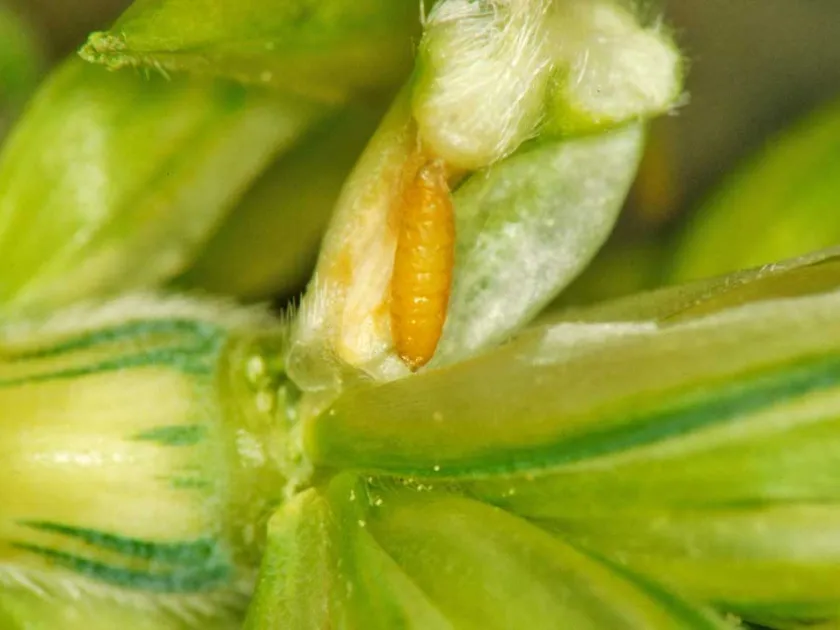
The larvae are spindle-shaped and undergo several developmental stages. They transition from a translucent state to a vibrant orange color, making them visible upon close inspection of the wheat head.
These midges overwinter as mature larvae in the soil, protected within small, sturdy cocoons made of silk and soil particles, at depths ranging from 5 to 10 centimeters.
In spring, triggered by environmental conditions and soil moisture, larvae move toward the surface to pupate, emerging as adults in synchronization with the wheat heading stage.
What it damages
The midge primarily attacks wheat, but it can also infest barley, rye, and various wild grasses, making it a persistent threat to cereal crops in many regions worldwide.
Damage is caused by the larvae feeding on the developing grain embryos and nutrients. This feeding process drains essential sap, leading to shriveled, malformed, or underdeveloped kernels.
Severe infestations can result in significant yield losses, potentially reducing the harvest by up to 50% in years with high pest pressure and favorable environmental conditions.
Beyond weight loss, the physical damage to the glumes creates entry points for various secondary fungal infections, which further degrade the overall quality and market value of the harvested grain.
The critical vulnerability period for the crop is during anthesis and early grain formation, where even low larval populations can impact yield components significantly.
Signs of infestation
A primary sign of infestation is the distortion of the wheat head. Because the grains fail to develop properly, the spikes may appear stunted, twisted, or irregularly shaped.
Upon careful inspection, one can find the bright orange larvae nestled inside the glumes, often attached to the developing kernel, which is a definitive indicator of the midge's presence.
Fields with high infestations may show signs of premature yellowing or a bleached appearance on specific parts of the heads, standing out against the healthier, developing plants.
Monitoring for the presence of adult midges involves using sweep nets in the late evening, as they are most active during calm, warm conditions around sunset.
- Twisted or stunted wheat spikes.
- Presence of orange larvae under glumes.
- Shriveled, small, or empty grain kernels.
- Premature yellowing of wheat ears.
Control measures
Implementing a diverse crop rotation is a fundamental cultural control method, as it prevents the buildup of larval populations by interrupting the insect's life cycle in the field.
Deep plowing in the autumn helps to bury the overwintering larvae at depths that prevent successful emergence of the adults in the following spring.
Selecting wheat varieties with tighter glumes provides a physical barrier that makes it harder for female midges to reach the ovary for oviposition, thus reducing infestation levels.
Chemical control must be timed precisely to coincide with the peak flight of the adult midges and before the larvae penetrate deep into the glumes where they are protected from contact insecticides.
Biological monitoring and the use of pheromone traps allow farmers to make informed decisions about if and when to apply protective treatments, minimizing unnecessary chemical use.
Taxonomy
- Latin name
- Sitodiplosis mosellana
- Order
- Diptera (flies)
- Family
- Cecidomyiidae
- EPPO code
- SITDMO
Discussion
No discussions yet — be the first.