
Wheat blossom midge
Sitodiplosis
Description
How to identify
The wheat blossom midge (Sitodiplosis mosellana) is a small dipteran insect belonging to the Cecidomyiidae family. It is a major pest of wheat crops worldwide.
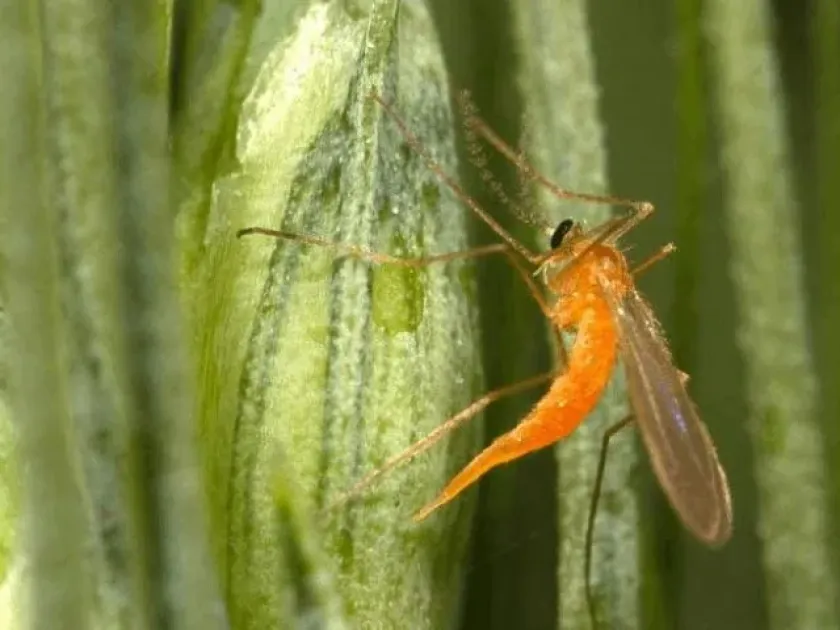
Adult midges are about 2–3 mm long, featuring a yellowish-orange body and delicate wings. They are short-lived and do not feed, focusing solely on mating and oviposition.
The larvae are bright lemon-yellow, legless, and headless. They are capable of jumping, which facilitates their movement into the soil for diapause or pupation.
The lifecycle consists of egg, larva, pupa, and adult stages. The midge typically completes one generation per year, though some larvae can remain in the soil for several years.
Damage is exclusively caused by larvae, which feed on the developing kernels within the ear, leading to significant yield losses if infestations are severe.
What it damages
The midge primarily attacks wheat, though it can also infest barley and rye. The critical window for damage is during the flowering and grain-filling stages.
Larvae lodge under the glumes of the wheat ear, feeding on the ovary. This nutrient depletion results in shriveled, deformed, and underweight grains.
Infestations can reduce crop yields by 15–30%. In extreme cases, high pest density can render a large percentage of the harvest unmarketable.
Beyond quantity, the milling quality is compromised. The infestation lowers gluten content and impairs dough quality, causing economic losses for growers.
Warm, humid conditions during the heading stage exacerbate the damage, as they favor egg-laying and larval survival, leading to widespread field outbreaks.
When it appears
Adult emergence usually occurs in late spring or early summer, synchronized with the wheat heading stage. Peak activity is typically observed in the evening hours.
Females deposit eggs on the ears. After about a week, the eggs hatch into larvae, which immediately enter the florets to begin feeding on the developing grain.
Larval feeding continues for 2–3 weeks. Once the grain hardens or environmental conditions become unfavorable, larvae exit the ear and drop to the soil.
The larvae overwinter in the upper soil layers at depths of 5–10 cm within protective cocoons, surviving cold winter temperatures until the following spring.
In spring, rising temperatures and soil moisture trigger the larvae to move toward the surface and pupate, completing the annual cycle of the midge.
Signs of infestation
A primary sign of infestation is the presence of small, lemon-yellow larvae visible upon prying open the glumes of the ear during the milk stage.
Visually, infested ears may appear distorted or lighter in color compared to healthy ones. Scattered "blind" or empty florets indicate successful larval feeding.
During harvest, infested grains are significantly lighter and are often lost through the combine's cleaning system, leading to unexpected yield gaps.
Monitoring using emergence cages placed in the field allows farmers to determine the exact timing of adult activity and optimize protective applications.
Sweeping with an entomological net during the evening is a standard scouting method to quantify the population density and trigger control thresholds.
Control measures
Integrated management starts with crop rotation, ensuring that wheat is not planted sequentially in the same field to break the pest's cycle.
- Deep tillage in autumn to bury overwintering larvae.
- Selection of wheat varieties with tighter glume attachments.
- Adjusting sowing dates to avoid the synchronization of heading with peak midge activity.
- Timely application of insecticides during the adult emergence phase.
- Encouraging the presence of natural parasitoids that prey on midge larvae.
Chemical control is highly effective if timed correctly before egg-laying occurs. Once the larvae are inside the glumes, insecticide efficacy drops drastically.
Scouting is vital; if the threshold of 2–3 adults per ear is exceeded during flowering, immediate action is required to minimize potential yield damage.
Taxonomy
- Latin name
- Sitodiplosis
- Order
- Diptera (flies)
- Family
- Cecidomyiidae
- EPPO code
- SITDSP
Discussion
No discussions yet — be the first.