
Sisyra fuscata
Sisyra fuscata
Description
How to identify
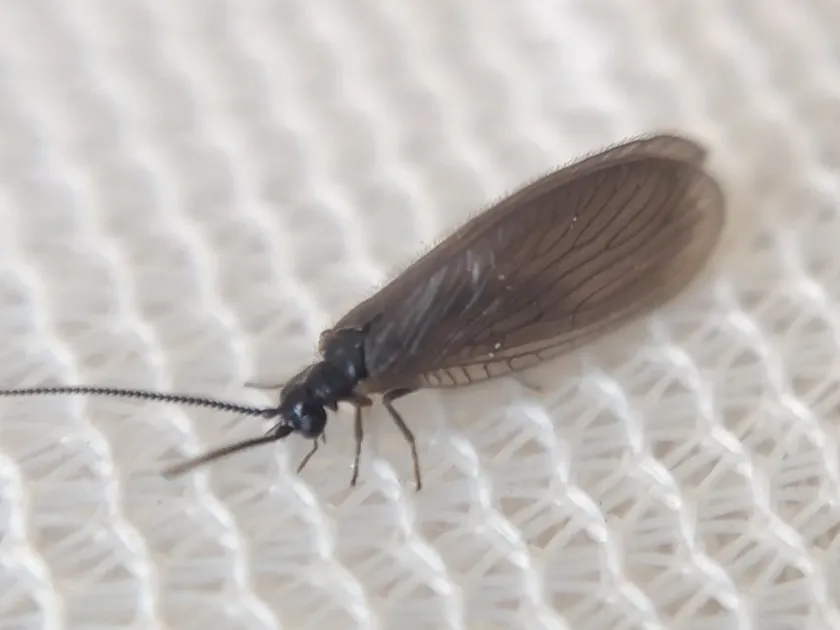
Sisyra fuscata, commonly known as a type of spongefly, belongs to the order Neuroptera and the family Sisyridae. Adults are small insects with a wingspan ranging from 10 to 12 millimeters.
The adults are characterized by a dark brown body color, which provides excellent camouflage against the bark of trees or vegetation located near water bodies.
Their wings are transparent with a complex network of veins, which is a hallmark of the Neuroptera order, and are typically held in a roof-like position over the body.
The larvae are specialized aquatic creatures with elongated, needle-like mouthparts specifically evolved for feeding on freshwater sponges.
Pupation occurs on land, where the larva constructs a strong, multi-layered silken cocoon in sheltered crevices, such as tree bark or under stones near the water's edge.
What it damages
The primary food source for Sisyra fuscata larvae is freshwater sponges (Porifera), particularly those of the genus Spongilla.
This insect does not cause damage to agricultural crops, as its biological niche is strictly tied to aquatic environments and sponge colonies.
The impact of this species is purely ecological, as larvae can significantly reduce the biomass of local sponge populations within a water body.
It is not considered a pest in agricultural or horticultural settings, and there is no economic threshold established for its management.
Its presence is typically seen as a bioindicator of the health of the aquatic ecosystem rather than a threat to food production.
When it appears
Adult flight usually occurs throughout the warmer months, typically from late May through August, depending on the local climate and temperature.
Females deposit eggs on vegetation overhanging the water, ensuring that the hatched larvae can immediately drop into the aquatic environment.
The larval phase is the most active stage, occurring during the summer when freshwater sponges are most abundant and actively growing.
As autumn approaches, mature larvae exit the water to seek dry, protected locations to spin their cocoons for the wintering period.
The species overwinters as a prepupa or pupa inside the silk cocoon, which protects the insect from freezing temperatures.
Control measures
No control measures are required for Sisyra fuscata, as it does not negatively affect cultivated crops or farming infrastructure.
The use of insecticides near water bodies is strictly discouraged, as it can cause significant harm to non-target aquatic organisms and disrupt the ecosystem.
Management, if deemed necessary for pond or reservoir aesthetics, is limited to maintaining clean water and preventing the accumulation of pollutants.
Promoting a balanced ecosystem with diverse predatory species helps to keep the population of spongeflies within natural limits.
Scientific observation confirms that this species plays a role in the natural cycle of aquatic ecosystems, which is beneficial for overall water quality maintenance.
Taxonomy
- Latin name
- Sisyra fuscata
- Family
- Sisyridae
- EPPO code
- SSYRFU
Discussion
No discussions yet — be the first.