
Spongillafly
Sisyra
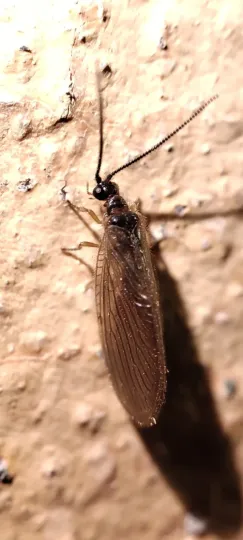
Description
How to identify
The Spongillafly (Sisyra) is a genus of insects belonging to the order Neuroptera and the family Sisyridae. These small insects typically have a wingspan of about 10 mm and exhibit the characteristic net-like wing venation of the order.
The life cycle of the spongillafly is uniquely adapted to aquatic environments, which sets them apart from most agricultural pests. Their larvae are semi-aquatic and live within freshwater habitats.
Larvae possess specialized, long, needle-like mouthparts designed for piercing and feeding on the soft tissues of freshwater sponges (Spongillidae).
The developmental process consists of the egg stage, three larval instars, a prepupal stage, a pupal stage, and the adult (imago) stage.
Adult spongillaflies are elusive and nocturnal, often found resting on riparian vegetation near streams, ponds, or lakes where their larvae develop.
What it damages
Spongillaflies are not considered pests of agricultural crops, as they do not feed on plant tissues or harvested products.
Their feeding habits are strictly specialized on freshwater sponges, which inhabit submerged structures or riparian plants in aquatic environments.
There is no direct damage caused to land-based crops, as the spongillafly lacks the biological mechanisms to harm cultivated vegetation.
In certain scenarios, their presence acts as a bio-indicator of water quality, signaling the health of the aquatic ecosystem near farmland.
Agricultural operations generally do not need to concern themselves with damage mitigation regarding this specific insect genus.
When it appears
Adult spongillaflies are most active during the warmer months, typically from late spring through the early autumn season.
The larval stage is most prevalent during summer, coinciding with the peak growth period of their primary food source, the freshwater sponge.
Their generation time is heavily influenced by water temperature and the hydrological stability of the local water bodies.
During the day, adults seek shelter among riparian plants, while their nocturnal activity includes mating and oviposition near the water's edge.
Seasonal fluctuations in population density are strongly tied to the availability of healthy sponge colonies and water quality levels.
Control measures
Since the spongillafly is not an agricultural pest, no chemical or biological control measures are necessary or recommended.
Maintaining the ecological health of water bodies, such as preventing excessive nutrient runoff, is the best way to keep the surrounding ecosystem stable.
Broad-spectrum insecticide application near water sources is generally discouraged as it can disrupt beneficial riparian insect populations.
Monitoring the presence of these insects can be useful for environmental assessment purposes to gauge the biodiversity of the farm's water resources.
Standard farm management practices such as riparian buffer strips are sufficient to provide a natural habitat for these non-harmful insects.
Taxonomy
- Latin name
- Sisyra
- Family
- Sisyridae
- EPPO code
- SSYRSP
Discussion
No discussions yet — be the first.