
Citrus aphid
Sinomegoura citricola
Description
How to identify
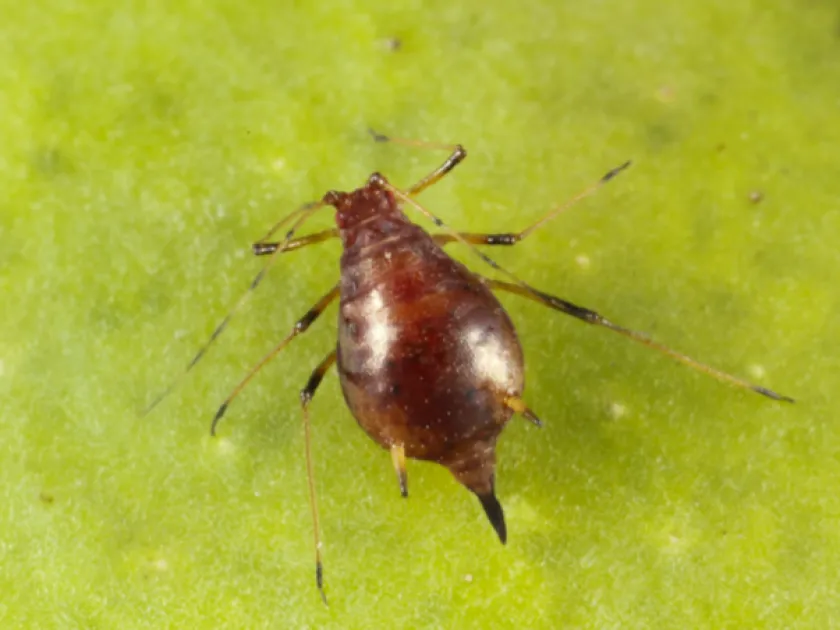
The citrus aphid (Sinomegoura citricola) belongs to the order Hemiptera and the family Aphididae. Adults are small, measuring about 1.5 to 2.5 mm in length, and generally appear green to brownish.
The species is recognized by its long antennae and distinct siphunculi (cornicles) on the dorsal abdomen. Both winged and wingless morphs exist, enabling colonization of new host plants.
Reproduction is largely parthenogenetic, allowing for rapid population growth during favorable environmental conditions without the need for mating.
Nymphs resemble smaller versions of adults and undergo several molts before reaching the reproductive adult stage. They are typically found in dense clusters.
Wintering usually occurs in the egg stage on branches, although in tropical and subtropical regions, populations can persist year-round on evergreen citrus foliage.
What it damages
Sinomegoura citricola primarily affects citrus trees, including lemons, oranges, mandarins, and grapefruits, focusing its feeding on succulent young growth.
Aphids insert their piercing-sucking mouthparts into the phloem of leaves and buds, extracting nutrients and causing significant physical stress to the plant.
The feeding process results in leaf curling, stunted shoot elongation, and distortion of buds, which directly impacts the tree's overall development and aesthetic.
This pest is a significant vector for various citrus viruses, which can lead to severe long-term yield reduction and tree decline across the orchard.
Furthermore, the excretion of honeydew promotes the growth of sooty mold, a fungus that interferes with photosynthesis by covering the leaf surface with a black film.
When it appears
The aphid activity is highly synchronized with the growth flushes of citrus trees, typically beginning in early spring when new buds start to break.
Seasonal peaks occur during the spring and fall growing periods when temperatures are mild and humidity levels are conducive to rapid development.
The pest has a very short generation time, allowing it to complete its life cycle in as little as one to two weeks depending on the temperature.
Wind dispersal of winged adults is the primary mechanism for infestation of new trees within an orchard or plantation throughout the active season.
Extreme summer heat often leads to a decline in aphid populations, as they prefer milder conditions to thrive and reproduce efficiently.
Signs of infestation
The first indicator of infestation is the curling and distortion of terminal leaves, often accompanied by a sticky residue on the foliage.
The presence of ants patrolling the branches is a strong diagnostic sign, as ants farm the aphids to collect the nutrient-rich honeydew secretions.
- Black, powdery sooty mold coating the leaves and stems.
- Premature yellowing of leaves and reduced plant vigor.
- Stunted or deformed growth of new shoots and flower buds.
- Clusters of small insects visible on the underside of leaves or along succulent stems.
Increased flower drop and failure of fruit set can be linked to heavy aphid infestations that deplete the plant's metabolic resources during critical development stages.
Control measures
Integrated Pest Management (IPM) for citrus aphids begins with maintaining tree health through proper fertilization, irrigation, and pruning to reduce hiding spots.
Ant control is essential; using trunk barriers or sticky traps helps prevent ants from protecting the aphids from their natural biological predators.
Encouraging beneficial insects, such as lady beetles, lacewings, and hoverflies, can significantly suppress aphid numbers naturally in sustainable garden environments.
Systemic insecticides are often required for commercial production to provide long-lasting control, as these products are ingested by the aphids during feeding.
Regular monitoring of growth flushes is crucial; timely interventions should be applied before the leaf curling becomes severe, as curled foliage provides physical protection for the pests.
Taxonomy
- Latin name
- Sinomegoura citricola
- Order
- Hemiptera (bugs, aphids, leafhoppers)
- Family
- Aphididae
- EPPO code
- SINMCI
Discussion
No discussions yet — be the first.