
Black scavenger fly
Sepsis punctum
Description
How to identify
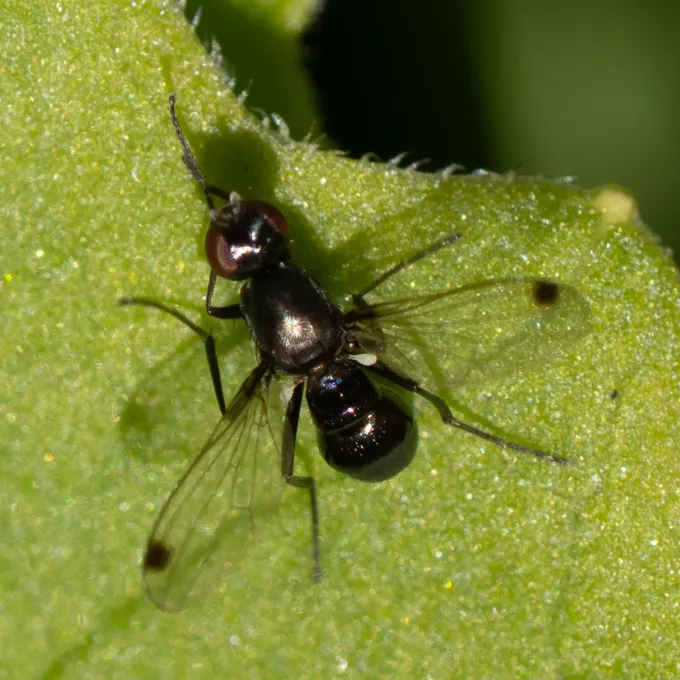
The black scavenger fly (Sepsis punctum) is a small insect belonging to the family Sepsidae, order Diptera. These flies typically measure between 3 and 4 mm in length.
They are easily recognizable by their slender, shiny black bodies and a distinct waist-like constriction on the abdomen, which gives them an ant-like appearance.
Their wings are generally clear but feature a characteristic dark, rounded spot at the tip, which serves as a key identifier for this particular species.
The larvae are typical of the family, being legless, conical in shape, and yellowish-white, growing up to 6 mm before reaching the pupal stage.
Adults exhibit a distinct behavior, frequently vibrating their wings while walking, which makes them highly noticeable when resting on vegetation or decaying matter.
What it damages
While Sepsis punctum is not a primary pest of healthy crops, it is considered a nuisance and a potential vector for various pathogens in agricultural settings.
The flies frequently visit decaying organic matter, where they can pick up bacteria and fungal spores that lead to root or stem rots in susceptible vegetables.
Larval development in decomposing plant debris may contribute to the spread of soil-borne diseases if that organic material is not properly managed.
In greenhouses, high populations of these flies indicate poor sanitation, which can create a stressful environment for developing plant seedlings.
Their presence is often an indicator of excessive moisture and the accumulation of waste, which in turn attracts other, more destructive pests to the area.
When it appears
The activity of black scavenger flies begins early in the spring, typically as soon as temperatures rise enough to facilitate organic decomposition.
Peak population levels are observed during the summer months when heat and moisture provide optimal conditions for multiple rapid life cycles.
The duration of the season is highly dependent on the climate, with warmer regions seeing more generations per year compared to cooler zones.
As the weather cools in autumn, the flies enter a dormant stage, overwintering as pupae or adults in protected areas like soil, leaf litter, or debris.
In controlled environments such as indoor storage or heated greenhouses, they may continue their life cycle throughout the year if organic waste is available.
Signs of infestation
The most obvious sign of an infestation is the presence of swarms of small black flies around manure, compost, or piles of decomposing plant matter.
Plants affected by the pathogens carried by these flies may show symptoms of rotting at the base, often accompanied by a distinct unpleasant odor.
The presence of larvae within rotting tissue or in the saturated substrate near the roots is a clear indication of a significant population density.
Sticky traps placed in greenhouses or storage facilities will quickly collect these flies, confirming their presence and providing a tool for monitoring.
Visual inspection of the foliage and stem bases may reveal adults resting on the plants, especially during the early morning hours when activity is lower.
Control measures
Effective control of Sepsis punctum relies primarily on rigorous field and facility sanitation to remove breeding sites and organic waste.
Compost piles and manure heaps should be located away from growing areas and properly managed to prevent them from becoming breeding grounds.
Improving drainage in fields and greenhouses is essential, as the flies thrive in moist, saturated environments that encourage decay.
Using yellow sticky cards or other monitoring devices helps detect early infestations, allowing for immediate intervention before populations spike.
Chemical control is rarely recommended as a first line of defense; instead, focusing on biological controls or cultural practices is significantly more sustainable.
Taxonomy
- Latin name
- Sepsis punctum
- Order
- Diptera (flies)
- Family
- Sepsidae
- EPPO code
- SEPSPU
Discussion
No discussions yet — be the first.